
Level:
Correct: 0
Incorrect: 0
Marks: 0/0
Exam Practice
Course:
Topics:
Edexcel GCSE Maths (Foundation non-calculator) Smart practice A mixed round aimed at your weak spots
Unit 1
Number
Unit 2
Algebra
Unit 3
Ratio, proportion and rates of change
Unit 4
Geometry and measures
Unit 5
Probability
Unit 6
Statistics
Avg
score:
–
Topics
done:
0/86

Ordering numbers and inequality symbols

Practise 28 exam-style questions on Ordering numbers and inequality symbols for Edexcel GCSE Maths (Foundation non-calculator). Write your answer as you would in the exam and get it marked in seconds against the mark scheme, point by point, with the Study Helper on hand if you get stuck.

  • 28 questions
  • 1–5 marks each
  • Instant marking
  • No sign-up needed
20 questions, marked as you go

Sample questions with model answers

Here are 4 of the questions in this topic, each with a model answer, an explanation of why it earns the marks and the mark scheme an examiner would use.

Question 1

1 mark

The table shows the lowest temperature in five towns one night in January.

Which town had the lowest temperature?
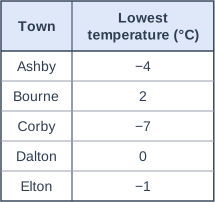
Table with columns "Town", "Lowest temperature (°C)". Town: Ashby; Lowest temperature (°C): −4 | Town: Bourne; Lowest temperature (°C): 2 | Town: Corby; Lowest temperature (°C): −7 | Town: Dalton; Lowest temperature (°C): 0 | Town: Elton; Lowest temperature (°C): −1.

Model answer

The temperatures are −4, 2, −7, 0 and −1.
The smallest number is −7.
Corby

Explanation

The lowest temperature is the smallest number. Negative temperatures are below 0 °C, and −7 is the furthest below 0, so Corby was the coldest. Remember the question asks for the town, not the temperature.

Mark scheme
  1. 1 mark

    B1 for Corby

    do not accept −7 on its own
Question 2

2 marks

\(x\) is an integer.

\(-2 \le x < 3\)

Write down all the possible values of \(x\).

Model answer

≤ means x can be equal to −2.
< means x must be less than 3, so x cannot be 3.
−2, −1, 0, 1, 2

Explanation

The symbol ≤ means 'less than or equal to', so −2 is included. The symbol < means 'less than', so 3 is not included. An integer is a whole number, which can be negative or zero, so list every whole number from −2 up to 2.

Mark scheme
  1. 2 marks

    B2 for −2, −1, 0, 1, 2 and no other values

    B1 for four correct values and no incorrect values, or for −2, −1, 0, 1, 2, 3 or for −1, 0, 1, 2

Question 3

3 marks

Write these numbers in order of size.
Start with the smallest number.

\(\dfrac{7}{4}\), 1.8, \(1\dfrac{2}{3}\), 1.65, \(\dfrac{17}{10}\)

Model answer

\(\frac{7}{4}\) = 7 ÷ 4 = 1.75
\(1\frac{2}{3}\) = 1.666...
\(\frac{17}{10}\) = 1.7
Numbers: 1.75, 1.8, 1.666..., 1.65, 1.7
In order: 1.65, 1.666..., 1.7, 1.75, 1.8
1.65, \(1\frac{2}{3}\), \(\frac{17}{10}\), \(\frac{7}{4}\), 1.8

Explanation

Change every fraction to a decimal so that all the numbers are in the same form. \(\frac{7}{4}\) is an improper fraction: 7 ÷ 4 = 1.75. \(\frac{2}{3}\) is 0.666..., which is just bigger than 0.65, so \(1\frac{2}{3}\) comes just after 1.65.

Mark scheme
  1. 1 mark

    M1 for converting at least two of \(\frac{7}{4}\), \(1\frac{2}{3}\), \(\frac{17}{10}\) correctly to decimals (1.75, 1.66... or 1.67, 1.7)

    or for at least two written correctly with a common denominator

  2. 1 mark

    M1 for all five numbers in a form that can be compared, e.g. 1.75, 1.8, 1.67, 1.65, 1.7

  3. 1 mark

    A1 for 1.65, \(1\frac{2}{3}\), \(\frac{17}{10}\), \(\frac{7}{4}\), 1.8

    cao; accept the numbers written as decimals in the correct order; correct answer with no working scores full marks

Question 4

4 marks

In golf, a player's score for a round can be positive or negative.
The lowest total score wins.

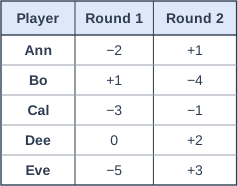
The table shows the scores of five players in two rounds.
Each player's total score is their Round 1 score added to their Round 2 score.

Write the players in order, starting with the winner.

Table with columns "Player", "Round 1", "Round 2". Player: Ann; Round 1: −2; Round 2: +1 | Player: Bo; Round 1: +1; Round 2: −4 | Player: Cal; Round 1: −3; Round 2: −1 | Player: Dee; Round 1: 0; Round 2: +2 | Player: Eve; Round 1: −5; Round 2: +3.

Model answer

Totals:
Ann: −2 + 1 = −1
Bo: 1 + (−4) = −3
Cal: −3 + (−1) = −4
Dee: 0 + 2 = 2
Eve: −5 + 3 = −2
Lowest to highest: −4, −3, −2, −1, 2
Cal, Bo, Eve, Ann, Dee

Explanation

Add each player's two scores, using a number line if it helps: −5 + 3 means start at −5 and move 3 to the right, giving −2. Then order the totals from lowest to highest, because the lowest score wins. Remember that −4 is lower than −3.

Mark scheme
  1. 1 mark

    M1 for a correct method to find the total for at least three players, e.g. −2 + 1 = −1

  2. 1 mark

    A1 for all five totals: Ann −1, Bo −3, Cal −4, Dee 2, Eve −2

  3. 1 mark

    M1 for putting their five totals in order from lowest to highest

    ft their totals

  4. 1 mark

    A1 for Cal, Bo, Eve, Ann, Dee

    cao; correct answer with no working scores full marks

Ready to try the rest? Every answer you write is marked against the mark scheme, so you can see exactly where the marks are.

Study Helper Hints first, answers after you try

Stuck on this one? Ask for a hint and I’ll point you in the right direction, without giving the answer away. Once you’ve checked your answer, I’ll show you how the marks are awarded.