Practise 29 exam-style questions on Converting standard and compound units for Edexcel GCSE Maths (Foundation non-calculator). Write your answer as you would in the exam and get it marked in seconds against the mark scheme, point by point, with the Study Helper on hand if you get stuck.
29 questions
1–5 marks each
Instant marking
No sign-up needed
20 questions, marked as you go
Sample questions with model answers
Here are 4 of the questions in this topic, each with a model answer, an explanation of why it earns the marks and the mark scheme an examiner would use.
Question 1
1 mark
A piece of rope is \(x\) metres long.
Write down an expression, in terms of \(x\), for the length of the rope in centimetres.
Model answer
1 m = 100 cm Length = \(100x\) cm
Explanation
Changing metres to centimetres always means multiplying by 100. It works in the same way with a letter: \(x\) metres is \(100 \times x = 100x\) centimetres.
Mark scheme
1 mark
B1 for \(100x\)
oe; accept 100 × x
Question 2
2 marks
Zac is asked to change 4 m² into cm². Here is his working.
1 m = 100 cm so 4 m² = 4 × 100 = 400 cm²
Zac's answer is wrong. Explain the mistake Zac has made and work out the correct answer.
Model answer
A square of side 1 m is 100 cm by 100 cm, so 1 m² = 100 × 100 = 10 000 cm². Zac multiplied by 100 instead of 10 000. 4 × 10 000 = 40 000 cm²
Explanation
Area units are squared, so the length conversion has to be used twice. A 1 m by 1 m square is 100 cm by 100 cm, which is 10 000 cm². Zac used 100, the conversion for lengths.
Mark scheme
1 mark
C1 for an explanation such as: 1 m² = 100 × 100 = 10 000 cm², so he should multiply by 10 000 not 100 (or he has used the length conversion for an area)
correct values with no working score the calculation marks
1 mark
B1 for 40 000 (cm²)
cao
Question 3
3 marks
A liquid has a density of 1.2 g/cm³. A bottle contains 2.5 litres of the liquid.
Work out the mass of the liquid in the bottle. Give your answer in kilograms.
Model answer
1 litre = 1000 cm³, so 2.5 litres = 2500 cm³ Mass = density × volume = 1.2 × 2500 = 3000 g 3000 g = 3 kg
Explanation
The density is in grams per cm³, so change the volume into cm³ first (1 litre = 1000 cm³). Then mass = density × volume gives grams, and dividing by 1000 changes grams into kilograms.
Mark scheme
1 mark
M1 for 2.5 litres = 2500 cm³
1 mark
M1 for 1.2 × 2500 (= 3000 g)
ft their volume in cm³
1 mark
A1 for 3 (kg)
cao; correct answer with no working scores full marks
Question 4
4 marks
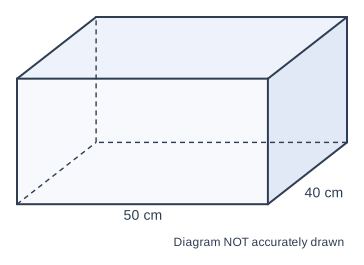
The diagram shows a box in the shape of a cuboid. The box rests on the floor on its base, which measures 50 cm by 40 cm. The box pushes down on the floor with a force of 400 newtons.
pressure = force ÷ area
Work out the pressure on the floor in newtons per m².
Model answer
50 cm = 0.5 m and 40 cm = 0.4 m Area of base = 0.5 × 0.4 = 0.2 m² Pressure = 400 ÷ 0.2 = 2000 N/m²
Explanation
The pressure is wanted in newtons per m², so the area must be in m². Changing the lengths into metres before multiplying avoids mistakes. Dividing by 0.2 is the same as multiplying by 5.
Mark scheme
1 mark
P1 for 50 × 40 (= 2000 cm²) or 0.5 and 0.4 seen
1 mark
P1 for changing the area to m², e.g. 2000 ÷ 10 000 or 0.5 × 0.4 (= 0.2 m²)
1 mark
P1 for 400 ÷ their area in m²
1 mark
A1 for 2000
cao; correct answer with no working scores full marks
Ready to try the rest? Every answer you write is marked against the mark scheme, so you can see exactly where the marks are.
Ctrl + Enter to check
Study HelperHints first, answers after you try
Stuck on this one? Ask for a hint and I’ll point you in the right direction, without giving the answer away. Once you’ve checked your answer, I’ll show you how the marks are awarded.