
Level:
Correct: 0
Incorrect: 0
Marks: 0/0
Exam Practice
Course:
Topics:
Edexcel GCSE Maths (Foundation non-calculator) Smart practice A mixed round aimed at your weak spots
Unit 1
Number
Unit 2
Algebra
Unit 3
Ratio, proportion and rates of change
Unit 4
Geometry and measures
Unit 5
Probability
Unit 6
Statistics
Avg
score:
–
Topics
done:
0/86

Exact calculation with fractions and π

Practise 28 exam-style questions on Exact calculation with fractions and π for Edexcel GCSE Maths (Foundation non-calculator). Write your answer as you would in the exam and get it marked in seconds against the mark scheme, point by point, with the Study Helper on hand if you get stuck.

  • 28 questions
  • 1–5 marks each
  • Instant marking
  • No sign-up needed
20 questions, marked as you go

Sample questions with model answers

Here are 4 of the questions in this topic, each with a model answer, an explanation of why it earns the marks and the mark scheme an examiner would use.

Question 1

1 mark

Work out \(\dfrac{1}{2} \div \dfrac{1}{4}\)

Model answer

\(\dfrac{1}{2} \div \dfrac{1}{4} = \dfrac{1}{2} \times \dfrac{4}{1} = \dfrac{4}{2} = 2\)

Explanation

Dividing by a fraction is the same as multiplying by its reciprocal (turn the second fraction upside down). You can also think "how many quarters are there in a half?" - the answer is 2. A common mistake is to give \(\frac{1}{8}\).

Mark scheme
  1. 1 mark

    B1 for 2

    cao; accept \(\frac{4}{2}\)
Question 2

2 marks

A recipe uses \(\dfrac{3}{4}\) kg of flour for one loaf of bread.
Holly makes 5 loaves.

How much flour does she use?
Give your answer as a mixed number.

Model answer

5 × \(\dfrac{3}{4}\) = \(\dfrac{15}{4}\)
\(\dfrac{15}{4} = 3\dfrac{3}{4}\) kg (because 15 ÷ 4 = 3 remainder 3)

Explanation

Multiply the numerator by 5 to get \(\frac{15}{4}\), then change the improper fraction to a mixed number: 4 goes into 15 three times with 3 left over. Do not multiply the denominator by 5 as well.

Mark scheme
  1. 1 mark

    M1 for 5 × \(\frac{3}{4}\) or \(\frac{15}{4}\)

    correct answer with no working scores full marks

  2. 1 mark

    A1 for \(3\frac{3}{4}\) kg

    cao

Question 3

3 marks

Work out \(3\dfrac{1}{5} \div 1\dfrac{1}{3}\)
Give your answer as a mixed number.

Model answer

\(3\dfrac{1}{5} = \dfrac{16}{5}\) and \(1\dfrac{1}{3} = \dfrac{4}{3}\)
\(\dfrac{16}{5} \div \dfrac{4}{3} = \dfrac{16}{5} \times \dfrac{3}{4} = \dfrac{48}{20} = \dfrac{12}{5}\)
\(\dfrac{12}{5} = 2\dfrac{2}{5}\)

Explanation

Always change mixed numbers into improper fractions before you divide. Then multiply by the reciprocal of the second fraction and simplify. Dividing the whole numbers and the fractions separately (3 ÷ 1 and \(\frac{1}{5} \div \frac{1}{3}\)) does not work.

Mark scheme
  1. 1 mark

    M1 for \(\frac{16}{5}\) and \(\frac{4}{3}\)

    correct answer with no working scores full marks

  2. 1 mark

    M1 for \(\frac{16}{5} \times \frac{3}{4}\)

    ft their improper fractions

  3. 1 mark

    A1 for \(2\frac{2}{5}\)

    cao

Question 4

4 marks

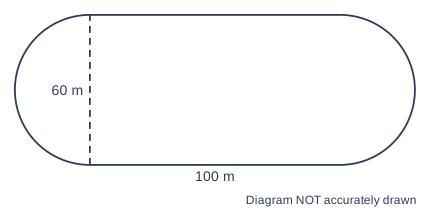
The diagram shows a running track.
The track is made from two straight sections, each 100 m long, and two semicircles, each with diameter 60 m.

Leah runs 4 times round the track.

Work out the total distance she runs.
Give your answer in terms of π.

Geometry diagram, marked "Diagram NOT accurately drawn". A horizontal line with no labelled ends is drawn. A horizontal line with no labelled ends is drawn. A semicircle on the straight line joining its ends as diameter, drawn to the right of it. A semicircle on the straight line joining its ends as diameter, drawn to the left of it. A dashed vertical line with no labelled ends is drawn. An unlabelled line going to the right is labelled 100 m. An unlabelled line going upwards is labelled 60 m.

Model answer

The two semicircles make one full circle with diameter 60 m.
Curved parts: π × 60 = \(60\pi\) m
Straight parts: 100 + 100 = 200 m
One lap: \(200 + 60\pi\) m
4 laps: 4 × (\(200 + 60\pi\)) = \(800 + 240\pi\) m

Explanation

The two semicircles at the ends join to make one whole circle, so their total length is π × 60. Add the two straight sections to get one lap, then multiply both parts by 4. Remember to multiply the 200 as well as the 60π.

Mark scheme
  1. 1 mark

    P1 for the length of one semicircle, π × 60 ÷ 2 (= \(30\pi\)), or the two semicircles together, π × 60 (= \(60\pi\))

    correct answer with no working scores full marks

  2. 1 mark

    P1 for the length of one lap, \(200 + 60\pi\)

    ft their curved length

  3. 1 mark

    P1 for 4 × their lap length

  4. 1 mark

    A1 for \(800 + 240\pi\) (m)

    oe

Ready to try the rest? Every answer you write is marked against the mark scheme, so you can see exactly where the marks are.

Study Helper Hints first, answers after you try

Stuck on this one? Ask for a hint and I’ll point you in the right direction, without giving the answer away. Once you’ve checked your answer, I’ll show you how the marks are awarded.