
Level:
Correct: 0
Incorrect: 0
Marks: 0/0
Exam Practice
Course:
Topics:
Edexcel GCSE Maths (Foundation non-calculator) Smart practice A mixed round aimed at your weak spots
Unit 1
Number
Unit 2
Algebra
Unit 3
Ratio, proportion and rates of change
Unit 4
Geometry and measures
Unit 5
Probability
Unit 6
Statistics
Avg
score:
–
Topics
done:
0/86

nth term of linear sequences

Practise 36 exam-style questions on nth term of linear sequences for Edexcel GCSE Maths (Foundation non-calculator). Write your answer as you would in the exam and get it marked in seconds against the mark scheme, point by point, with the Study Helper on hand if you get stuck.

  • 36 questions
  • 1–5 marks each
  • Instant marking
  • No sign-up needed
20 questions, marked as you go

Sample questions with model answers

Here are 4 of the questions in this topic, each with a model answer, an explanation of why it earns the marks and the mark scheme an examiner would use.

Question 1

1 mark

The nth term of a sequence is \(3n + 2\)

Ali says, "The term-to-term rule for this sequence is add 2."

Explain why Ali is wrong.

Model answer

The terms are 5, 8, 11, 14, ... which go up by 3 each time.
The term-to-term rule is "add 3", not "add 2". The + 2 only changes the starting value.

Explanation

In an nth term like \(3n + 2\), the number multiplying \(n\) is the difference between terms. The number added on (+ 2) does not change the difference. Writing out the first few terms shows this.

Mark scheme
  1. 1 mark

    C1 for a correct explanation, e.g. "the terms are 5, 8, 11, ..., which go up by 3" or "the number in front of \(n\) (3) is how much it goes up by, so the rule is add 3"
Question 2

2 marks

Here are the first four terms of a sequence.

10 25 40 55

Find an expression for the nth term of the sequence.

Model answer

The terms go up by 15, so compare with \(15n\): 15, 30, 45, 60
Each term is 5 less.
nth term = \(15n - 5\)

Explanation

The difference between terms is 15, so start with \(15n\). The first term is 10 and 15 × 1 = 15, so subtract 5. Check: 15 × 4 − 5 = 55.

Mark scheme
  1. 1 mark

    M1 for \(15n + k\) where \(k\) is any number, or for \(15n\) seen

  2. 1 mark

    A1 for \(15n - 5\)

    oe, e.g. \(5(3n - 1)\); correct answer with no working scores full marks

Question 3

3 marks

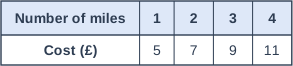
The table shows the cost of some taxi journeys.

The costs form a linear sequence.

Write down an expression for the cost, in pounds, of a journey of \(n\) miles.
Use your expression to work out the cost of a journey of 15 miles.

Table with columns "Number of miles", "1", "2", "3", "4". Number of miles: Cost (£); 1: 5; 2: 7; 3: 9; 4: 11.

Model answer

The cost goes up by £2 for each mile, so compare with \(2n\): 2, 4, 6, 8
Each cost is 3 more.
Cost = \(2n + 3\) pounds
15 miles: \(2 \times 15 + 3 = 30 + 3 = 33\), so the cost is £33

Explanation

The cost goes up by £2 a mile, so the expression starts with \(2n\). For 1 mile, \(2n = 2\) but the cost is £5, so add 3 (a fixed charge). Then substitute \(n = 15\).

Mark scheme
  1. 1 mark

    M1 for \(2n + k\) where \(k\) is any number, or for \(2n\) seen

    correct answer with no working scores full marks

  2. 1 mark

    A1 for \(2n + 3\)

    oe

  3. 1 mark

    B1 for £33

    ft their linear expression with \(n = 15\)

Question 4

4 marks

A gym charges a joining fee and then the same amount every month.

The total cost for 1 month is £35.
The total cost for 2 months is £50.
The total cost for 3 months is £65.

Mia has £200.

What is the greatest number of months she can pay for?

Model answer

The cost goes up by £15 a month.
Joining fee = 35 − 15 = £20
Total cost for \(n\) months = \(15n + 20\)
\(15n + 20 \le 200\)
\(15n \le 180\)
\(n \le 12\)
Mia can pay for 12 months.

Explanation

The costs form a linear sequence going up by 15, so the total for \(n\) months is \(15n + 20\). Mia can spend up to £200, so solve \(15n + 20 \le 200\). Check: 15 × 12 + 20 = 200 exactly, so 12 months is affordable.

Mark scheme
  1. 1 mark

    P1 for the monthly cost 15, or \(15n\) seen

    correct answer with no working scores full marks

  2. 1 mark

    P1 for the total cost of \(n\) months, \(15n + 20\), or for a joining fee of £20

  3. 1 mark

    P1 for \(15n + 20 \le 200\) or (200 − 20) ÷ 15

  4. 1 mark

    A1 for 12 (months)

    cao

Ready to try the rest? Every answer you write is marked against the mark scheme, so you can see exactly where the marks are.

Study Helper Hints first, answers after you try

Stuck on this one? Ask for a hint and I’ll point you in the right direction, without giving the answer away. Once you’ve checked your answer, I’ll show you how the marks are awarded.