
Level:
Correct: 0
Incorrect: 0
Marks: 0/0
Exam Practice
Course:
Topics:
Edexcel GCSE Maths (Foundation non-calculator) Smart practice A mixed round aimed at your weak spots
Unit 1
Number
Unit 2
Algebra
Unit 3
Ratio, proportion and rates of change
Unit 4
Geometry and measures
Unit 5
Probability
Unit 6
Statistics
Avg
score:
–
Topics
done:
0/86

Compound units: speed, density and pressure

Practise 30 exam-style questions on Compound units: speed, density and pressure for Edexcel GCSE Maths (Foundation non-calculator). Write your answer as you would in the exam and get it marked in seconds against the mark scheme, point by point, with the Study Helper on hand if you get stuck.

  • 30 questions
  • 1–5 marks each
  • Instant marking
  • No sign-up needed
20 questions, marked as you go

Sample questions with model answers

Here are 4 of the questions in this topic, each with a model answer, an explanation of why it earns the marks and the mark scheme an examiner would use.

Question 1

1 mark

A block of metal has a mass of 60 g and a volume of 20 cm³.

Work out the density of the block.

Model answer

density = mass ÷ volume
60 ÷ 20 = 3 g/cm³

Explanation

Density = mass ÷ volume. The mass is in grams and the volume is in cm³, so the density is in grams per cm³ (g/cm³). A common mistake is to multiply or to divide the wrong way round.

Mark scheme
  1. 1 mark

    B1 for 3 g/cm³

    accept 3 with no units; do not accept 1200 or 0.3
Question 2

2 marks

Oak has a density of 0.7 g/cm³.
A piece of oak has a volume of 400 cm³.

Work out the mass of the piece of oak.

Model answer

mass = density × volume
0.7 × 400 = 280 g

Explanation

Density = mass ÷ volume, so mass = density × volume. A density of 0.7 g/cm³ means every cm³ has a mass of 0.7 g, so 400 cm³ has a mass of 400 × 0.7 = 280 g.

Mark scheme
  1. 1 mark

    M1 for 0.7 × 400

  2. 1 mark

    A1 for 280 g

    correct answer with no working scores full marks

Question 3

3 marks

Tom drives 105 km to a service station.
He stops there for 20 minutes.
He then drives another 45 km to his destination.

Tom leaves home at 09:20 and arrives at his destination at 12:20

Work out his average speed for the whole journey, including the stop.

Model answer

Total distance: 105 + 45 = 150 km
Total time: 09:20 to 12:20 = 3 hours
Average speed: 150 ÷ 3 = 50 km/h

Explanation

Average speed for a whole journey = total distance ÷ total time. The question says to include the stop, so use the whole time from 09:20 to 12:20, which is 3 hours. Do not take off the 20 minutes and do not average two speeds.

Mark scheme
  1. 1 mark

    P1 for 105 + 45 (= 150 km)

  2. 1 mark

    P1 for a total time of 3 hours

    the 20 minute stop is included in the time

  3. 1 mark

    A1 for 50 km/h

    correct answer with no working scores full marks

Question 4

4 marks

Kim works in a shop.
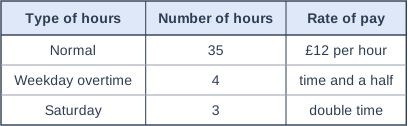
The table shows the hours Kim worked last week and her rates of pay.

Work out how much Kim was paid last week.

Table with columns "Type of hours", "Number of hours", "Rate of pay". Type of hours: Normal; Number of hours: 35; Rate of pay: £12 per hour | Type of hours: Weekday overtime; Number of hours: 4; Rate of pay: time and a half | Type of hours: Saturday; Number of hours: 3; Rate of pay: double time.

Model answer

Normal pay: 35 × £12 = £420
Time and a half: 1.5 × £12 = £18 per hour, 4 × £18 = £72
Double time: 2 × £12 = £24 per hour, 3 × £24 = £72
Total: £420 + £72 + £72 = £564

Explanation

Time and a half means 1.5 times the normal rate (£12 + £6 = £18), and double time means twice the normal rate (£24). Work out each type of pay separately and add them up.

Mark scheme
  1. 1 mark

    P1 for 35 × 12 (= 420)

    correct answer with no working scores full marks

  2. 1 mark

    P1 for an overtime rate: 1.5 × 12 (= 18) or 2 × 12 (= 24)

  3. 1 mark

    P1 for 4 × 18 (= 72) and 3 × 24 (= 72)

    ft their overtime rates

  4. 1 mark

    A1 for £564

    cao

Ready to try the rest? Every answer you write is marked against the mark scheme, so you can see exactly where the marks are.

Study Helper Hints first, answers after you try

Stuck on this one? Ask for a hint and I’ll point you in the right direction, without giving the answer away. Once you’ve checked your answer, I’ll show you how the marks are awarded.