Practise 29 exam-style questions on One quantity as a fraction of another for Edexcel GCSE Maths (Foundation non-calculator). Write your answer as you would in the exam and get it marked in seconds against the mark scheme, point by point, with the Study Helper on hand if you get stuck.
29 questions
1–5 marks each
Instant marking
No sign-up needed
20 questions, marked as you go
Sample questions with model answers
Here are 4 of the questions in this topic, each with a model answer, an explanation of why it earns the marks and the mark scheme an examiner would use.
Question 1
1 mark
Write 18 as a fraction of 12. Give your answer in its simplest form.
"18 as a fraction of 12" means 18 divided by 12, so 18 goes on the top. The fraction is bigger than 1 because 18 is bigger than 12. Divide the top and bottom by 6 to simplify.
Mark scheme
1 mark
B1 for \(\frac{3}{2}\)
accept \(1\frac{1}{2}\); do not accept 1.5 or \(\frac{2}{3}\)
Question 2
2 marks
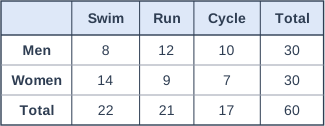
The two-way table shows information about the 60 members of a gym.
What fraction of the members who swim are women? Give your answer in its simplest form.
Model answer
22 members swim. 14 of them are women. \(\dfrac{14}{22} = \dfrac{7}{11}\)
Explanation
The question is about the members who swim, so the bottom of the fraction is the total of the Swim column, 22, not 60. Then simplify \(\frac{14}{22}\) by dividing by 2.
Mark scheme
1 mark
M1 for \(\frac{14}{22}\)
1 mark
A1 for \(\frac{7}{11}\)
cao; correct answer with no working scores full marks
Question 3
3 marks
Kate earns £1800 each month. She spends £450 on rent and £300 on food.
What fraction of her earnings does she have left? Give your answer in its simplest form.
First find how much Kate has left by subtracting what she spends. Then write the amount left over her total earnings and simplify, for example by dividing by 10 and then by 15.
Mark scheme
1 mark
M1 for 1800 − 450 − 300 (= 1050)
1 mark
M1 for \(\frac{1050}{1800}\) oe
ft their amount left
1 mark
A1 for \(\frac{7}{12}\)
cao; correct answer with no working scores full marks
Question 4
4 marks
A bag contains only red, blue and green counters. There are 12 red counters. There are twice as many blue counters as red counters. There are 4 fewer green counters than blue counters.
What fraction of the counters in the bag are green? Give your answer in its simplest form.
Model answer
Red = 12 Blue = 2 × 12 = 24 Green = 24 − 4 = 20 Total = 12 + 24 + 20 = 56 \(\dfrac{20}{56} = \dfrac{5}{14}\)
Explanation
Work out each colour in turn, then add them to find the total number of counters. The fraction green is the number of green counters over the total. Simplify by dividing the top and bottom by 4.
Mark scheme
1 mark
P1 for blue = 12 × 2 (= 24)
1 mark
P1 for green = their 24 − 4 (= 20)
1 mark
P1 for their 20 over their total, e.g. \(\frac{20}{56}\)
the total must be 12 + their blue + their green
1 mark
A1 for \(\frac{5}{14}\)
cao; correct answer with no working scores full marks
Ready to try the rest? Every answer you write is marked against the mark scheme, so you can see exactly where the marks are.
Ctrl + Enter to check
Study HelperHints first, answers after you try
Stuck on this one? Ask for a hint and I’ll point you in the right direction, without giving the answer away. Once you’ve checked your answer, I’ll show you how the marks are awarded.