Practise 28 exam-style questions on Congruence and similar shapes for Edexcel GCSE Maths (Foundation non-calculator). Write your answer as you would in the exam and get it marked in seconds against the mark scheme, point by point, with the Study Helper on hand if you get stuck.
28 questions
1–5 marks each
Instant marking
No sign-up needed
20 questions, marked as you go
Sample questions with model answers
Here are 4 of the questions in this topic, each with a model answer, an explanation of why it earns the marks and the mark scheme an examiner would use.
Question 1
1 mark
Triangle ABC is congruent to triangle DEF. A corresponds to D, B corresponds to E and C corresponds to F.
BC = 9 cm
Write down the length of EF.
Model answer
EF corresponds to BC. Congruent triangles have equal corresponding sides, so EF = 9 cm.
Explanation
Congruent triangles are exactly the same shape and size, so matching sides are equal. B matches E and C matches F, so side BC matches side EF.
Mark scheme
1 mark
B1 for 9 (cm)
cao
Question 2
2 marks
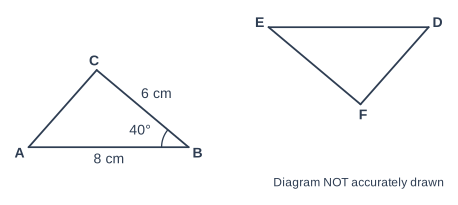
The diagram shows triangle ABC and triangle DEF. Triangle ABC is congruent to triangle DEF. A corresponds to D, B corresponds to E and C corresponds to F.
Write down the length of DE and the size of angle DEF.
Model answer
DE corresponds to AB, so DE = 8 cm. Angle DEF corresponds to angle ABC, so angle DEF = 40°.
Explanation
In congruent triangles, matching sides and matching angles are equal. Use the order of the letters to match them: DE matches AB, and angle DEF (at E) matches angle ABC (at B). Triangle DEF is drawn the other way round, so do not rely on where the sides are on the page.
Mark scheme
1 mark
B1 for DE = 8 (cm)
cao; correct answer with no working scores full marks
1 mark
B1 for angle DEF = 40(°)
cao
Question 3
3 marks
Triangle P has sides of length 3 cm, 4 cm and 5 cm. Triangle Q has sides of length 6 cm, 8 cm and 11 cm.
Are the two triangles similar? You must show how you get your answer.
Model answer
6 ÷ 3 = 2 8 ÷ 4 = 2 11 ÷ 5 = 2.2 The sides are not all multiplied by the same number, so the triangles are not similar. (If they were similar, the longest side of Q would be 5 × 2 = 10 cm.)
Explanation
For similar triangles, every side must be multiplied by the same scale factor. Match the shortest sides, the middle sides and the longest sides and divide. Two of the ratios are 2, but the third is 2.2, so the triangles are not similar.
Mark scheme
1 mark
M1 for one correct ratio of matching sides, e.g. 6 ÷ 3 = 2 or 8 ÷ 4 = 2
or for multiplying the sides of P by 2 (6, 8, 10)
1 mark
M1 for comparing all three pairs, e.g. 11 ÷ 5 = 2.2, or showing 5 × 2 = 10 ≠ 11
1 mark
C1 for No, with a correct reason from correct working
e.g. 'No, the longest side would need to be 10 cm' or 'No, 2.2 is not 2'
Question 4
4 marks
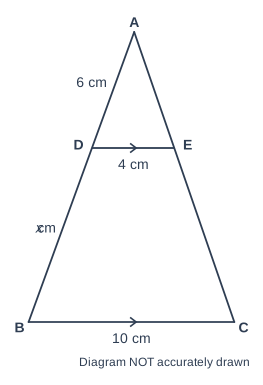
The diagram shows triangle ABC. D is a point on AB and E is a point on AC. DE is parallel to BC. Triangle ADE is similar to triangle ABC.
Work out the value of x.
Model answer
DE corresponds to BC: scale factor = 10 ÷ 4 = 2.5 AD corresponds to AB: AB = 6 × 2.5 = 15 cm x = DB = 15 − 6 = 9
Explanation
The small triangle ADE and the large triangle ABC are similar. Find the scale factor from DE and BC. This gives the whole side AB, so subtract AD to find DB. A common mistake is to give AB (15) as the answer.
Mark scheme
1 mark
M1 for the scale factor 10 ÷ 4 (= 2.5)
1 mark
M1 for AB = 6 × their 2.5 (= 15)
1 mark
M1 for their 15 − 6
1 mark
A1 for 9
cao; correct answer with no working scores full marks; 15 scores M1 M1 only
Ready to try the rest? Every answer you write is marked against the mark scheme, so you can see exactly where the marks are.
Ctrl + Enter to check
Study HelperHints first, answers after you try
Stuck on this one? Ask for a hint and I’ll point you in the right direction, without giving the answer away. Once you’ve checked your answer, I’ll show you how the marks are awarded.