Practise 28 exam-style questions on Circles, surface area and volume of solids for Edexcel GCSE Maths (Foundation non-calculator). Write your answer as you would in the exam and get it marked in seconds against the mark scheme, point by point, with the Study Helper on hand if you get stuck.
28 questions
1–5 marks each
Instant marking
No sign-up needed
20 questions, marked as you go
Sample questions with model answers
Here are 4 of the questions in this topic, each with a model answer, an explanation of why it earns the marks and the mark scheme an examiner would use.
Question 1
1 mark
A regular hexagon has sides of length 7 cm.
Work out the perimeter of the hexagon.
Model answer
A hexagon has 6 sides, all 7 cm long because it is regular. Perimeter = 6 × 7 = 42 cm
Explanation
The perimeter is the total distance around the outside of a shape. A regular hexagon has 6 equal sides, so multiply the length of one side by 6.
Mark scheme
1 mark
B1 for 42 (cm)
cao
Question 2
2 marks
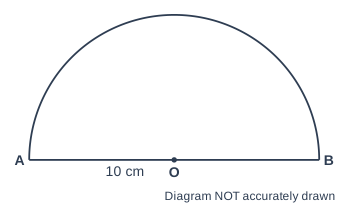
The diagram shows a semicircle. The diameter of the semicircle is 10 cm.
Work out the perimeter of the semicircle. Give your answer in terms of π.
Model answer
Curved part = half the circumference = \(\frac{1}{2} \times \pi \times 10\) = \(5\pi\) cm Perimeter = \(5\pi + 10\) cm
Explanation
The curved edge is half of the circumference of a circle with diameter 10 cm, so it is 5π cm. The perimeter goes all the way round, so you must also add the straight edge (the diameter, 10 cm).
Mark scheme
1 mark
M1 for the curved part, \(\frac{1}{2} \times \pi \times 10\) (= \(5\pi\))
correct answer with no working scores full marks
1 mark
A1 for \(5\pi + 10\) (cm)
oe, e.g. \(10 + 5\pi\); do not accept \(5\pi\) on its own
Question 3
3 marks
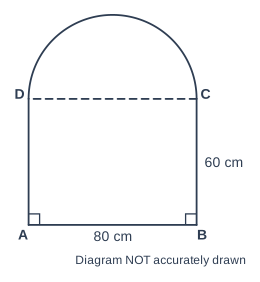
The diagram shows a window. The window is a rectangle with a semicircle on top.
Use π = 3 to work out an estimate for the area of the window.
Model answer
Area of the rectangle = 80 × 60 = 4800 cm² Radius of the semicircle = 80 ÷ 2 = 40 cm Area of the semicircle = \(\frac{1}{2}\) × 3 × \(40^2\) = \(\frac{1}{2}\) × 3 × 1600 = 2400 cm² Total area = 4800 + 2400 = 7200 cm²
Explanation
Split the window into a rectangle and a semicircle. The diameter of the semicircle is the width of the rectangle, 80 cm, so its radius is 40 cm. A semicircle is half a circle, so halve πr².
Mark scheme
1 mark
M1 for the area of the rectangle, 80 × 60 (= 4800)
1 mark
M1 for the area of the semicircle, \(\frac{1}{2}\) × 3 × \(40^2\) (= 2400)
must use radius 40
1 mark
A1 for 7200 (cm²)
cao; correct answer with no working scores full marks
Question 4
4 marks
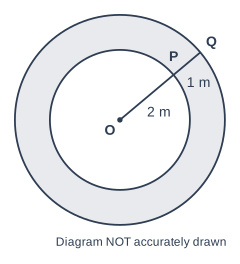
The diagram shows a circular pond and a path around it. The pond has a radius of 2 m. The path is 1 m wide all the way round.
Paving slabs for the path cost £12 per m².
Use π = 3 to work out an estimate for the cost of the paving slabs for the path.
Model answer
Radius of the large circle = 2 + 1 = 3 m Area of the large circle = 3 × \(3^2\) = 27 m² Area of the pond = 3 × \(2^2\) = 12 m² Area of the path = 27 − 12 = 15 m² Cost = 15 × £12 = £180
Explanation
The path is the large circle with the pond taken away. The radius of the large circle is the pond's radius plus the width of the path, 3 m. Subtract the two areas, then multiply by the cost of one square metre.
Mark scheme
1 mark
P1 for the area of the large circle, 3 × \(3^2\) (= 27)
must use radius 3; accept \(9\pi\); correct answer with no working scores full marks
1 mark
P1 for the area of the pond, 3 × \(2^2\) (= 12)
accept \(4\pi\)
1 mark
P1 for (their 27 − their 12) × 12
area of the path = 15 m² (or \(5\pi\))
1 mark
A1 for £180
cao
Ready to try the rest? Every answer you write is marked against the mark scheme, so you can see exactly where the marks are.
Ctrl + Enter to check
Study HelperHints first, answers after you try
Stuck on this one? Ask for a hint and I’ll point you in the right direction, without giving the answer away. Once you’ve checked your answer, I’ll show you how the marks are awarded.