Level:
Correct: 0
Incorrect: 0
Marks: 0/0
Exam Practice
Course:
Topics:
Edexcel GCSE Maths (Foundation non-calculator) Smart practice A mixed round aimed at your weak spots
Unit 1
Number
Unit 2
Algebra
Unit 3
Ratio, proportion and rates of change
Unit 4
Geometry and measures
Unit 5
Probability
Unit 6
Statistics
Avg
score:
–
Topics
done:
0/86

Geometric notation, polygons and symmetry

Practise 18 exam-style questions on Geometric notation, polygons and symmetry for Edexcel GCSE Maths (Foundation non-calculator). Write your answer as you would in the exam and get it marked in seconds against the mark scheme, point by point, with the Study Helper on hand if you get stuck.

  • 18 questions
  • 1–4 marks each
  • Instant marking
  • No sign-up needed
18 questions, marked as you go

Sample questions with model answers

Here are 4 of the questions in this topic, each with a model answer, an explanation of why it earns the marks and the mark scheme an examiner would use.

Question 1

1 mark

The diagram shows triangle ABC.

Use three letters to name the angle marked x.
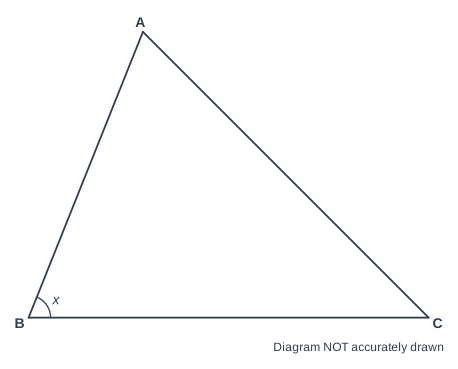
Geometry diagram, marked "Diagram NOT accurately drawn". Triangle ABC. Angle ABC is marked x.

Model answer

Angle ABC

Explanation

To name an angle with three letters, the middle letter is the vertex where the angle is, and the other two letters are on the two lines that make the angle. The angle x is at B, between BA and BC, so it is angle ABC (or CBA).

Mark scheme
  1. 1 mark

    B1 for angle ABC

    accept CBA, ∠ABC, ∠CBA or \(\angle ABC\); do not accept B or angle B
Question 2

2 marks

A polygon has 5 sides that are all the same length.
All 5 of its angles are the same size.

Write down the mathematical name for this polygon.
Write down the number of lines of symmetry it has.

Model answer

Regular pentagon
It has 5 lines of symmetry.

Explanation

A polygon with 5 sides is a pentagon, and when all its sides and all its angles are equal it is a regular pentagon. A regular polygon has the same number of lines of symmetry as it has sides.

Mark scheme
  1. 1 mark

    B1 for regular pentagon

    both words needed; correct answer with no working scores full marks

  2. 1 mark

    B1 for 5

    cao

Question 3

2 marks

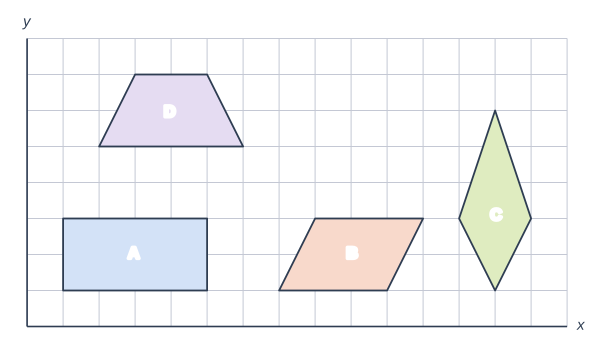
The diagram shows four quadrilaterals, A, B, C and D, on a grid.

Write down the letters of all the quadrilaterals that have rotational symmetry of order 2.

A coordinate grid with x from 0 to 15 and y from 0 to 8; each grid square is 1 unit across, and the axes cross at the origin O. Shape A is a shaded quadrilateral with vertices (1, 1), (5, 1), (5, 3) and (1, 3). Shape B is a shaded quadrilateral with vertices (7, 1), (10, 1), (11, 3) and (8, 3). Shape C is a shaded quadrilateral with vertices (13, 1), (14, 3), (13, 6) and (12, 3). Shape D is a shaded quadrilateral with vertices (2, 5), (6, 5), (5, 7) and (3, 7).

Model answer

A (rectangle) and B (parallelogram)

Explanation

A shape has rotational symmetry of order 2 when it looks the same after a half turn. A rectangle and a parallelogram both do. The kite C and the isosceles trapezium D only look the same after a full turn, so they have order 1.

Mark scheme
  1. 2 marks

    B2 for A and B only

    B1 for one of A or B with no incorrect letters, or for A and B with one incorrect letter (C or D)

Question 4

3 marks

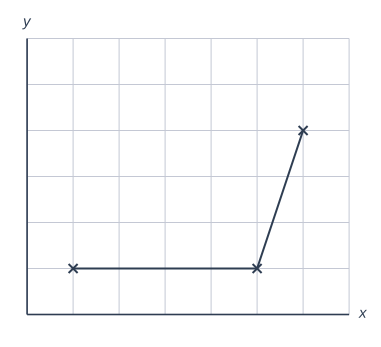
A, B and C are three vertices of a parallelogram ABCD.
The points A, B and C are shown on the grid.

Write down the coordinates of D.
Write down the side of the parallelogram that is parallel to BC.
Write down the order of rotational symmetry of the parallelogram.

A coordinate grid with x from 0 to 7 and y from 0 to 6; each grid square is 1 unit across, and the axes cross at the origin O. Point A is marked with a cross at (1, 1). Point B is marked with a cross at (5, 1). Point C is marked with a cross at (6, 4). A straight line segment joins A (1, 1) to B (5, 1). A straight line segment joins B (5, 1) to C (6, 4).

Model answer

A is (1, 1), B is (5, 1) and C is (6, 4).
To go from B to C you go 1 right and 3 up. AD is parallel to BC and the same length, so D is 1 right and 3 up from A: D = (2, 4).
The side parallel to BC is AD.
A parallelogram has rotational symmetry of order 2.

Explanation

In parallelogram ABCD the vertices go round in order, so AB is parallel to DC and BC is parallel to AD. Opposite sides are parallel and equal, so moving from A the same way as from B to C gives D. A parallelogram looks the same after a half turn, so its order of rotational symmetry is 2.

Mark scheme
  1. 1 mark

    B1 for D (2, 4)

    cao; correct answer with no working scores full marks

  2. 1 mark

    B1 for AD

    accept DA

  3. 1 mark

    B1 for 2

    cao

Ready to try the rest? Every answer you write is marked against the mark scheme, so you can see exactly where the marks are.

Study Helper Hints first, answers after you try

Stuck on this one? Ask for a hint and I’ll point you in the right direction, without giving the answer away. Once you’ve checked your answer, I’ll show you how the marks are awarded.