Level:
Correct: 0
Incorrect: 0
Marks: 0/0
Exam Practice
Course:
Topics:
AQA GCSE Combined Science (Chemistry Paper 2) Smart practice A mixed round aimed at your weak spots
Unit 6
The rate and extent of chemical change
Unit 7
Organic chemistry
Unit 8
Chemical analysis
Unit 9
Chemistry of the atmosphere
Unit 10
Using resources
Avg
score:
–
Topics
done:
0/38

Ways of reducing the use of resources

Practise 16 exam-style questions on Ways of reducing the use of resources for AQA GCSE Combined Science (Chemistry Paper 2). Write your answer as you would in the exam and get it marked in seconds against the mark scheme, point by point, with the Study Helper on hand if you get stuck.

  • 16 questions
  • 1–6 marks each
  • Instant marking
  • No sign-up needed
16 questions, marked as you go

Sample questions with model answers

Here are 4 of the questions in this topic, each with a model answer, an explanation of why it earns the marks and the mark scheme an examiner would use.

Question 1

2 marks

Raw materials for making metals, glass and building materials are obtained from the Earth by quarrying and mining.

Give two environmental impacts of quarrying and mining.

Model answer

Quarrying and mining destroy habitats and leave large holes that scar the landscape. They also cause noise and dust, and produce large amounts of waste rock.

Explanation

Reusing and recycling materials reduces the need for new raw materials, and so reduces the amount of quarrying and mining and their environmental impacts.

Mark scheme
  1. 1 mark

    destroys habitats / damages the landscape (scarring)

    any two; max 2

  2. 1 mark

    noise and dust

    allow either

  3. 1 mark

    large amounts of waste rock / spoil heaps

  4. 1 mark

    more traffic / lorries transporting the materials (burning fuel)

  5. 1 mark

    water pollution from mine waste

Question 2

3 marks

Explain how reducing the use of materials, reusing them and recycling them reduces environmental impacts.

Model answer

Fewer raw materials need to be dug out of the ground by quarrying and mining, so there is less damage to the landscape and habitats. Less energy is needed to extract and process new materials, so fewer fossil fuels are burned and less carbon dioxide is released. Less waste is sent to landfill.

Explanation

Reducing, reusing and recycling by end users reduces the use of limited resources, the use of energy sources, the amount of waste and the environmental impacts. Reducing and reusing usually save more than recycling, because recycling still needs energy.

Mark scheme
  1. 1 mark

    fewer raw materials need to be obtained by quarrying and mining (so less damage to the landscape / habitats)

    any three; max 3

  2. 1 mark

    less energy is used / fewer fossil fuels are burned to extract and process materials

  3. 1 mark

    so less carbon dioxide / fewer pollutants are released

  4. 1 mark

    less waste goes to landfill

  5. 1 mark

    limited resources last longer / are conserved for the future

Question 3

3 marks

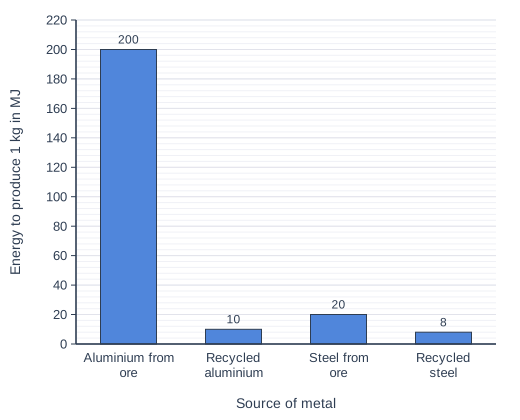
The bar chart shows the energy needed to produce 1 kg of aluminium and 1 kg of steel from their ores and from recycled metal.

Calculate the percentage of energy saved when aluminium is recycled instead of being extracted from its ore.
Use the bar chart to suggest why recycling aluminium is especially worthwhile.

Bar chart of Energy to produce 1 kg in MJ for each source of metal: Aluminium from ore 200, Recycled aluminium 10, Steel from ore 20, Recycled steel 8.

Model answer

Energy saved = 200 − 10 = 190 MJ
Percentage saved = 190 ÷ 200 × 100 = 95%
Recycling aluminium is especially worthwhile because extracting it from its ore needs a very large amount of energy (200 MJ per kg, ten times as much as steel), so recycling saves much more energy than recycling steel, which saves 12 MJ per kg (60%).

Explanation

Percentage saved = energy saved ÷ original energy × 100. Aluminium is extracted by electrolysis, which uses huge amounts of electricity, so recycling it saves most of that energy.

Mark scheme
  1. 1 mark

    energy saved = 200 − 10 = 190 (MJ); 190 ÷ 200 × 100

    an answer of 95(%) scores the first 2 marks

  2. 1 mark

    95 (%)

    allow ecf

  3. 1 mark

    the saving is much larger than for steel (steel saves 12 MJ, 60%) / extracting aluminium from its ore needs a very large amount of energy

    allow aluminium from ore needs 10 times as much energy as steel from ore

Question 4

5 marks

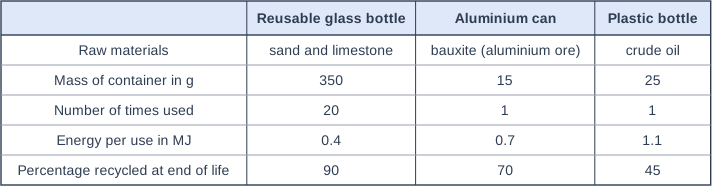
A drinks company is choosing between three types of container. The table gives information about them. The energy per use includes making the container, washing (if reused), transport and recycling.

Evaluate the three containers in terms of reducing the use of limited resources.

Table with columns (row headings), "Reusable glass bottle", "Aluminium can", "Plastic bottle". Raw materials; Reusable glass bottle: sand and limestone; Aluminium can: bauxite (aluminium ore); Plastic bottle: crude oil | Mass of container in g; Reusable glass bottle: 350; Aluminium can: 15; Plastic bottle: 25 | Number of times used; Reusable glass bottle: 20; Aluminium can: 1; Plastic bottle: 1 | Energy per use in MJ; Reusable glass bottle: 0.4; Aluminium can: 0.7; Plastic bottle: 1.1 | Percentage recycled at end of life; Reusable glass bottle: 90; Aluminium can: 70; Plastic bottle: 45.

Model answer

The reusable glass bottle uses the least energy per use, 0.4 MJ, because each bottle is used 20 times, and 90% are recycled at the end of their life. However, glass bottles are heavy (350 g), so more fuel is needed to transport them, and the system only works if people return the bottles. The aluminium can is light and 70% are recycled, which saves bauxite and a lot of energy, but each can is used only once and it uses more energy per use (0.7 MJ). The plastic bottle is made from crude oil, a finite resource, has the highest energy per use (1.1 MJ) and the lowest recycling rate (45%). Overall, the reusable glass bottle reduces the use of limited resources the most, as long as the bottles are returned, and the plastic bottle is the least sustainable.

Explanation

To evaluate ways of reducing the use of limited resources, compare the raw materials, the energy used and how much is reused or recycled, and point out any limitations, such as the need for bottles to be returned. Then reach a conclusion supported by the data.

Mark scheme
  1. 1 mark

    the reusable glass bottle uses the least energy per use (0.4 MJ) because it is used 20 times

    Level of response question: credit a coherent, logically linked answer; max 5.

  2. 1 mark

    but glass bottles are heavy (350 g), so more fuel is needed to transport them / they must be returned and collected to be reused

  3. 1 mark

    the aluminium can is light and a high percentage (70%) is recycled, saving bauxite and energy

  4. 1 mark

    the aluminium can is used only once, and uses more energy per use (0.7 MJ) than the glass bottle

  5. 1 mark

    the plastic bottle uses crude oil (a finite resource), has the highest energy per use (1.1 MJ) and the lowest recycling rate (45%)

  6. 1 mark

    a justified conclusion, e.g. the reusable glass bottle best reduces the use of limited resources, provided the bottles are returned; the plastic bottle is the worst

Ready to try the rest? Every answer you write is marked against the mark scheme, so you can see exactly where the marks are.

Revision notes

Ways of reducing the use of resources

The big idea

Reducing the use of materials, reusing products and recycling materials all cut the use of limited resources, the use of energy sources, the amount of waste and the environmental impacts of making new materials. In the exam you need to explain how each method helps, using examples, and evaluate ways of saving resources from data.

Why it matters

Metals, glass, building materials, clay ceramics and most plastics are produced from limited raw materials: raw materials that are finite, because they are not replaced as fast as they are used.

MaterialLimited raw material
MetalsMetal ores, such as iron ore and bauxite (aluminium ore)
GlassSand, limestone and sodium carbonate
Building materialsLimestone, sand, gravel and other rock
Clay ceramicsClay
Most plasticsCrude oil

Much of the energy for making these materials also comes from limited resources: fossil fuels such as coal, oil and natural gas.

Obtaining raw materials from the Earth by quarrying and mining causes environmental impacts: it destroys habitats, scars the landscape, causes noise and dust and leaves heaps of waste rock.

Reduce, reuse, recycle

MethodWhat it meansExample
ReduceUse less material in the first placeLighter bottles, less packaging
ReuseUse the same product again for the same jobGlass bottles collected, washed and refilled
RecycleBreak the product down to its material and make something newGlass crushed and melted; metals melted and recast

They save resources in that order. Material you do not use needs no raw materials or energy at all. Reusing a glass bottle only needs washing, while recycling it needs the glass to be melted at a high temperature. Recycling still needs energy for collecting, sorting and reprocessing, but much less than making the material from raw materials.

Recycling different materials

  • Glass: some products, such as glass bottles, can be reused. Glass can also be crushed and melted to make different glass products. It is usually sorted by colour, because coloured glass would tint new clear glass.
  • Metals are recycled by melting and recasting or reforming into different products. This uses far less energy than extracting a metal from its ore, because the ore does not need to be mined and the metal compound does not need to be reduced or electrolysed. The saving is especially large for aluminium, which is extracted by electrolysis.
  • Steel: some scrap steel is added to the iron from a blast furnace. This reduces the amount of iron that needs to be extracted from iron ore, so less ore is mined and less energy is used. Steel cans are easy to separate from aluminium cans with a magnet, because steel contains iron.
  • Products that cannot be reused are often recycled for a different use: used plastic bottles become fibres for clothing, and crushed bricks and concrete become hardcore for roads and foundations. Clay ceramics change permanently when they are fired, so they cannot be melted down and remade.

How much separation is needed depends on the material and the properties required of the final product. Copper for electrical wires must be very pure, because impurities reduce how well it conducts, so scrap copper for wiring must be carefully separated and purified. Scrap copper used to make brass, an alloy, needs less separation, because small amounts of other metals matter less.

Evaluating ways to save resources

When a question gives you data, weigh up:

  • how much energy, raw material and carbon dioxide each option saves;
  • the energy used to collect, sort and transport materials for reuse or recycling;
  • whether the recycled material can make the same product or only a different one;
  • practical limits: there may not be enough scrap, and items may not be returned.

Making jars lighter

A food company sells 4.0 million glass jars a year. It redesigns each jar so that its mass falls from 250 g to 205 g. Making 1 tonne of new glass needs about 1.2 tonnes of raw materials. Calculate the mass of raw materials saved each year, and give one other way the change saves resources.

Glass saved per jar: \(250 - 205 = 45\) g

Glass saved per year: \(45 \times 4.0 \times 10^6 = 1.8 \times 10^8\) g = 180 tonnes

Raw materials saved: \(180 \times 1.2 = 216\) tonnes, about 220 tonnes of sand, limestone and sodium carbonate

Less energy (mostly from fossil fuels) is needed to melt less glass, and lighter jars use less fuel to transport. Unlike recycling, reducing needs no extra energy for collection or sorting.

Common mistakes

  • Mixing up reusing and recycling. Reusing keeps the product as it is (a bottle refilled); recycling breaks it down to make something new (glass melted).
  • Saying recycling uses no energy. Collecting, sorting, transporting and melting all use energy, but much less than using raw materials.
  • Working out the percentage of energy used when asked for the percentage saved: \(\text{percentage saved} = \dfrac{\text{energy saved}}{\text{original energy}} \times 100\).
  • Thinking every material is recycled into the same product. Many plastic bottles become fibres, not new bottles.
  • Saying bricks and other clay ceramics can be melted and reshaped like glass. They are crushed and used for a different purpose.

Exam tip

In an "evaluate" question, use the data for both sides (savings in energy, raw materials and carbon dioxide against the costs of collection and sorting), then give a judgement with a reason. In a six-mark question on reduce, reuse and recycle, give an example of each and link it to a specific benefit.

Study Helper Hints first, answers after you try

Stuck on this one? Ask for a hint and I’ll point you in the right direction, without giving the answer away. Once you’ve checked your answer, I’ll show you how the marks are awarded.