Level:
Correct: 0
Incorrect: 0
Marks: 0/0
Exam Practice
Course:
Topics:
AQA GCSE Combined Science (Chemistry Paper 2) Smart practice A mixed round aimed at your weak spots
Unit 6
The rate and extent of chemical change
Unit 7
Organic chemistry
Unit 8
Chemical analysis
Unit 9
Chemistry of the atmosphere
Unit 10
Using resources
Avg
score:
–
Topics
done:
0/38

Fractional distillation and petrochemicals

Practise 15 exam-style questions on Fractional distillation and petrochemicals for AQA GCSE Combined Science (Chemistry Paper 2). Write your answer as you would in the exam and get it marked in seconds against the mark scheme, point by point, with the Study Helper on hand if you get stuck.

  • 15 questions
  • 1–6 marks each
  • Instant marking
  • No sign-up needed
15 questions, marked as you go

Sample questions with model answers

Here are 4 of the questions in this topic, each with a model answer, an explanation of why it earns the marks and the mark scheme an examiner would use.

Question 1

1 mark

Many fuels are produced from crude oil.

Name one fuel produced from crude oil, other than petrol.

Model answer

Kerosene (jet fuel).

Explanation

Petrol, diesel oil, kerosene, heavy fuel oil and liquefied petroleum gases are all fuels produced from crude oil. They power cars, lorries, aircraft, ships and heaters.

Mark scheme
  1. 1 mark

    any one from: diesel oil, kerosene, heavy fuel oil, liquefied petroleum gases (LPG)

    allow diesel; allow paraffin for kerosene; ignore petrol; do not accept natural gas or coal

Question 2

2 marks

Each fraction collected from fractional distillation of crude oil is a mixture, not a pure substance.

Explain why.

Model answer

Crude oil contains a very large number of hydrocarbons, and many of them have similar boiling points. These hydrocarbons condense at the same level of the column, within a range of temperatures, so they are collected together as one fraction.

Explanation

A fraction is collected over a range of temperatures rather than at one exact boiling point, so it contains many compounds. This is good enough for most uses, such as fuels.

Mark scheme
  1. 1 mark

    many different hydrocarbons have similar boiling points

  2. 1 mark

    so they condense at the same level / within the same range of temperatures and are collected together

    allow the fraction is collected over a range of temperatures

Question 3

3 marks

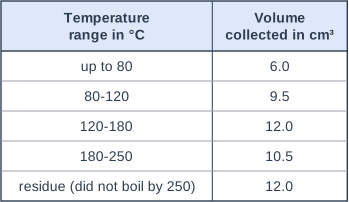
A student distilled 50.0 cm³ of a crude oil substitute in the laboratory. The student collected fractions over different temperature ranges. The table shows the results.

Calculate the percentage of the sample that was collected below 120 °C.

Table with columns "Temperature range in °C", "Volume collected in cm³". Temperature range in °C: up to 80; Volume collected in cm³: 6.0 | Temperature range in °C: 80-120; Volume collected in cm³: 9.5 | Temperature range in °C: 120-180; Volume collected in cm³: 12.0 | Temperature range in °C: 180-250; Volume collected in cm³: 10.5 | Temperature range in °C: residue (did not boil by 250); Volume collected in cm³: 12.0.

Model answer

Volume collected below 120 °C = 6.0 + 9.5 = 15.5 cm³
Percentage = (15.5 ÷ 50.0) × 100 = 31%

Explanation

Add the volumes of all the fractions that boiled below 120 °C, then divide by the total volume of the sample and multiply by 100. The volumes in the table add up to 50.0 cm³, which is a useful check.

Mark scheme
  1. 1 mark

    volume collected below 120 °C = 6.0 + 9.5 = 15.5 (cm³)

    an answer of 31 (%) scores 3 marks

  2. 1 mark

    percentage = 15.5 ÷ 50.0 × 100

    allow ecf from an incorrect volume

  3. 1 mark

    31 (%)

    allow ecf

Question 4

4 marks

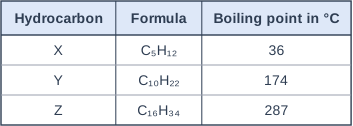
A mixture of three hydrocarbons, X, Y and Z, enters a fractionating column as a vapour. The table gives their formulae and boiling points. The temperatures at four levels of the column are: level 1 (bottom) 350 °C, level 2 250 °C, level 3 150 °C and level 4 (top) 50 °C.

Predict where each hydrocarbon is collected. Explain your answer.

Table with columns "Hydrocarbon", "Formula", "Boiling point in °C". Hydrocarbon: X; Formula: C₅H₁₂; Boiling point in °C: 36 | Hydrocarbon: Y; Formula: C₁₀H₂₂; Boiling point in °C: 174 | Hydrocarbon: Z; Formula: C₁₆H₃₄; Boiling point in °C: 287.

Model answer

Each hydrocarbon condenses at the first level it reaches where the temperature is lower than its boiling point. Z (boiling point 287 °C) is still a gas at level 1 (350 °C) but condenses at level 2 (250 °C). Y (boiling point 174 °C) stays a gas at level 2 but condenses at level 3 (150 °C). X (boiling point 36 °C) is still a gas at level 4 (50 °C), so it leaves the top of the column as a gas.

Explanation

As the vapour rises, the temperature falls. A hydrocarbon stays a gas while the temperature is above its boiling point and condenses as soon as the temperature drops below it. Larger molecules, with higher boiling points, therefore condense lower down.

Mark scheme
  1. 1 mark

    Z is collected at level 2

  2. 1 mark

    Y is collected at level 3

  3. 1 mark

    X does not condense / leaves the top of the column as a gas

    allow X is collected at the top as a gas

  4. 1 mark

    each hydrocarbon condenses at the first level it reaches where the temperature is below its boiling point

    allow Z (287 °C) is still a gas at 350 °C but condenses at 250 °C

Ready to try the rest? Every answer you write is marked against the mark scheme, so you can see exactly where the marks are.

Revision notes

Fractional distillation and petrochemicals

The big idea

Crude oil is not much use as it comes out of the ground. Fractional distillation separates its many hydrocarbons into fractions: groups of molecules with a similar number of carbon atoms, and so similar boiling points. The fractions are then processed into the fuels and the feedstock (raw materials) that modern life depends on.

How fractional distillation works

  1. The crude oil is heated to about 350 °C, so that most of it evaporates (turns into a vapour).
  2. The vapours enter near the bottom of a tall fractionating column and rise up it.
  3. The column has a temperature gradient: it is hottest at the bottom and coolest at the top.
  4. As each vapour rises, it cools. Each hydrocarbon condenses (turns back into a liquid) when it reaches a level where the temperature is below its boiling point.
  5. The liquids are collected (tapped off) at different heights.
  6. The smallest molecules have such low boiling points that they never condense in the column, so they leave the top as gases. The largest molecules have such high boiling points that they never evaporate, so they leave the bottom as a thick liquid residue.
Diagram of a fractionating column for crude oil. Labelled parts: Liquefied petroleum gases, Petrol, Kerosene, Diesel oil, Heavy fuel oil, Lubricating oil, Bitumen, Fractionating column.
The column is hottest at the bottom. From top to bottom, the molecules get bigger and their boiling points get higher. You only need to name the top five fractions.

Fractional distillation is a physical process: no new substances are made. When a hydrocarbon evaporates, only the weak forces between molecules (intermolecular forces) are overcome, and they form again when it condenses. The covalent bonds inside the molecules do not break.

Why molecule size decides where a fraction is collected

Bigger hydrocarbon molecules have stronger intermolecular forces. More energy is needed to overcome these forces, so bigger molecules have higher boiling points and condense at the higher temperatures found lower down the column.

Molecules with a similar number of carbon atoms are a similar size, so they have similar boiling points. They condense at the same level and are collected together as one fraction. A fraction is still a mixture of different hydrocarbons, so it boils over a range of temperatures, not at one fixed temperature like a pure substance.

Deciding where a hydrocarbon is collected

A hydrocarbon has a boiling point of 150 °C. In a fractionating column, outlet P is at 220 °C. Outlet Q, higher up the column, is at 110 °C. At which outlet is the hydrocarbon collected?

At P, the temperature (220 °C) is above the hydrocarbon's boiling point, so it stays a vapour and keeps rising.

At Q, the temperature (110 °C) is below its boiling point, so it condenses and is collected at Q.

A hydrocarbon with bigger molecules and a boiling point of 250 °C is already below its boiling point at P, so it condenses at P or lower down and never reaches Q.

The fuels from crude oil

Many of the fuels our modern lifestyle depends on are produced from crude oil. You need to know these five, listed from the top of the column down; you do not need the names of any other fractions.

FuelTypical use
Liquefied petroleum gases (LPG)Heating and cooking, camping gas
PetrolFuel for cars
KeroseneFuel for aircraft (jet fuel)
Diesel oilFuel for cars, lorries and trains
Heavy fuel oilFuel for ships and power stations

Fuels and feedstock

The fractions are processed in two main ways:

  • A fuel is burned to release energy, for example petrol in a car engine.
  • A feedstock is a raw material that is chemically changed into other products. The petrochemical industry uses fractions to make solvents, lubricants, polymers (plastics) and detergents.

There is a vast array of natural and synthetic carbon compounds because each carbon atom forms four covalent bonds, and carbon atoms can bond to each other in chains (and rings) of different lengths. This lets carbon form families of similar compounds, such as the alkanes.

Remember

  • Fractional distillation separates crude oil into fractions by boiling point, using evaporation and then condensation.
  • The column is hot at the bottom and cooler at the top.
  • Small molecules: low boiling points, collected near the top. Large molecules: high boiling points, collected near the bottom.
  • Fuels from crude oil: LPG, petrol, kerosene, diesel oil and heavy fuel oil.
  • Petrochemical products: solvents, lubricants, polymers and detergents.

Common mistakes

  • Writing "distillation" or "cracking" when the answer is fractional distillation. Cracking breaks molecules up; fractional distillation only separates them.
  • Saying the covalent bonds break when a hydrocarbon boils. Only the intermolecular forces are overcome.
  • Saying the column is hottest at the top. It is hottest at the bottom.
  • Calling a fraction a pure substance. It is a mixture of hydrocarbons with similar boiling points.
  • Saying the small molecules rise "because they are light". They reach the top because their boiling points are low, so they do not condense lower down.

Exam tip

In a 6-mark "explain how" question, use both key words: the crude oil is heated so it evaporates, and each hydrocarbon condenses where the temperature falls below its boiling point. Then link the chain of ideas: molecule size → strength of intermolecular forces → boiling point → height in the column.

Study Helper Hints first, answers after you try

Stuck on this one? Ask for a hint and I’ll point you in the right direction, without giving the answer away. Once you’ve checked your answer, I’ll show you how the marks are awarded.