Level:
Correct: 0
Incorrect: 0
Marks: 0/0
Exam Practice
Course:
Topics:
AQA GCSE Combined Science (Chemistry Paper 2) Smart practice A mixed round aimed at your weak spots
Unit 6
The rate and extent of chemical change
Unit 7
Organic chemistry
Unit 8
Chemical analysis
Unit 9
Chemistry of the atmosphere
Unit 10
Using resources
Avg
score:
–
Topics
done:
0/38

The Earth's early atmosphere

Practise 16 exam-style questions on The Earth's early atmosphere for AQA GCSE Combined Science (Chemistry Paper 2). Write your answer as you would in the exam and get it marked in seconds against the mark scheme, point by point, with the Study Helper on hand if you get stuck.

  • 16 questions
  • 1–6 marks each
  • Instant marking
  • No sign-up needed
16 questions, marked as you go

Sample questions with model answers

Here are 4 of the questions in this topic, each with a model answer, an explanation of why it earns the marks and the mark scheme an examiner would use.

Question 1

2 marks

Explain why the evidence about the Earth's early atmosphere is limited.

Model answer

The early atmosphere existed billions of years ago (the Earth is about 4.6 billion years old). Over that time most of the rocks that formed then have been eroded, melted or changed, and nobody was there to observe or measure the atmosphere, so there is very little direct evidence.

Explanation

Scientists cannot sample the early atmosphere directly, so they rely on indirect evidence such as the chemicals in very old rocks. Because the time scale is so long, little of this evidence survives, which is why there is more than one theory and why theories have changed over time.

Mark scheme
  1. 1 mark

    the early atmosphere existed a very long time ago / the time scale is about 4.6 billion years

  2. 1 mark

    so most rocks / evidence from that time have been destroyed or changed / no one was there to observe or measure it

    allow few rocks or fossils survive from that time; allow rocks have been eroded, melted or recycled

Question 2

2 marks

Volcanoes in the Earth's early history produced nitrogen.

Describe how the amount of nitrogen in the atmosphere changed over time and explain why.

Model answer

The amount of nitrogen gradually built up until it became the main gas in the atmosphere (about 80% today). This is because volcanoes released nitrogen and, because nitrogen is very unreactive, very little of it was removed from the atmosphere.

Explanation

Carbon dioxide was removed by dissolving in the oceans and later by photosynthesis, but nitrogen was not removed in the same way. So even though volcanoes released less nitrogen than carbon dioxide, nitrogen built up and ended up as the largest part of the atmosphere.

Mark scheme
  1. 1 mark

    the amount of nitrogen gradually increased / built up

    allow it is now about 80% of the atmosphere

  2. 1 mark

    because volcanoes kept releasing it and (being unreactive) little of it was removed

    allow nitrogen does not dissolve in the oceans or react much

Question 3

3 marks

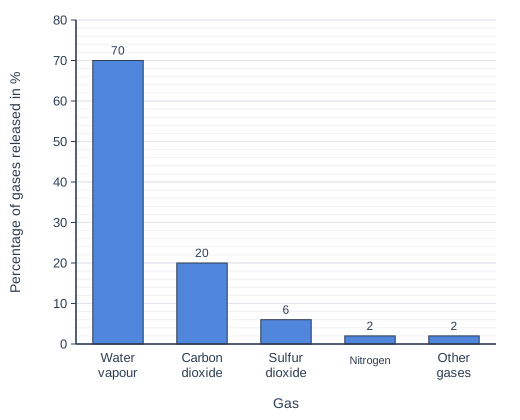
The bar chart shows the percentages of the gases released by a volcano.

Imagine that all the water vapour condensed and that all the other gases stayed in the atmosphere.

Calculate the percentage of carbon dioxide in the remaining gases.
Give your answer to 2 significant figures.

Bar chart of percentage of gases released in % for each gas: Water vapour 70, Carbon dioxide 20, Sulfur dioxide 6, Nitrogen 2, Other gases 2.

Model answer

Percentage of gases that are not water vapour = 100 − 70 = 30%
Percentage of carbon dioxide in the remaining gases = 20 ÷ 30 × 100 = 66.66...%
= 67% (2 s.f.)

Explanation

Once the water vapour is removed, the remaining gases (30% of the original mixture) make up the whole of the new mixture. Carbon dioxide is 20 out of those 30 parts, so it becomes about two-thirds of the gas, which helps explain why the early atmosphere was mainly carbon dioxide.

Mark scheme
  1. 1 mark

    remaining gases = 100 − 70 = 30 (%)

    an answer of 67(%) scores 3 marks

  2. 1 mark

    percentage of carbon dioxide = 20 ÷ 30 × 100 = 66.66...(%)

    allow ecf from an incorrect total

  3. 1 mark

    67 (%)

    answer to 2 significant figures; allow ecf

Question 4

5 marks

Scientists have two theories about where the water in the Earth's oceans came from.

Theory A: The water was released as water vapour by volcanoes and then condensed.
Theory B: Most of the water was brought to Earth by icy comets that crashed into the young Earth.

Evidence:
1. Volcanoes today release large amounts of water vapour.
2. Craters on the Moon show that many comets and asteroids hit the Earth and Moon during their first billion years.
3. The water in most of the comets that have been studied contains a different proportion of heavy hydrogen atoms from the water in the Earth's oceans. Only a few comets have been studied.

Evaluate the two theories. Use the evidence.

Model answer

Evidence 1 supports theory A, because volcanoes today release large amounts of water vapour, which could condense to form oceans. Evidence 2 shows that theory B is possible, because comets did hit the early Earth. However, evidence 3 goes against theory B: the water in most comets studied is different from ocean water, so most of the ocean water probably did not come from comets. Evidence 3 is limited because only a few comets have been studied, and evidence 1 assumes that volcanoes today behave like those 4 billion years ago. Both processes may have contributed some water, but overall theory A is better supported by this evidence.

Explanation

To evaluate theories, say which evidence supports and which goes against each one, comment on the quality of the evidence (sample size, indirect evidence), and reach a conclusion based on it. Because evidence about the early Earth is limited, scientists keep testing such theories as new evidence appears.

Mark scheme
  1. 1 mark

    evidence 1 supports theory A (volcanoes can produce large amounts of water vapour)

    Level of response question: credit a coherent, logically linked answer; max 5.

  2. 1 mark

    evidence 2 shows theory B is possible / comets did hit the early Earth

  3. 1 mark

    evidence 3 goes against theory B, because ocean water does not match the water in most comets

    allow suggests most of the ocean water did not come from comets

  4. 1 mark

    but only a few comets have been studied, so evidence 3 may not represent all comets

    allow small sample size

  5. 1 mark

    volcanoes today may not be the same as volcanoes on the early Earth / evidence 1 is indirect

    allow nobody observed the early Earth; the time scale of 4.6 billion years limits the evidence

  6. 1 mark

    both processes could have contributed water

  7. 1 mark

    a justified conclusion, e.g. theory A is better supported because evidence 3 is against theory B

    conclusion must be linked to the evidence

Ready to try the rest? Every answer you write is marked against the mark scheme, so you can see exactly where the marks are.

Revision notes

The Earth's early atmosphere

The big idea

The Earth is about 4.6 billion years old, and nobody was there to measure its first atmosphere. Because the evidence is limited, scientists have theories about what the early atmosphere contained and how it formed, and these theories have changed and developed over time. You need to know one theory, and to be able to use information you are given to evaluate theories.

Why the evidence is limited

  • The time scale is huge: the early atmosphere existed around 4 billion years ago, long before anyone could observe or measure it.
  • Very few rocks survive from that time; most have been eroded, melted or changed.
  • So scientists rely on indirect evidence, such as chemicals in ancient rocks, the gases that volcanoes release today and the atmospheres of other planets.

Theories change when new evidence is found (for example very old rocks, or data from space probes), when new technology lets evidence be analysed in better ways, and when other scientists check and question the ideas.

One theory: the first billion years

  1. During the first billion years there was intense volcanic activity. The volcanoes released the gases that formed the early atmosphere.
  2. At the start of this period the atmosphere may have been like the atmospheres of Mars and Venus today: mainly carbon dioxide, with little or no oxygen gas. Volcanic gases contain no oxygen gas, and there were no algae or plants to make any.
  3. Volcanoes also released water vapour. As the Earth cooled, the water vapour condensed to form the oceans.
  4. Volcanoes produced nitrogen, which gradually built up in the atmosphere. Nitrogen is unreactive and does not dissolve much in water, so little of it was removed.
  5. There may have been small proportions of methane (CH₄) and ammonia (NH₃).
  6. When the oceans formed, carbon dioxide dissolved in the water and carbonates were precipitated, producing sediments. This reduced the amount of carbon dioxide in the atmosphere. Calcium carbonate is one example of a carbonate that formed.

You only need to know this theory, but a question may describe another one and ask you to weigh it up using the information given.

Then and now

GasEarly atmosphere (this theory)Atmosphere today
Carbon dioxidemost of the atmospherea small proportion (about 0.04%)
Oxygenlittle or noneabout 20%
Nitrogena small proportion, slowly building upabout 80%
Water vapourlarge amounts from volcanoessmall amounts that vary
Methane and ammoniapossibly small proportionsvery little

When you compare, mention both atmospheres in each point, for example "mainly carbon dioxide then, but only about 0.04% now".

Evaluating evidence and theories

When a question gives you information, ask:

  • Which parts support each theory, and which go against it? Quote the data.
  • Is the evidence direct or indirect? Volcanoes today may not release the same gases as volcanoes billions of years ago, and another planet is not the Earth.
  • Is there enough evidence, and is it representative (one sample, one place)?
  • What conclusion does the information support? Theories use words like "may" and "suggests" because the evidence is limited.

Using evidence from ancient rocks

Suppose geologists find a layer of sedimentary rock about 3.8 billion years old that contains pebbles worn smooth and round by flowing water. Explain what this suggests about the early Earth, and give one limitation of the evidence.

  • Pebbles are rounded by moving water in rivers and seas, so there was liquid water on the Earth's surface by then.
  • So the Earth had already cooled enough for water vapour to condense. This fits the theory that water vapour from volcanoes condensed to form the oceans, although it does not show where the water came from.
  • Limitation: one rock layer from one place may not be representative, and its age is an estimate. It also tells us about water, not directly about which gases were in the air.

Common mistakes

  • Saying the water vapour "evaporated" to form the oceans. It condensed as the Earth cooled.
  • Writing "carbon monoxide" for carbon dioxide, or "ammonium" for ammonia (NH₃).
  • Saying the early atmosphere had plenty of oxygen. It had little or no oxygen, because there were no algae or plants yet.
  • Saying plants removed the carbon dioxide in the first billion years. In this theory it dissolved in the oceans and formed carbonate sediments; photosynthesis came later.
  • Stating a theory as a fact. Write "one theory suggests" or "may have been".

Exam tip

In 6-mark "describe" questions, give the events in time order and name the process at each step (released, condensed, dissolved, precipitated): a list of gases without the processes scores few marks. In "evaluate" questions, give points for and against each theory, mention the limits of the evidence and finish with a judgement.

Study Helper Hints first, answers after you try

Stuck on this one? Ask for a hint and I’ll point you in the right direction, without giving the answer away. Once you’ve checked your answer, I’ll show you how the marks are awarded.