Factors which affect the rates of chemical reactions
Practise 13 exam-style questions on Factors which affect the rates of chemical reactions for AQA GCSE Combined Science (Chemistry Paper 2). Write your answer as you would in the exam and get it marked in seconds against the mark scheme, point by point, with the Study Helper on hand if you get stuck.
13 questions
1–6 marks each
Instant marking
No sign-up needed
13 questions, marked as you go
Sample questions with model answers
Here are 4 of the questions in this topic, each with a model answer, an explanation of why it earns the marks and the mark scheme an examiner would use.
Question 1
1 mark
A small amount of manganese(IV) oxide powder is added to hydrogen peroxide solution. Oxygen is produced much faster than before. At the end of the reaction the manganese(IV) oxide is still there and has the same mass.
Which factor affecting the rate of reaction does this show?
Model answer
It shows the effect of a catalyst: manganese(IV) oxide speeds up the reaction but is not used up.
Explanation
A catalyst increases the rate of a reaction but is not used up, so the same mass remains at the end. The five factors that affect rate are concentration, pressure of gases, surface area of solids, temperature and catalysts.
Mark scheme
1 mark
the presence of a catalyst
allow manganese(IV) oxide is a catalyst; do not accept surface area or temperature
Question 2
2 marks
Sodium thiosulfate solution reacts with dilute hydrochloric acid:
The mixture is clear at the start. A black cross on paper under the flask can be seen through the mixture. After a while the cross can no longer be seen.
Use the equation to explain why the cross disappears.
Model answer
One of the products is sulfur, S(s), which is a solid. As more sulfur forms, the mixture becomes cloudy so light cannot pass through and the cross can no longer be seen.
Explanation
The state symbol (s) shows that sulfur is produced as an insoluble solid. The cloudiness (turbidity) builds up as the reaction goes on, so the time for the cross to disappear is the time taken to make a fixed amount of sulfur.
Mark scheme
1 mark
sulfur is produced, which is a solid
allow a precipitate (of sulfur) forms; allow S(s) is formed
1 mark
the solid makes the mixture cloudy / opaque so light cannot pass through it
allow the mixture becomes turbid
Question 3
3 marks
Two students timed the same reaction between sodium thiosulfate and hydrochloric acid using the disappearing cross method. They used the same flask and the same solutions at the same time. Student A recorded 42 s and student B recorded 47 s.
Suggest why the students' times were different, and suggest how the method could be improved.
Model answer
The time is found by deciding by eye when the cross can no longer be seen, which is subjective. The two students have different eyesight and may have looked from different heights, so they decided that the cross had disappeared at different times. A light sensor connected to a data logger could be used to measure when the light passing through the mixture falls to a set value, which removes human judgement.
Explanation
When an end point depends on human judgement, different people (or the same person at different times) can get different results, so the results are less repeatable and reproducible. Measuring instruments such as a light sensor make the end point the same every time.
Mark scheme
1 mark
the end point is judged by eye / is subjective
allow it is difficult to tell exactly when the cross disappears
1 mark
the students judge the disappearance of the cross differently
allow they had different eyesight / looked from different heights or angles / had different reaction times
1 mark
improvement: use a light sensor and data logger to measure when the light passing through drops to a set level
allow use a colorimeter; allow have the same person judge every result (and look from the same height)
Question 4
4 marks
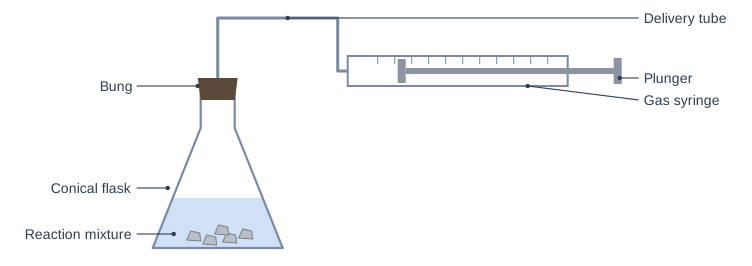
The diagram shows the apparatus a student used to investigate how the concentration of hydrochloric acid affects the rate of its reaction with magnesium ribbon.
Describe how the student could use this apparatus to do the investigation.
Model answer
Use a measuring cylinder to put 50 cm³ of hydrochloric acid of known concentration into the conical flask. Add a 3 cm length of magnesium ribbon, quickly put in the bung and start the stop clock. Record the volume of hydrogen in the gas syringe every 10 seconds until the reaction stops. Repeat with acid of different concentrations, using the same length of magnesium, the same volume of acid and the same temperature each time, and compare the rates.
Explanation
The gas syringe measures the volume of hydrogen produced, so readings at regular times show how fast the product forms. The bung must go in straight away or some gas escapes, and only the acid concentration should change between experiments.
Mark scheme
1 mark
measure a fixed volume of hydrochloric acid into the conical flask using a measuring cylinder
max 4
1 mark
add a fixed length / mass of magnesium ribbon, put the bung in quickly and start the stop clock
1 mark
record the volume of gas in the gas syringe at regular time intervals
allow measure the time taken to collect a fixed volume of gas
1 mark
repeat with different concentrations of hydrochloric acid
at least three concentrations
1 mark
keep the temperature / the length of magnesium / the volume of acid the same
allow use the same mass of magnesium
1 mark
repeat each concentration and calculate means
allow compare the initial gradients / mean rates from graphs of volume against time
Ready to try the rest? Every answer you write is marked against the mark scheme, so you can see exactly where the marks are.
Ctrl + Enter to check
Study HelperHints first, answers after you try
Stuck on this one? Ask for a hint and I’ll point you in the right direction, without giving the answer away. Once you’ve checked your answer, I’ll show you how the marks are awarded.