Practise 10 exam-style questions on How oxygen increased for AQA GCSE Combined Science (Chemistry Paper 2). Write your answer as you would in the exam and get it marked in seconds against the mark scheme, point by point, with the Study Helper on hand if you get stuck.
10 questions
1–4 marks each
Instant marking
No sign-up needed
10 questions, marked as you go
Sample questions with model answers
Here are 4 of the questions in this topic, each with a model answer, an explanation of why it earns the marks and the mark scheme an examiner would use.
Question 1
1 mark
About how long ago did algae first produce oxygen?
Model answer
About 2.7 billion years ago.
Explanation
Algae first produced oxygen about 2.7 billion years ago, and soon after this oxygen appeared in the atmosphere. Over the next billion years plants evolved and the percentage of oxygen gradually increased.
Mark scheme
1 mark
about 2.7 billion years ago
allow 2.5-3 billion years ago; allow 2.7 × 10⁹ years; do not accept million
Question 2
2 marks
The formula of glucose is C₆H₁₂O₆.
Write a balanced symbol equation for photosynthesis.
Model answer
6CO₂ + 6H₂O → C₆H₁₂O₆ + 6O₂
Explanation
Balance carbon first: 6 carbon atoms in glucose need 6CO₂. Then hydrogen: 12 hydrogen atoms need 6H₂O. Finally oxygen: there are 12 + 6 = 18 oxygen atoms on the left; glucose has 6, so the other 12 make 6O₂.
Mark scheme
1 mark
CO₂ + H₂O → C₆H₁₂O₆ + O₂
correct formulae of all reactants and products; an answer of 6CO₂ + 6H₂O → C₆H₁₂O₆ + 6O₂ scores 2 marks
1 mark
6CO₂ + 6H₂O → C₆H₁₂O₆ + 6O₂
correctly balanced; allow multiples; ignore state symbols
Question 3
3 marks
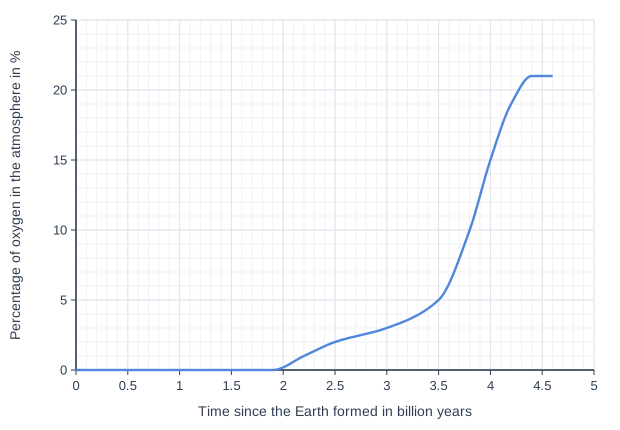
The graph shows how scientists think the percentage of oxygen in the atmosphere has changed since the Earth formed, 4.6 billion years ago.
Algae first produced oxygen about 2.7 billion years ago.
Determine how many billion years it took from when algae first produced oxygen until oxygen made up 10% of the atmosphere. Use the graph.
Model answer
The graph's time axis starts when the Earth formed. Algae first produced oxygen 2.7 billion years ago, which is 4.6 − 2.7 = 1.9 billion years after the Earth formed. From the graph, oxygen reached 10% at 3.8 billion years after the Earth formed. Time taken = 3.8 − 1.9 = 1.9 billion years
Explanation
The trap is mixing up 'years ago' with 'years since the Earth formed': the graph uses time since formation, so 2.7 billion years ago must be converted first. The answer shows how slowly the oxygen built up, taking almost 2 billion years to reach half of today's level.
Mark scheme
1 mark
algae first produced oxygen at 4.6 − 2.7 = 1.9 billion years after the Earth formed
an answer of 1.9 billion years scores 3 marks
1 mark
oxygen reached 10% at 3.8 billion years after the Earth formed
allow 3.7-3.9
1 mark
time taken = 3.8 − 1.9 = 1.9 billion years
allow 1.8-2.0; allow ecf from their readings
Question 4
3 marks
During photosynthesis, a tree takes in 88 kg of carbon dioxide.
6CO₂ + 6H₂O → C₆H₁₂O₆ + 6O₂
Calculate the mass of oxygen released.
Relative atomic masses (Ar): C = 12, O = 16
Model answer
Mr of CO₂ = 12 + (2 × 16) = 44 Mr of O₂ = 2 × 16 = 32 Moles of CO₂ = 88 000 g ÷ 44 = 2000 mol The equation shows 6CO₂ : 6O₂, which is 1 : 1, so moles of O₂ = 2000 mol Mass of O₂ = 2000 × 32 = 64 000 g = 64 kg
Explanation
Use the balanced equation to find the mole ratio: 6 molecules of CO₂ give 6 molecules of O₂, so the number of moles is the same. The mass of oxygen is less than the mass of carbon dioxide because each O₂ molecule (Mr 32) is lighter than each CO₂ molecule (Mr 44).
Mark scheme
1 mark
Mr of CO₂ = 44 and Mr of O₂ = 32
both needed; an answer of 64 kg scores 3 marks
1 mark
moles of CO₂ = 88 000 ÷ 44 = 2000 mol, so moles of O₂ = 2000 mol (1 : 1 ratio)
allow working in kg: 88 ÷ 44 = 2 (kmol); allow ecf from incorrect Mr
1 mark
mass of O₂ = 2000 × 32 = 64 000 g = 64 kg
allow 64 000 g; allow ecf
Ready to try the rest? Every answer you write is marked against the mark scheme, so you can see exactly where the marks are.
Ctrl + Enter to check
Study HelperHints first, answers after you try
Stuck on this one? Ask for a hint and I’ll point you in the right direction, without giving the answer away. Once you’ve checked your answer, I’ll show you how the marks are awarded.