Practise 12 exam-style questions on The effect of changing concentration (HT only) for AQA GCSE Combined Science (Chemistry Paper 2). Write your answer as you would in the exam and get it marked in seconds against the mark scheme, point by point, with the Study Helper on hand if you get stuck.
12 questions
1–6 marks each
Instant marking
No sign-up needed
12 questions, marked as you go
Sample questions with model answers
Here are 4 of the questions in this topic, each with a model answer, an explanation of why it earns the marks and the mark scheme an examiner would use.
Question 1
2 marks
A reversible reaction is at equilibrium. The concentration of one of the products is decreased by removing some of it.
Describe how the system responds.
Model answer
The system is no longer at equilibrium, so more of the reactants react to form products. This continues, replacing some of the product that was removed, until equilibrium is reached again.
Explanation
Removing a product is counteracted by making more of it, so the equilibrium shifts to the right. This is why removing a product as it forms can increase the yield of a reversible reaction.
Mark scheme
1 mark
more reactants react / the forward reaction is favoured / the equilibrium shifts to the right
1 mark
forming more products until equilibrium is reached again
allow to replace the product that was removed
Question 2
2 marks
A reversible reaction in a sealed container was at equilibrium:
A(g) + B(g) ⇌ C(g)
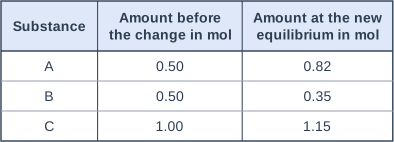
A chemist added more of one substance. The table shows the amounts at equilibrium before and after the change.
Which substance did the chemist add? Explain how the data show this.
Model answer
Substance A was added. At the new equilibrium there is more A (0.82 mol compared with 0.50 mol), but less B (0.35 mol) and more C (1.15 mol). This shows the equilibrium shifted to the right to use up some of the added A, which also used up some B and formed more C.
Explanation
Work out which change would explain all three results. Only B decreased, so B was used up by the forward reaction; the forward reaction must have been favoured by adding A, because adding C would have shifted the equilibrium to the left.
Mark scheme
1 mark
A
1 mark
the amount of A increased but B decreased and C increased, so the equilibrium shifted to the right to use up some of the added A
allow if B had been added, the amount of B would have increased; if C had been added, A and B would have increased
Question 3
3 marks
Iron(III) ions react with thiocyanate ions in a reversible reaction:
Fe³⁺(aq) + SCN⁻(aq) ⇌ FeSCN²⁺(aq)
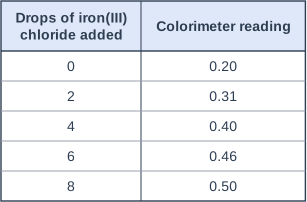
FeSCN²⁺ is blood red. A student added drops of iron(III) chloride solution to an equilibrium mixture and used a colorimeter to measure how strongly the mixture absorbed light. A higher reading means more of the red FeSCN²⁺. The table shows the results.
Explain the trend in the results.
Model answer
Each drop of iron(III) chloride increases the concentration of Fe³⁺ ions, a reactant. The position of equilibrium shifts to the right to use up some of the added Fe³⁺, so more red FeSCN²⁺ forms. This is why the colorimeter reading rises from 0.20 with no drops to 0.50 with 8 drops. The rise gets smaller each time because the SCN⁻ ions are being used up.
Explanation
The colorimeter reading is a measure of how much product is present, so it tracks the position of equilibrium. Increasing the concentration of a reactant forms more product until equilibrium is reached again.
Mark scheme
1 mark
adding iron(III) chloride increases the concentration of Fe³⁺ ions (a reactant)
1 mark
so the equilibrium shifts to the right / more FeSCN²⁺ forms
1 mark
so the colorimeter reading increases as more drops are added (from 0.20 to 0.50)
allow the increase gets smaller with each addition because SCN⁻ ions are being used up
Question 4
4 marks
Hydrogen and iodine react in a sealed flask:
H₂(g) + I₂(g) ⇌ 2HI(g)
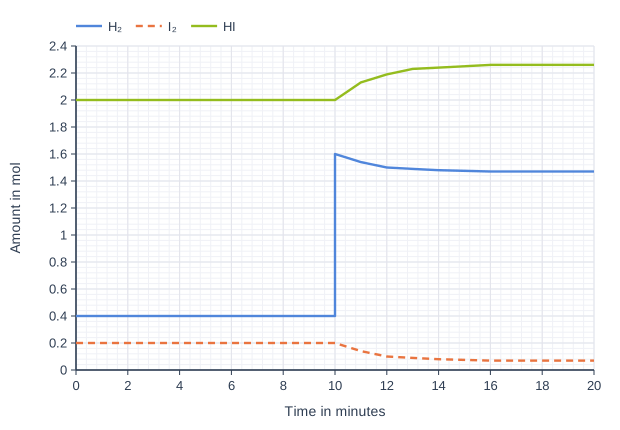
The mixture was at equilibrium. At 10 minutes, extra hydrogen was added. The graph shows the amounts of the three substances.
Describe and explain the changes in the amounts after 10 minutes.
Model answer
When hydrogen is added the amount of hydrogen jumps from 0.40 mol to 1.60 mol. The system is no longer at equilibrium, and it counteracts the change by using up some of the added hydrogen: the position of equilibrium shifts to the right. Hydrogen reacts with iodine, so the amount of hydrogen falls to 1.47 mol, the amount of iodine falls from 0.20 mol to 0.07 mol, and the amount of hydrogen iodide rises from 2.00 mol to 2.26 mol. After about 16 minutes the amounts stop changing because a new equilibrium has been reached.
Explanation
Changing the concentration of one substance changes the concentrations of all the substances until equilibrium is reached again. The added reactant is only partly used up, so at the new equilibrium there is still more hydrogen than before.
Mark scheme
1 mark
the amount of hydrogen increases suddenly (from 0.40 to 1.60 mol) when it is added, then decreases
1 mark
the equilibrium shifts to the right to use up some of the added hydrogen
allow the system counteracts the change
1 mark
so the amount of iodine decreases and the amount of HI increases
allow data, e.g. iodine falls from 0.20 to 0.07 mol, HI rises from 2.00 to 2.26 mol
1 mark
after about 16 minutes all the amounts stay constant, so a new equilibrium has been reached
allow 14-18 minutes
Ready to try the rest? Every answer you write is marked against the mark scheme, so you can see exactly where the marks are.
Ctrl + Enter to check
Study HelperHints first, answers after you try
Stuck on this one? Ask for a hint and I’ll point you in the right direction, without giving the answer away. Once you’ve checked your answer, I’ll show you how the marks are awarded.