Level:
Correct: 0
Incorrect: 0
Marks: 0/0
Exam Practice
Course:
Topics:
AQA GCSE Combined Science (Chemistry Paper 2) Smart practice A mixed round aimed at your weak spots
Unit 6
The rate and extent of chemical change
Unit 7
Organic chemistry
Unit 8
Chemical analysis
Unit 9
Chemistry of the atmosphere
Unit 10
Using resources
Avg
score:
–
Topics
done:
0/38

The carbon footprint and its reduction

Practise 10 exam-style questions on The carbon footprint and its reduction for AQA GCSE Combined Science (Chemistry Paper 2). Write your answer as you would in the exam and get it marked in seconds against the mark scheme, point by point, with the Study Helper on hand if you get stuck.

  • 10 questions
  • 2–6 marks each
  • Instant marking
  • No sign-up needed
10 questions, marked as you go

Sample questions with model answers

Here are 4 of the questions in this topic, each with a model answer, an explanation of why it earns the marks and the mark scheme an examiner would use.

Question 1

2 marks

Describe two actions that could reduce emissions of methane.

Model answer

Collect the methane given off by landfill sites and burn it as a fuel to generate electricity. Reduce the amount of food waste sent to landfill by composting or recycling it.

Explanation

The main human sources of methane are cattle farming, landfill sites, rice fields and leaks from natural gas supplies, so actions target these. Burning collected methane still produces carbon dioxide, but carbon dioxide has a much smaller warming effect than the methane it replaces.

Mark scheme
  1. 1 mark

    collect methane from landfill sites (and burn it as a fuel)

    any two; max 2

  2. 1 mark

    send less waste to landfill, e.g. recycle or compost food waste

    allow reduce food waste

  3. 1 mark

    farm fewer cattle / eat less beef and dairy

    allow change cattle feed to reduce methane

  4. 1 mark

    fix leaks from gas pipes / gas wells

Question 2

2 marks

A return flight produces about 1000 kg of carbon dioxide for each passenger. An airline offers to plant young trees to offset this. One young tree absorbs about 25 kg of carbon dioxide each year.

Calculate the number of young trees needed to absorb 1000 kg of carbon dioxide in one year.
Suggest one reason why planting trees may not fully offset the flight.

Model answer

1000 ÷ 25 = 40 trees.
The flight releases the carbon dioxide immediately, but the trees absorb it slowly over many years, and some trees may die or be cut down before they have absorbed it.

Explanation

Carbon offsetting balances emissions by removing the same amount of carbon dioxide elsewhere. It only works if the trees survive and grow for many years, which is one reason offsetting is less effective than reducing emissions in the first place.

Mark scheme
  1. 1 mark

    1000 ÷ 25 = 40 (trees)

  2. 1 mark

    trees take many years to grow / the carbon dioxide is released now but absorbed slowly / trees may die, be cut down or burn

    allow any sensible reason, e.g. the trees might have been planted anyway

Question 3

3 marks

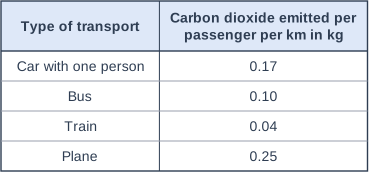
The table shows the mass of carbon dioxide emitted for each passenger for each kilometre travelled by different types of transport.

A student travels 400 km to visit a university.

Calculate how much less carbon dioxide is emitted if the student travels by train instead of driving alone by car.

Table with columns "Type of transport", "Carbon dioxide emitted per passenger per km in kg". Type of transport: Car with one person; Carbon dioxide emitted per passenger per km in kg: 0.17 | Type of transport: Bus; Carbon dioxide emitted per passenger per km in kg: 0.10 | Type of transport: Train; Carbon dioxide emitted per passenger per km in kg: 0.04 | Type of transport: Plane; Carbon dioxide emitted per passenger per km in kg: 0.25.

Model answer

Car: 0.17 × 400 = 68 kg
Train: 0.04 × 400 = 16 kg
Reduction = 68 − 16 = 52 kg of carbon dioxide

Explanation

Multiply the emissions per kilometre by the distance for each type of transport, then subtract. Choosing lower-carbon transport is one way an individual can reduce their carbon footprint.

Mark scheme
  1. 1 mark

    car: 0.17 × 400 = 68 (kg)

    an answer of 52 kg scores 3 marks

  2. 1 mark

    train: 0.04 × 400 = 16 (kg)

  3. 1 mark

    difference = 68 − 16 = 52 (kg)

    allow (0.17 − 0.04) × 400 = 52 for 3 marks; allow ecf

Question 4

4 marks

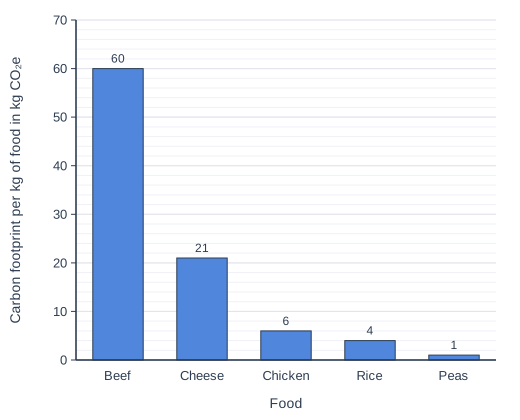
The bar chart shows the carbon footprints of some foods. The carbon footprint is given in kg of carbon dioxide equivalent (kg CO₂e), which includes the effect of methane and other greenhouse gases.

Calculate how many times greater the carbon footprint of beef is than the carbon footprint of chicken.
Suggest reasons why beef has such a large carbon footprint.

Bar chart of Carbon footprint per kg of food in kg CO₂e for each food: Beef 60, Cheese 21, Chicken 6, Rice 4, Peas 1.

Model answer

60 ÷ 6 = 10, so the carbon footprint of beef is 10 times greater than chicken.
Cattle release methane as they digest their food, and methane is a powerful greenhouse gas. Cattle also need a lot of land, so forests are cut down for grazing and to grow feed, and energy from fossil fuels is used to grow the feed and to transport and process the meat.

Explanation

A food's carbon footprint includes every stage of its life cycle. For beef, the methane from cattle and the deforestation for grazing make the footprint very large, which is why eating less beef is one way to reduce an individual's carbon footprint.

Mark scheme
  1. 1 mark

    60 ÷ 6 = 10 (times)

    max 3 for reasons

  2. 1 mark

    cattle release methane (as they digest their food)

  3. 1 mark

    methane is a powerful greenhouse gas / has a large warming effect

  4. 1 mark

    forests are cut down (deforestation) to make grazing land or grow cattle feed

    allow cattle need a lot of land

  5. 1 mark

    energy (from fossil fuels) is used to grow feed, transport and process the meat

Ready to try the rest? Every answer you write is marked against the mark scheme, so you can see exactly where the marks are.

Revision notes

The carbon footprint and its reduction

The big idea

The carbon footprint is the total amount of carbon dioxide and other greenhouse gases emitted over the full life cycle of a product, service or event. It can be reduced by reducing emissions of carbon dioxide and methane. You need to describe actions that do this, and give reasons why the actions may be limited.

What a carbon footprint includes

  • Every greenhouse gas, not just carbon dioxide. Other gases are counted as a carbon dioxide equivalent: a tonne of methane counts as many tonnes of carbon dioxide, because methane has a much stronger warming effect.
  • Every stage of the life cycle: getting the raw materials, manufacture, transport, use and disposal.
  • It can be worked out for a product (a mobile phone), a service (a bus route) or an event (a football match).

Reducing carbon dioxide emissions

ActionHow it reduces emissions
Alternative energy supplies (wind, solar, hydroelectric, nuclear)Less fossil fuel is burned to generate electricity
Energy conservation (insulating buildings, efficient appliances, LED lights)Less energy is needed, so less fuel is burned
Carbon capture and storageCarbon dioxide is removed from power station waste gases and stored underground, for example in old oil and gas fields, so it does not reach the atmosphere
Carbon taxes and licencesEmitting carbon dioxide costs money, so companies are encouraged to emit less
Carbon off-setting, including tree plantingTrees take in carbon dioxide by photosynthesis, balancing some emissions

Something is carbon neutral when there is no net release of carbon dioxide: any carbon dioxide released is balanced by the same amount being absorbed or offset.

Reducing methane emissions

  • Send less waste to landfill, by recycling and composting food waste.
  • Collect methane from landfill sites, or make biogas from waste by anaerobic digestion, and burn it as a fuel. Burning turns the methane into carbon dioxide, a much weaker greenhouse gas, and the fuel replaces some fossil fuel.
  • Change the diet of cattle so they produce less methane, or farm fewer cattle (people eating less meat and dairy).
  • Drain rice paddy fields for part of the growing season.
  • Repair leaks from gas pipelines and wells.

Why actions may be limited

  • Scientific disagreement about the causes and consequences of global climate change, or a belief that scientists disagree.
  • Lack of public information and education about the problem.
  • Lifestyle changes: people may not want to drive, fly or heat their homes less, and many lifestyles now involve more car and air travel.
  • Economic considerations: alternatives can be expensive, businesses may lose profits or jobs, and developing countries need cheap energy to grow.
  • Incomplete international cooperation: not every country agrees to act, so one country's efforts have a smaller effect.

The carbon footprint of an event

A one-day music festival produces: 120 tonnes of carbon dioxide from visitors' travel, 30 tonnes of carbon dioxide from diesel generators and 0.5 tonnes of methane from food waste in landfill. Take 1 tonne of methane as having the same warming effect as 28 tonnes of carbon dioxide. Calculate the carbon footprint. The organisers say that composting the food waste would cut the footprint more than running the stages on solar power instead of diesel. Evaluate this claim.

methane as carbon dioxide equivalent: \(0.5 \times 28 = 14\) tonnes

carbon footprint: \(120 + 30 + 14 = 164\) tonnes of carbon dioxide equivalent

Composting could save at most about 14 tonnes, but replacing the generators could save up to 30 tonnes, less the footprint of making and transporting the solar panels. So the claim is probably wrong. Both savings are small next to the 120 tonnes from travel, and that is the hardest part to cut, because the organisers cannot make visitors change how they travel.

Common mistakes

  • Defining the carbon footprint as "the carbon dioxide a product releases". Include other greenhouse gases and the full life cycle.
  • Calling solar panels "energy conservation". They are an alternative energy supply; energy conservation means using less energy.
  • Saying carbon neutral means no carbon dioxide is released. It means no net release.
  • Saying carbon capture and storage stops a fuel producing carbon dioxide. It stops the carbon dioxide reaching the atmosphere.
  • Giving actions for carbon dioxide when the question asks about methane.

Exam tip

When asked why actions may be limited, give reasons from different groups (scientific, education, lifestyle, economic, international) rather than three ways of saying "it costs too much". In a 6-mark question, give actions for both gases and at least one limitation.

Study Helper Hints first, answers after you try

Stuck on this one? Ask for a hint and I’ll point you in the right direction, without giving the answer away. Once you’ve checked your answer, I’ll show you how the marks are awarded.