Level:
Correct: 0
Incorrect: 0
Marks: 0/0
Exam Practice
Course:
Topics:
AQA GCSE Combined Science (Chemistry Paper 2) Smart practice A mixed round aimed at your weak spots
Unit 6
The rate and extent of chemical change
Unit 7
Organic chemistry
Unit 8
Chemical analysis
Unit 9
Chemistry of the atmosphere
Unit 10
Using resources
Avg
score:
–
Topics
done:
0/38

The effect of pressure changes on equilibrium (HT only)

Practise 11 exam-style questions on The effect of pressure changes on equilibrium (HT only) for AQA GCSE Combined Science (Chemistry Paper 2). Write your answer as you would in the exam and get it marked in seconds against the mark scheme, point by point, with the Study Helper on hand if you get stuck.

  • 11 questions
  • 1–5 marks each
  • Instant marking
  • No sign-up needed
11 questions, marked as you go

Sample questions with model answers

Here are 4 of the questions in this topic, each with a model answer, an explanation of why it earns the marks and the mark scheme an examiner would use.

Question 1

2 marks

Nitrogen monoxide reacts with oxygen in a reversible reaction:

2NO(g) + O₂(g) ⇌ 2NO₂(g)

Predict the effect of increasing the pressure on the amount of NO₂ at equilibrium. Explain your answer.

Model answer

The amount of NO₂ increases. There are 3 molecules of gas on the left (2NO + O₂) and 2 on the right (2NO₂). Increasing the pressure shifts the position of equilibrium towards the side with the smaller number of molecules, to the right.

Explanation

Count molecules from the numbers in front of the formulae in the balanced equation: 2 + 1 = 3 on the left and 2 on the right. The system reduces the pressure by forming fewer molecules.

Mark scheme
  1. 1 mark

    the amount of NO₂ increases

  2. 1 mark

    there are 3 molecules on the left and 2 on the right, and increasing the pressure shifts the equilibrium towards the side with fewer molecules

    must refer to numbers of molecules

Question 2

2 marks

At high temperatures, ammonia reacts with oxygen. All the substances are gases:

4NH₃(g) + 5O₂(g) ⇌ 4NO(g) + 6H₂O(g)

Predict the effect of increasing the pressure on the amount of NO at equilibrium. Explain your answer.

Model answer

The amount of NO decreases. There are 4 + 5 = 9 molecules of gas on the left and 4 + 6 = 10 on the right. Increasing the pressure shifts the equilibrium towards the side with fewer molecules, which is the left, so less NO is present at equilibrium.

Explanation

Add up all the coefficients of the gases on each side. Even a small difference (9 compared with 10) means that pressure changes affect the position of equilibrium.

Mark scheme
  1. 1 mark

    the amount of NO decreases

  2. 1 mark

    there are 9 molecules on the left and 10 on the right, so increasing the pressure shifts the equilibrium to the left (towards fewer molecules)

    must refer to the numbers of molecules

Question 3

3 marks

Methanol is made from carbon monoxide and hydrogen:

CO(g) + 2H₂(g) ⇌ CH₃OH(g)

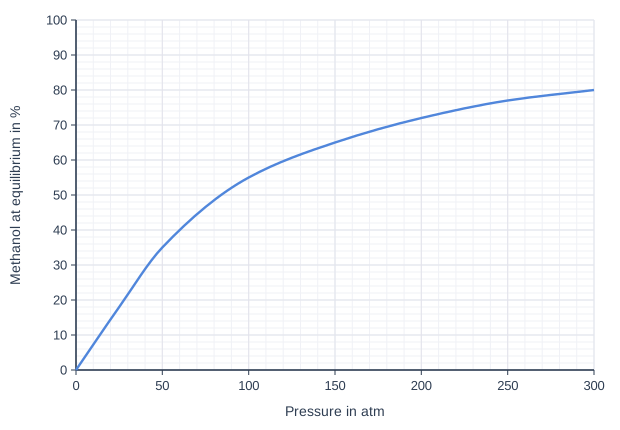
The graph shows how the percentage of methanol at equilibrium changes with pressure at 250 °C.

Use the graph to determine the percentage of methanol at 120 atm. Explain the shape of the graph.

Line graph of methanol at equilibrium in % (y-axis, 0 to 100) against pressure in atm (x-axis, 0 to 300). The line is a smooth curve through (0, 0), (25, 18), (50, 35), (100, 55), (150, 65), (200, 72), (250, 77), (300, 80).

Model answer

At 120 atm the percentage of methanol is about 60%. The percentage of methanol increases as the pressure increases. There are 3 molecules of gas on the left (CO + 2H₂) and only 1 on the right (CH₃OH), so increasing the pressure shifts the position of equilibrium towards the side with fewer molecules, forming more methanol.

Explanation

Read the value by going up from 120 atm to the curve and across to the y-axis. The curve rises because a higher pressure favours the side of the equation with fewer gas molecules.

Mark scheme
  1. 1 mark

    60 (%)

    allow 58-62

  2. 1 mark

    the percentage of methanol increases as the pressure increases

    allow the line rises (less steeply at higher pressures)

  3. 1 mark

    because there are 3 molecules on the left and 1 on the right, so increasing the pressure shifts the equilibrium to the right

    must refer to numbers of molecules

Question 4

4 marks

Methanol is made from carbon monoxide and hydrogen:

CO(g) + 2H₂(g) ⇌ CH₃OH(g)

A company makes methanol at a pressure of 50-100 atm. Higher pressures would give a higher equilibrium yield.

Explain why a high pressure increases the yield and the rate, and suggest why the company does not use a much higher pressure.

Model answer

There are 3 molecules of gas on the left and 1 on the right, so a high pressure shifts the position of equilibrium to the right, giving a higher yield of methanol. At high pressure the gas particles are closer together, so they collide more frequently and the rate of reaction increases. However, very high pressures need thick-walled, expensive pipes and vessels, are more dangerous because of the risk of leaks or explosions, and use a lot of energy to compress the gases. The extra methanol would not be worth these extra costs.

Explanation

Pressure helps both yield (fewer molecules on the product side) and rate (more frequent collisions), but the cost and safety of very high pressures limit how high it can go.

Mark scheme
  1. 1 mark

    there are fewer molecules on the right (1) than on the left (3), so a high pressure shifts the equilibrium to the right / increases the yield

  2. 1 mark

    at high pressure the gas particles are closer together so they collide more frequently, increasing the rate

  3. 1 mark

    very high pressures need stronger, more expensive equipment / are more dangerous

    allow risk of explosion / leaks

  4. 1 mark

    compressing gases to very high pressures uses a lot of energy, which is expensive

    allow the extra yield is not worth the extra cost

Ready to try the rest? Every answer you write is marked against the mark scheme, so you can see exactly where the marks are.

Revision notes

The effect of pressure changes on equilibrium (HT only)

The big idea

For a reaction between gases at equilibrium, changing the pressure can move the position of equilibrium. An increase in pressure shifts it towards the side with the smaller number of molecules; a decrease in pressure shifts it towards the side with the larger number of molecules. You find the numbers of molecules from the symbol equation.

Why pressure has this effect

Gas pressure is caused by gas molecules colliding with the walls of their container. The fewer molecules there are, the lower the pressure.

  • When the pressure is increased, the system counteracts the change by making fewer molecules, which lowers the pressure.
  • When the pressure is decreased, the system counteracts it by making more molecules, which raises the pressure.

You can increase the pressure of a gas mixture by pumping in more gas or by squeezing it into a smaller volume, for example by pushing in the plunger of a sealed gas syringe.

Counting molecules

  • Use the balancing numbers in the equation: 3H₂ is 3 molecules, and a substance with no number in front counts as 1.
  • Count molecules, not atoms. A balanced equation always has the same number of atoms on each side.
  • Count molecules, not the number of different substances.
  • Only gases count, because pressure only affects the position for reactions involving gases. A reaction in which everything is dissolved is not affected.
  • If both sides have the same number of gas molecules, changing the pressure has no effect on the position.

Predicting the effect of pressure

Predict the effect of increasing the pressure on the equilibrium yield of the products in each reaction.

ReactionGas molecules on the leftGas molecules on the rightEffect of higher pressure
C₂H₄(g) + HCl(g) ⇌ C₂H₅Cl(g)1 + 1 = 21Shifts right: the yield increases
C₃H₈(g) ⇌ C₃H₆(g) + H₂(g)11 + 1 = 2Shifts left: the yield decreases
CO(g) + H₂O(g) ⇌ CO₂(g) + H₂(g)1 + 1 = 21 + 1 = 2No effect on the yield

In each case the higher pressure shifts the position towards the side with fewer molecules, so the system counteracts the increase in pressure.

Pressure, rate and cost

A higher pressure also makes a gas reaction faster, because the molecules are closer together and collide more frequently. This is true whichever way the position of equilibrium shifts.

High pressures are expensive and risky, though:

  • the reactor and pipes must be strong and thick-walled, which costs more to build;
  • compressors use a lot of energy to squeeze the gases;
  • a leak or a burst at high pressure is dangerous.

So industry often uses a moderately high pressure as a compromise. If the yield is already high at a low pressure, the small extra yield from a high pressure is not worth the cost.

Remember

  • Higher pressure: shifts towards the side with fewer gas molecules.
  • Lower pressure: shifts towards the side with more gas molecules.
  • Equal numbers of gas molecules on each side: pressure has no effect on the position.
  • Pressure only affects equilibria that involve gases.

Common mistakes

  • Counting atoms instead of molecules. The numbers of atoms are always equal on both sides.
  • Counting the number of different substances. In 2CO(g) + 2NO(g) ⇌ 2CO₂(g) + N₂(g) there are two substances on each side, but 4 molecules on the left and only 3 on the right.
  • Thinking a higher pressure always increases the yield. It decreases the yield when the products have more gas molecules.
  • Forgetting that pressure has no effect when both sides have the same number of gas molecules.

Exam tip

Always show the count: write "4 molecules on the left and 2 on the right" before you say which way the position shifts. Many mark schemes give a mark for the numbers and another for the direction.

Study Helper Hints first, answers after you try

Stuck on this one? Ask for a hint and I’ll point you in the right direction, without giving the answer away. Once you’ve checked your answer, I’ll show you how the marks are awarded.