Practise 9 exam-style questions on Equilibrium for AQA GCSE Combined Science (Chemistry Paper 2). Write your answer as you would in the exam and get it marked in seconds against the mark scheme, point by point, with the Study Helper on hand if you get stuck.
9 questions
1–4 marks each
Instant marking
No sign-up needed
9 questions, marked as you go
Sample questions with model answers
Here are 4 of the questions in this topic, each with a model answer, an explanation of why it earns the marks and the mark scheme an examiner would use.
Question 1
2 marks
A reversible reaction is at equilibrium in a closed system.
Give two features of the reaction at equilibrium.
Model answer
At equilibrium the forward and reverse reactions happen at exactly the same rate, so the amounts of the reactants and products stay constant.
Explanation
Equilibrium is dynamic: both reactions keep going, but because their rates are equal there is no overall change in the amounts of any substance. The amounts are constant, not necessarily equal.
Mark scheme
1 mark
the forward and reverse reactions occur at exactly the same rate
max 2; allow the rates of the forward and reverse reactions are equal
1 mark
the amounts / concentrations of reactants and products stay constant
allow do not change; do not accept are equal
1 mark
both the forward and reverse reactions are still happening
allow the equilibrium is dynamic
Question 2
2 marks
A student says: "At equilibrium, the amounts of reactants and products are equal."
Explain why the student is wrong.
Model answer
At equilibrium it is the rates of the forward and reverse reactions that are equal. The amounts of reactants and products stay constant, but they are not usually equal: depending on the conditions, the mixture may contain mostly reactants or mostly products.
Explanation
Do not confuse equal rates with equal amounts. A reaction can reach equilibrium with 90% products or 10% products; what makes it equilibrium is that the amounts no longer change.
Mark scheme
1 mark
at equilibrium the amounts of reactants and products are constant / do not change
allow it is the rates of the forward and reverse reactions that are equal
1 mark
but they are not necessarily equal; there may be more reactants or more products
allow the amounts depend on the conditions
Question 3
3 marks
Some hydrogen and iodine gases were sealed in a flask. They react in a reversible reaction:
H₂(g) + I₂(g) ⇌ 2HI(g)
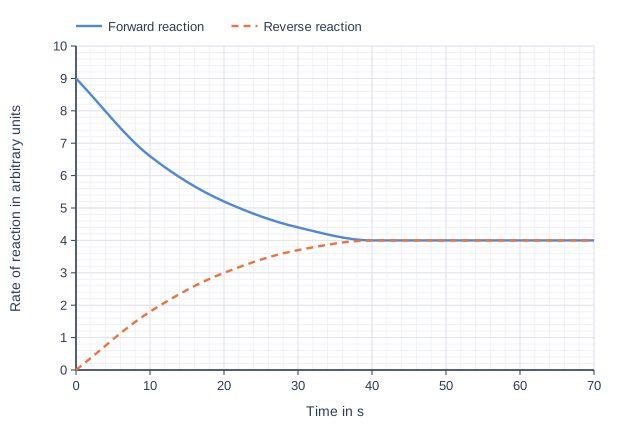
The graph shows how the rates of the forward and reverse reactions changed with time.
Explain the shape of the graph.
Model answer
At the start the flask contains only hydrogen and iodine, so the forward reaction is fastest and the reverse rate is zero because there is no hydrogen iodide. As hydrogen and iodine are used up, the forward rate decreases; as hydrogen iodide builds up, the reverse rate increases. At 40 s the two rates become equal, so the system has reached equilibrium and both rates then stay constant.
Explanation
The rate of each reaction depends on how much of its reactants is present. Equilibrium is reached when the forward and reverse rates are exactly the same, so the two lines meet and then stay level together.
Mark scheme
1 mark
at the start there is no HI, so the rate of the reverse reaction is zero
allow only reactants at the start, so the forward rate is highest
1 mark
as H₂ and I₂ are used up the forward rate decreases, and as HI builds up the reverse rate increases
both ideas needed
1 mark
at 40 s the rates become equal so equilibrium is reached (and the rates stay constant)
allow 35-45 s
Question 4
3 marks
Calcium carbonate decomposes when heated in a reversible reaction:
CaCO₃(s) ⇌ CaO(s) + CO₂(g)
When calcium carbonate is heated strongly in an open crucible, it can all be converted into calcium oxide. When it is heated in a sealed container, some calcium carbonate always remains.
Explain this difference.
Model answer
In an open crucible the carbon dioxide gas escapes, so it cannot react with the calcium oxide and the reverse reaction does not happen; the decomposition continues until all the calcium carbonate is used up. In a sealed container the carbon dioxide cannot escape, so it reacts with calcium oxide to re-form calcium carbonate. Equilibrium is reached, with the forward and reverse reactions happening at the same rate, so some calcium carbonate always remains.
Explanation
Equilibrium can only be reached in a closed system, because the products must stay in contact with each other to react in the reverse direction. Removing a product (here by letting a gas escape) allows a reversible reaction to go to completion.
Mark scheme
1 mark
in the open crucible the carbon dioxide escapes
1 mark
so the reverse reaction cannot happen / CO₂ cannot react with the CaO to re-form CaCO₃
1 mark
in the sealed container (closed system) the carbon dioxide reacts with calcium oxide and equilibrium is reached
allow the forward and reverse reactions reach the same rate
Ready to try the rest? Every answer you write is marked against the mark scheme, so you can see exactly where the marks are.
Ctrl + Enter to check
Study HelperHints first, answers after you try
Stuck on this one? Ask for a hint and I’ll point you in the right direction, without giving the answer away. Once you’ve checked your answer, I’ll show you how the marks are awarded.