The big idea
An increase in the average global temperature is a major cause of climate change. Climate change has several potential effects on people and on the natural world. You need to describe four of them briefly, and to discuss the scale, risk and environmental implications of global climate change.
Potential effects
| Effect | Why it happens, or what it means |
|---|
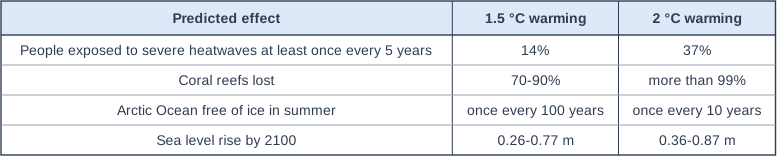
| Sea level rise | Ice on land (ice sheets and glaciers) melts and adds water to the oceans, and sea water expands as it warms. This may cause flooding and more coastal erosion |
| More frequent and more severe storms | Warmer oceans mean more evaporation, and there is more energy in the atmosphere |
| Changes in the amount, timing and distribution of rainfall | Some places may get more droughts, others more floods |
| Temperature and water stress for humans and wildlife | Heatwaves, and not enough fresh water to meet people's and wildlife's needs |
| Changes in the food producing capacity of some regions | Crops can fail in droughts, heat or floods; some cooler regions may gain a longer growing season |
| Changes to the distribution of wildlife species | Species move to places that suit them, such as towards the poles or higher up mountains; those that cannot move or adapt may die out in some areas |
The temperature rise itself is the cause, so "the Earth gets hotter" does not count as an effect. Sea ice that is already floating makes little difference to sea level when it melts.
Scale, risk and environmental implications
- Scale: the change is global, so it affects every country. Its effects could last for centuries and be hard to reverse.
- Risk: peer-reviewed evidence suggests the effects are likely, but their exact size and timing are uncertain, because climate models are simplified. The risk is greatest for low-lying land and small islands, for hot, dry regions, and for poorer countries that cannot easily afford to adapt, for example by building flood defences.
- Environmental implications: habitats could change or be lost, species could move or become extinct, and supplies of water and food could be affected. Effects differ from place to place, and a few regions may even benefit.
Using data on wildlife
Suppose records show that the northern edge of the area where a butterfly species lives moved 120 km further north over 30 years. Calculate the mean rate of movement, and suggest an explanation.
\(\text{mean rate} = \dfrac{120}{30} = 4\) km per year
As the average temperature rises, places further north become warm enough for the butterfly and the plants it feeds on, so the species spreads north: a change in the distribution of a wildlife species. Other changes, such as new farmland or gardens, could also play a part, so more evidence would be needed to be sure.
Common mistakes
- Giving "the temperature rises" or "global warming" as an effect. It is the cause.
- Bringing in the ozone layer. It is not part of this topic.
- Writing vague effects such as "the weather gets worse". Be specific: "more frequent and more severe storms".
- Saying that all melting ice raises sea level. Melting land ice and the expansion of warmer sea water raise it.
- Assuming the effects will be the same everywhere. Different regions face different risks.
Exam tip
"Describe briefly four potential effects" needs four different effects from the list, one short sentence each. In a 6-mark "discuss" question, cover all three of scale, risk and environmental implications, and mention that the predictions are uncertain.