Practise 11 exam-style questions on Pure substances for AQA GCSE Combined Science (Chemistry Paper 2). Write your answer as you would in the exam and get it marked in seconds against the mark scheme, point by point, with the Study Helper on hand if you get stuck.
11 questions
1–4 marks each
Instant marking
No sign-up needed
11 questions, marked as you go
Sample questions with model answers
Here are 4 of the questions in this topic, each with a model answer, an explanation of why it earns the marks and the mark scheme an examiner would use.
Question 1
2 marks
A carton of milk is labelled "pure milk".
Explain why a chemist would not describe the milk as pure.
Model answer
On the label, pure means that nothing has been added to the milk and it is in its natural state. To a chemist, a pure substance is a single element or compound, but milk is a mixture of many substances, such as water, fats, proteins and sugars, so it is not pure.
Explanation
The everyday meaning of pure (unadulterated, natural) is different from the chemical meaning (one substance only). Most natural products, such as milk, are mixtures.
Mark scheme
1 mark
in everyday language, pure means nothing has been added / it is in its natural state
allow unadulterated
1 mark
but milk is a mixture of many substances (e.g. water, fats, proteins, sugars), so it is not a single element or compound
Question 2
2 marks
Iron is a pure substance but steel is not.
Explain this difference.
Model answer
Iron is a single element, containing only iron atoms, so it is a pure substance. Steel is an alloy, a mixture of iron with small amounts of other elements such as carbon, so it is not pure.
Explanation
A pure substance contains only one element or compound. Alloys such as steel are deliberately made as mixtures because they have more useful properties than the pure metal.
Mark scheme
1 mark
iron is a single element / contains only iron atoms
1 mark
steel is a mixture (alloy) of iron with other elements, e.g. carbon
allow steel contains more than one substance
Question 3
3 marks
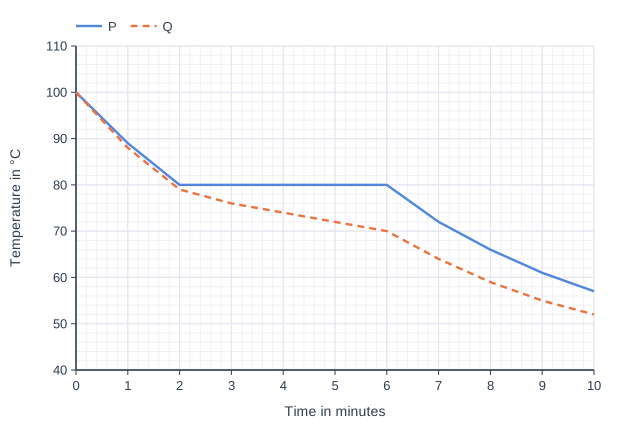
Two liquids, P and Q, were allowed to cool and the temperature was recorded every minute. The graph shows the results.
Which substance is pure? Give its melting point and a reason for your answer.
Model answer
Substance P is pure. Its melting (freezing) point is 80 °C. The graph for P has a flat section at 80 °C, which shows that it freezes at a specific temperature, whereas the temperature of Q keeps falling while it freezes, so Q is a mixture.
Explanation
A pure substance changes state at one specific temperature, so its cooling curve has a horizontal section. A mixture freezes over a range of temperatures, so its cooling curve slopes gradually instead.
Mark scheme
1 mark
P
1 mark
80 (°C)
allow 79-81
1 mark
the temperature of P stays constant while it freezes / P freezes at a single temperature (flat line)
allow Q freezes over a range of temperatures (sloping line)
Question 4
3 marks
In winter, salt is spread on roads to stop ice forming.
Use ideas about pure substances and mixtures to explain why this works.
Model answer
Salt dissolves in the water on the road to form salt solution, which is a mixture. Pure water freezes at a specific temperature, 0 °C, but adding salt as an impurity lowers the freezing point. So the salt solution stays liquid at temperatures a few degrees below 0 °C, and ice does not form unless it is colder than that.
Explanation
Impurities lower the melting point of a substance. This is the same idea that lets chemists use melting points to test purity, applied to keeping roads clear of ice.
Mark scheme
1 mark
the salt dissolves in water to form a mixture / salt solution
1 mark
pure water freezes (and ice melts) at 0 °C
1 mark
the mixture freezes at a lower temperature than pure water, so it does not freeze until it is colder than 0 °C
allow impurities lower the melting / freezing point
Ready to try the rest? Every answer you write is marked against the mark scheme, so you can see exactly where the marks are.
Ctrl + Enter to check
Study HelperHints first, answers after you try
Stuck on this one? Ask for a hint and I’ll point you in the right direction, without giving the answer away. Once you’ve checked your answer, I’ll show you how the marks are awarded.