The big idea
In a reversible reaction, one direction is exothermic and the other is endothermic, transferring the same amount of energy. So a change in temperature affects the two directions differently and moves the position of equilibrium. Raising the temperature favours the endothermic direction; lowering it favours the exothermic direction.
The rules
| Change in temperature | Forward reaction endothermic | Forward reaction exothermic |
|---|
| Increased | Relative amount of products increases | Relative amount of products decreases |
| Decreased | Relative amount of products decreases | Relative amount of products increases |
These follow from Le Chatelier's Principle: the system responds to counteract the change.
- If you heat the mixture, the system counteracts the rise in temperature by taking in energy, so the endothermic direction is favoured.
- If you cool it, the system counteracts the fall by releasing energy, so the exothermic direction is favoured.
Which direction is exothermic?
You may be told this directly, or you may have to work it out:
- Energy change values: a negative value means exothermic and a positive value means endothermic. Check which direction the value is for: the reverse reaction has the same value with the opposite sign.
- A reaction profile: if the products are lower in energy than the reactants, the forward reaction is exothermic.
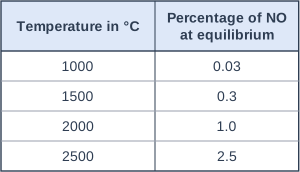
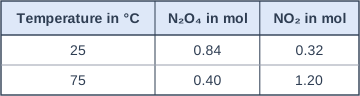
- Data: if the equilibrium yield of product goes up when the temperature rises, the forward reaction is endothermic; if the yield goes down, it is exothermic. Compare only results where the temperature is the one thing that changes.
A value given for the other direction
Propene, used to make poly(propene), can be made from propane:
C₃H₈(g) ⇌ C₃H₆(g) + H₂(g)
When propene reacts with hydrogen to form propane, 124 kJ/mol is released. Should the reactor be kept hot or cool to give a high yield of propene at equilibrium?
Step 1: the energy value is for the reverse reaction, which is exothermic. So the forward reaction is endothermic: it takes in 124 kJ/mol.
Step 2: a higher temperature favours the endothermic direction, so the position shifts right: keep the reactor hot for a high yield of propene.
Rate and yield are different
Temperature changes the rate of both the forward and the reverse reactions, which decides how quickly equilibrium is reached. The position of equilibrium changes for a different reason: one direction takes in energy and the other releases it.
When the forward reaction is exothermic, this causes a conflict:
- a low temperature gives a high equilibrium yield, but the reaction is slow, so equilibrium takes a long time to reach;
- a high temperature is fast, but the yield is low and the heating costs more.
Industry therefore uses a compromise temperature that gives a reasonable yield in a reasonable time. Any unreacted gases can often be recycled through the reactor.
Common mistakes
- Saying a higher temperature always gives more product "because reactions go faster". It speeds up both directions; whether the yield goes up depends on which direction is endothermic.
- Saying heating favours the exothermic direction. The system counteracts heating by taking in energy, so the endothermic direction is favoured.
- Using an energy value for the wrong direction. Check how the equation is written before you decide.
- Forgetting that a lower temperature, which raises the yield of an exothermic reaction, also slows the reaction down.
Exam tip
"Deduce whether the forward reaction is exothermic or endothermic" questions award the last mark only for the reasoning. Describe the trend with values from the data, say which way the position moved, then link it: "a rise in temperature favours the endothermic direction, so the forward reaction is endothermic".