Practise 9 exam-style questions on Energy changes and reversible reactions for AQA GCSE Combined Science (Chemistry Paper 2). Write your answer as you would in the exam and get it marked in seconds against the mark scheme, point by point, with the Study Helper on hand if you get stuck.
9 questions
1–4 marks each
Instant marking
No sign-up needed
9 questions, marked as you go
Sample questions with model answers
Here are 4 of the questions in this topic, each with a model answer, an explanation of why it earns the marks and the mark scheme an examiner would use.
Question 1
2 marks
A student heated some hydrated copper sulfate crystals in a test tube.
hydrated copper sulfate ⇌ anhydrous copper sulfate + water
Describe the colour change the student would see, and state whether this forward reaction is exothermic or endothermic.
Model answer
The crystals change from blue to white. The forward reaction is endothermic because energy must be taken in (by heating) to remove the water.
Explanation
Hydrated copper sulfate is blue and anhydrous copper sulfate is white. Heating supplies the energy needed for the endothermic forward reaction, which drives off the water.
Mark scheme
1 mark
blue to white
both colours needed in the correct order
1 mark
endothermic
allow it takes in energy / needs to be heated
Question 2
2 marks
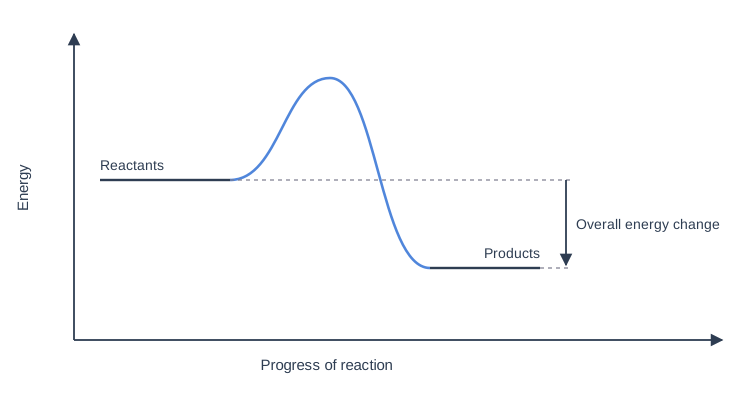
The diagram shows the reaction profile for the forward reaction of a reversible reaction.
Is the reverse reaction exothermic or endothermic? Give a reason for your answer.
Model answer
The reverse reaction is endothermic. The products are lower in energy than the reactants, so the forward reaction is exothermic; to go back from the products to the reactants, the same amount of energy must be taken in.
Explanation
On a reaction profile, the reverse reaction starts at the products' level and ends at the reactants' level. If that is uphill, energy is taken in from the surroundings, so the reaction is endothermic.
Mark scheme
1 mark
endothermic
1 mark
the products are at a lower energy than the reactants, so energy must be taken in to turn the products back into reactants
allow the forward reaction is exothermic, so the reverse reaction is endothermic
Question 3
3 marks
When 0.10 mol of anhydrous copper sulfate reacts with water to form hydrated copper sulfate, 7.8 kJ of energy is released.
hydrated copper sulfate ⇌ anhydrous copper sulfate + water
Calculate the energy needed to convert 0.25 mol of hydrated copper sulfate into anhydrous copper sulfate.
Model answer
Energy released per mole when water is added = 7.8 ÷ 0.10 = 78 kJ The same amount of energy must be taken in to reverse the reaction. Energy needed for 0.25 mol = 78 × 0.25 = 19.5 kJ
Explanation
The reverse reaction transfers the same amount of energy as the forward reaction, but in the opposite direction, so dehydrating hydrated copper sulfate takes in 78 kJ per mole. Scale this to the number of moles used.
Mark scheme
1 mark
energy for 1 mol = 7.8 ÷ 0.10 = 78 (kJ)
an answer of 19.5 (kJ) scores 3 marks; allow scaling 7.8 × (0.25 ÷ 0.10)
1 mark
energy for 0.25 mol = 78 × 0.25
allow ecf
1 mark
19.5 (kJ)
allow 20 (kJ); ignore a positive sign
Question 4
3 marks
Engineers are developing ways to store energy from the Sun using this reversible reaction:
Suggest how this reaction could be used to store energy from the Sun and release it later.
Model answer
During the day, energy from the Sun heats calcium hydroxide and drives the endothermic forward reaction, so the energy is stored in the products, calcium oxide and water. These are stored separately. When energy is needed, for example at night, water is added to the calcium oxide. The reverse reaction is exothermic and releases the same amount of energy that was taken in.
Explanation
Because the same amount of energy is transferred in each direction of a reversible reaction, the energy taken in by the endothermic forward reaction can be recovered later from the exothermic reverse reaction. Keeping the products apart stops the reverse reaction until it is wanted.
Mark scheme
1 mark
energy from the Sun is used to heat calcium hydroxide so that the (endothermic) forward reaction happens
allow sunlight provides the energy to make calcium oxide and water
1 mark
the calcium oxide (and water) are kept separate until the energy is needed
allow the products are stored
1 mark
when water is added to the calcium oxide, the reverse reaction is exothermic and releases the same amount of energy
allow energy is released at night / when needed
Ready to try the rest? Every answer you write is marked against the mark scheme, so you can see exactly where the marks are.
Ctrl + Enter to check
Study HelperHints first, answers after you try
Stuck on this one? Ask for a hint and I’ll point you in the right direction, without giving the answer away. Once you’ve checked your answer, I’ll show you how the marks are awarded.