Level:
Correct: 0
Incorrect: 0
Marks: 0/0
Exam Practice
Course:
Topics:
AQA GCSE Combined Science (Chemistry Paper 2) Smart practice A mixed round aimed at your weak spots
Unit 6
The rate and extent of chemical change
Unit 7
Organic chemistry
Unit 8
Chemical analysis
Unit 9
Chemistry of the atmosphere
Unit 10
Using resources
Avg
score:
–
Topics
done:
0/38

How carbon dioxide decreased

Practise 11 exam-style questions on How carbon dioxide decreased for AQA GCSE Combined Science (Chemistry Paper 2). Write your answer as you would in the exam and get it marked in seconds against the mark scheme, point by point, with the Study Helper on hand if you get stuck.

  • 11 questions
  • 1–6 marks each
  • Instant marking
  • No sign-up needed
11 questions, marked as you go

Sample questions with model answers

Here are 4 of the questions in this topic, each with a model answer, an explanation of why it earns the marks and the mark scheme an examiner would use.

Question 1

2 marks

Give two ways, other than dissolving in the oceans, in which the amount of carbon dioxide in the Earth's atmosphere decreased.

Model answer

1. Algae and plants absorbed carbon dioxide for photosynthesis.
2. Carbon was locked up in sedimentary rocks such as limestone and in fossil fuels such as coal, crude oil and natural gas.

Explanation

Photosynthesis removed carbon dioxide from the air and turned the carbon into compounds in living things. When these organisms died, some of that carbon ended up buried in sedimentary rocks and fossil fuels, where it stayed for millions of years.

Mark scheme
  1. 1 mark

    photosynthesis by algae and plants

  2. 1 mark

    formation of sedimentary rocks (such as limestone) / formation of fossil fuels (that contain carbon)

    allow formation of coal, crude oil or natural gas

Question 2

2 marks

Fossil fuels such as coal contain carbon that was removed from the atmosphere millions of years ago.

Explain why burning fossil fuels increases the amount of carbon dioxide in the atmosphere.

Model answer

When a fossil fuel burns, the carbon in it reacts with oxygen to form carbon dioxide. This returns carbon to the atmosphere that had been locked away underground for millions of years, and it does so much faster than it was removed.

Explanation

Fossil fuels formed slowly over millions of years, taking carbon out of the atmosphere. Burning them reverses this in a very short time, which is why the concentration of carbon dioxide in the atmosphere is rising.

Mark scheme
  1. 1 mark

    the carbon in the fuel reacts with oxygen to form carbon dioxide when it burns

    allow combustion produces carbon dioxide

  2. 1 mark

    this releases carbon that had been locked away for millions of years / far faster than it was removed

    allow it puts back carbon that was stored underground

Question 3

3 marks

Describe how deposits of crude oil and natural gas were formed.

Model answer

Crude oil and natural gas formed from the remains of plankton (tiny sea organisms). When they died, their remains were buried in mud on the sea bed. Over millions of years, the high pressure and temperature from the layers above changed them into crude oil and natural gas.

Explanation

The carbon in crude oil and natural gas came from carbon dioxide taken in by plankton when they were alive. Because they form so slowly, crude oil and natural gas are finite resources that cannot be replaced once used.

Mark scheme
  1. 1 mark

    from the remains of plankton / tiny sea organisms

    allow remains of ancient biomass / marine organisms; do not accept dinosaurs

  2. 1 mark

    buried in mud (on the sea bed)

    allow buried in sediment

  3. 1 mark

    compressed (high pressure) and heated over millions of years

    allow heat and pressure over a long time

Question 4

4 marks

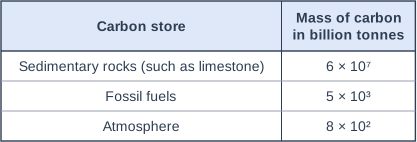
The table shows estimates of the mass of carbon stored in different places on Earth today.

Calculate how many times more carbon is stored in sedimentary rocks than in the atmosphere. Give your answer in standard form.

Explain what this suggests about the carbon dioxide in the Earth's early atmosphere.

Table with columns "Carbon store", "Mass of carbon in billion tonnes". Carbon store: Sedimentary rocks (such as limestone); Mass of carbon in billion tonnes: 6 × 10⁷ | Carbon store: Fossil fuels; Mass of carbon in billion tonnes: 5 × 10³ | Carbon store: Atmosphere; Mass of carbon in billion tonnes: 8 × 10².

Model answer

6 × 10⁷ ÷ 8 × 10² = 0.75 × 10⁵ = 7.5 × 10⁴ times more carbon in sedimentary rocks.
This suggests that the early atmosphere contained far more carbon dioxide than today, and that most of this carbon was removed from the atmosphere and locked up in sedimentary rocks such as limestone, with some in fossil fuels.

Explanation

When dividing in standard form, divide the numbers (6 ÷ 8 = 0.75) and subtract the powers (7 − 2 = 5), then adjust 0.75 × 10⁵ to 7.5 × 10⁴. The huge store of carbon in rocks supports the idea that the atmosphere was once mainly carbon dioxide.

Mark scheme
  1. 1 mark

    6 × 10⁷ ÷ 8 × 10²

    an answer of 7.5 × 10⁴ scores the first 2 marks; an answer of 75 000 (not in standard form) scores 1 mark

  2. 1 mark

    7.5 × 10⁴

    must be in standard form

  3. 1 mark

    most of the carbon from the carbon dioxide in the early atmosphere is now locked up in sedimentary rocks

    allow the early atmosphere had much more carbon dioxide than today

  4. 1 mark

    carbon dioxide was removed by forming sedimentary rocks such as limestone (and fossil fuels), which store far more carbon than the atmosphere holds now

    allow fossil fuels also store carbon that was in the early atmosphere

Ready to try the rest? Every answer you write is marked against the mark scheme, so you can see exactly where the marks are.

Revision notes

How carbon dioxide decreased

The big idea

The Earth's early atmosphere was probably mainly carbon dioxide, but today carbon dioxide is only a small proportion of the air. Algae and plants removed some of it by photosynthesis, and much of the carbon is now locked away in sedimentary rocks such as limestone and in fossil fuels: coal, crude oil and natural gas.

Four ways carbon dioxide was removed

ProcessWhat happened
Dissolving in the oceansCarbon dioxide dissolved in sea water and carbonates were precipitated, forming sediments on the sea bed
PhotosynthesisAlgae and plants took in carbon dioxide to make glucose, releasing oxygen
Forming sedimentary rocksCarbonate sediments and the shells and skeletons of sea creatures were compressed into rocks such as limestone
Forming fossil fuelsThe remains of plants and plankton, which contained carbon, were buried and became coal, crude oil and natural gas

Respiration by animals does not remove carbon dioxide: it releases it.

How limestone formed

  1. Carbon dioxide from the atmosphere dissolved in the oceans.
  2. Marine organisms used the dissolved carbon to build shells and skeletons of calcium carbonate, CaCO₃.
  3. When they died, their remains settled on the sea floor.
  4. More layers of sediment covered them and compressed them over millions of years, forming limestone.

Limestone is a store of carbon that was once in the air. The huge amount of limestone in the Earth's crust is evidence that a great deal of carbon dioxide has been removed.

How fossil fuels formed

CoalCrude oil and natural gas
Formed fromthe remains of land plants and treesthe remains of plankton (tiny organisms in the sea)
Buried inmud and sediment in swampsmud on the sea floor

The key idea is burial before decay. The organisms' bodies contained carbon that came from carbon dioxide in the air. Decay in air would have released that carbon as carbon dioxide again, but burial with little or no oxygen stopped the remains decaying. Then heat and pressure over millions of years turned them into fossil fuels. Burning fossil fuels today returns this ancient carbon to the atmosphere as carbon dioxide, very quickly.

The main changes over time

Line graph of percentage of the atmosphere in % (y-axis, 0 to 100) against Time since the Earth formed in billion years (x-axis, 0 to 5). "Carbon dioxide" is a smooth curve through (0, 90), (0.5, 68), (1, 45), (1.5, 30), (2, 19), (2.5, 11), (3, 6), (3.5, 3), (4, 1), (4.6, 0). "Oxygen" (dashed) is a smooth curve through (0, 0), (1, 0), (1.9, 0), (2.4, 0.6), (2.9, 1.5), (3.4, 3), (3.8, 6), (4.2, 12), (4.6, 20).
A sketch of one model (the real values are uncertain): carbon dioxide falls from most of the atmosphere to a tiny proportion while oxygen rises to about 20%.
  • Carbon dioxide: from most of the atmosphere to a small proportion (about 0.04%), because of the four processes above.
  • Oxygen: from little or none to about 20%, produced by photosynthesis.
  • Nitrogen: from a small proportion to about 80%. Volcanoes released it, and because it is unreactive it built up.
  • Water vapour: most of it condensed to form the oceans.

Carbon stored in limestone

A 250 g piece of limestone is 90% calcium carbonate, CaCO₃, by mass. Calculate the mass of carbon stored in it. (Ar: C = 12, O = 16, Ca = 40)

mass of CaCO₃ = \(250 \times \dfrac{90}{100} = 225\) g

Mr of CaCO₃ = \(40 + 12 + (3 \times 16) = 100\), and 12 of every 100 g is carbon.

mass of carbon = \(225 \times \dfrac{12}{100} = 27\) g

This carbon came from carbon dioxide that dissolved in the oceans long ago.

Common mistakes

  • Saying animals removed carbon dioxide by breathing. Respiration releases carbon dioxide.
  • Saying coal formed from sea creatures, or crude oil from trees. Coal: land plants. Crude oil and natural gas: plankton.
  • Leaving out why the remains did not decay: they were buried where there was little or no oxygen.
  • Calling limestone calcium oxide. It is mainly calcium carbonate.
  • Writing "it got used up" as a reason. Name the process: photosynthesis, dissolving in the oceans, forming sedimentary rocks or forming fossil fuels.

Exam tip

In 6-mark questions, put each change and its cause in the same sentence, joined by "because", rather than listing the changes first and the causes later. Name the process precisely: "dissolved in the oceans and formed carbonate sediments" scores; "went into the sea" does not.

Study Helper Hints first, answers after you try

Stuck on this one? Ask for a hint and I’ll point you in the right direction, without giving the answer away. Once you’ve checked your answer, I’ll show you how the marks are awarded.