The big idea
Chlorine is a toxic, pale green gas. The test uses litmus paper: when damp litmus paper is put into chlorine, it is bleached and turns white. Because chlorine is toxic, the test is done in a fume cupboard.
The test
- Wet a piece of litmus paper with water (blue litmus or universal indicator paper both work).
- Hold the damp paper in the gas, or at the mouth of the tube.
- If the paper is bleached and turns white, the gas is chlorine.
Why the paper must be damp: chlorine has to dissolve in (react with) the water on the paper. The solution formed is acidic and contains a bleach. Dry chlorine cannot do this, so dry litmus paper does not change colour.
Why blue litmus may go red first: the solution is acidic, so blue litmus can turn red for a moment before the bleach removes the colour. The key result is the bleaching.
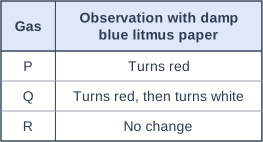
Comparing results with damp blue litmus paper
| Gas | What happens |
|---|
| Chlorine | May turn red, then is bleached white |
| Other acidic gases, e.g. hydrogen chloride, sulfur dioxide | Turns red, but is not bleached |
| Hydrogen, oxygen | No change |
So "turns red" only shows the gas is acidic; only bleaching identifies chlorine. Looking at the colour of the gas is not a good test either: a small amount of chlorine is so pale that it is very hard to see.
Where chlorine comes from
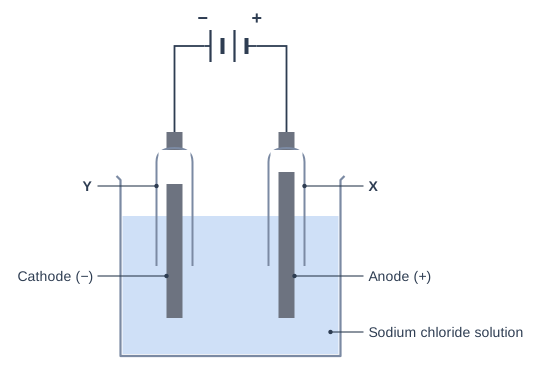
Chlorine forms at the positive electrode when a solution containing chloride ions is electrolysed, such as sodium chloride or copper(II) chloride solution.
Common mistakes
- Leaving out "damp". Dry litmus paper is not bleached, so the word damp (or moist) is needed for the mark.
- Giving "turns red" as the result. Many acidic gases do that; chlorine bleaches the paper white.
- Naming the gas "chloride". Chloride is the ion (Cl⁻); the gas is chlorine (Cl₂).
- Giving gloves or a lab coat as the safety precaution. The danger is breathing chlorine in, so use a fume cupboard.
Exam tip
The two marks are usually "damp litmus paper" and "bleached / turns white". In questions where you test several gases, keep each test matched to its result: burning splint and pop for hydrogen, glowing splint and relights for oxygen, damp litmus and bleached for chlorine.