Level:
Correct: 0
Incorrect: 0
Marks: 0/0
Exam Practice
Course:
Topics:
AQA GCSE Combined Science (Chemistry Paper 2) Smart practice A mixed round aimed at your weak spots
Unit 6
The rate and extent of chemical change
Unit 7
Organic chemistry
Unit 8
Chemical analysis
Unit 9
Chemistry of the atmosphere
Unit 10
Using resources
Avg
score:
–
Topics
done:
0/38

Calculating rates of reactions

Practise 16 exam-style questions on Calculating rates of reactions for AQA GCSE Combined Science (Chemistry Paper 2). Write your answer as you would in the exam and get it marked in seconds against the mark scheme, point by point, with the Study Helper on hand if you get stuck.

  • 16 questions
  • 1–6 marks each
  • Instant marking
  • No sign-up needed
16 questions, marked as you go

Sample questions with model answers

Here are 4 of the questions in this topic, each with a model answer, an explanation of why it earns the marks and the mark scheme an examiner would use.

Question 1

2 marks

A student reacts marble chips (calcium carbonate) with dilute hydrochloric acid in a conical flask.

CaCO₃(s) + 2HCl(aq) → CaCl₂(aq) + H₂O(l) + CO₂(g)

Describe two different measurements the student could make to find the rate of this reaction.

Model answer

1. Collect the carbon dioxide in a gas syringe and record the volume of gas every 10 seconds.
2. Stand the flask on a balance and record the mass every 10 seconds; the mass decreases as carbon dioxide escapes.

Explanation

Rate can be found from the quantity of a product formed or a reactant used over time. Carbon dioxide is a gas, so it can be measured as a volume, or as the mass lost from the flask when the gas escapes. Every measurement must be linked to time, otherwise it cannot give a rate.

Mark scheme
  1. 1 mark

    measure the volume of carbon dioxide / gas produced at regular time intervals

    max 2; allow collect the gas in a gas syringe / in an upturned measuring cylinder over water and record the volume every 10 s; each point must refer to time

  2. 1 mark

    measure the loss in mass (of the flask and contents) at regular time intervals

    allow put the flask on a balance and record the mass every 10 s (as carbon dioxide escapes)

  3. 1 mark

    measure the time taken for a known mass of marble chips to be used up

    allow measure the mass of marble chips remaining at regular time intervals

Question 2

3 marks

In a reaction between calcium carbonate and hydrochloric acid, 84 cm³ of carbon dioxide was collected in 2 minutes.

Calculate the mean rate of reaction in cm³/s.

Model answer

Time = 2 × 60 = 120 s
Mean rate of reaction = quantity of product formed ÷ time taken
Mean rate = 84 ÷ 120 = 0.70 cm³/s

Explanation

Because the rate is wanted in cm³/s, the time must be in seconds before dividing. Dividing 84 cm³ by 2 gives 42, which is a rate in cm³ per minute, not cm³ per second - a common mistake.

Mark scheme
  1. 1 mark

    2 minutes = 120 s

    an answer of 0.70 (cm³/s) scores 3 marks; an answer of 42 scores 1 mark

  2. 1 mark

    mean rate = 84 ÷ 120

    allow ecf from an incorrect conversion of the time

  3. 1 mark

    0.70 (cm³/s)

    allow 0.7 (cm³/s)

Question 3

3 marks

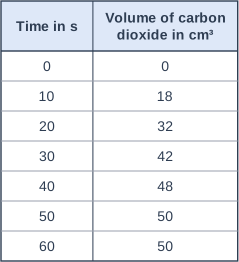
A student measured the volume of carbon dioxide produced when marble chips reacted with acid. The table shows the results.

Calculate the mean rate of reaction between 10 s and 30 s.

Table with columns "Time in s", "Volume of carbon dioxide in cm³". Time in s: 0; Volume of carbon dioxide in cm³: 0 | Time in s: 10; Volume of carbon dioxide in cm³: 18 | Time in s: 20; Volume of carbon dioxide in cm³: 32 | Time in s: 30; Volume of carbon dioxide in cm³: 42 | Time in s: 40; Volume of carbon dioxide in cm³: 48 | Time in s: 50; Volume of carbon dioxide in cm³: 50 | Time in s: 60; Volume of carbon dioxide in cm³: 50.

Model answer

Volume produced between 10 s and 30 s = 42 − 18 = 24 cm³
Time taken = 30 − 10 = 20 s
Mean rate = 24 ÷ 20 = 1.2 cm³/s

Explanation

For a mean rate between two times, use the change in volume over that period divided by the time between the two readings. Using the total volume at 30 s (42 cm³) would give the mean rate from the start, not between 10 s and 30 s.

Mark scheme
  1. 1 mark

    volume produced between 10 s and 30 s = 42 − 18 = 24 (cm³)

    an answer of 1.2 (cm³/s) scores 3 marks

  2. 1 mark

    mean rate = 24 ÷ 20

    allow ecf from an incorrect volume; time taken must be 20 s

  3. 1 mark

    1.2 (cm³/s)

    allow ecf; an answer of 1.4 (= 42 ÷ 30) scores 1 mark

Question 4

4 marks

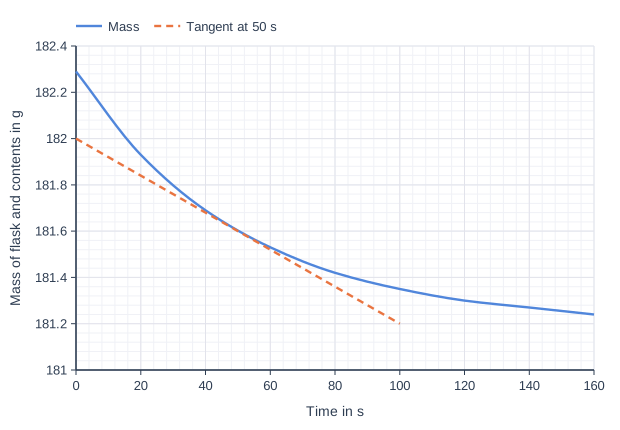
Marble chips react with acid in an open flask on a balance. The graph shows how the mass of the flask and contents changes with time. A tangent has been drawn to the curve at 50 s.

Use the tangent to calculate the rate of reaction at 50 s, in g/s.
Give your answer in standard form.

Line graph of mass of flask and contents in g (y-axis, 181 to 182.4) against time in s (x-axis, 0 to 160). "Mass" is a smooth curve through (0, 182.29), (20, 181.93), (40, 181.69), (60, 181.53), (80, 181.42), (100, 181.35), (120, 181.3), (140, 181.27), (160, 181.24). "Tangent at 50 s" (dashed) joins the points (0, 182), (100, 181.2).

Model answer

Two points on the tangent: (0 s, 182.00 g) and (100 s, 181.20 g)
Change in mass = 182.00 − 181.20 = 0.80 g
Gradient = 0.80 ÷ 100 = 0.0080
Rate at 50 s = 8.0 × 10⁻³ g/s

Explanation

The mass of the flask goes down as carbon dioxide escapes, so the tangent slopes downwards; the size of its gradient is the rate of reaction at 50 s. A rate is given as a positive value, so the minus sign from a falling graph is ignored.

Mark scheme
  1. 1 mark

    two points read correctly from the tangent, e.g. (0 s, 182.00 g) and (100 s, 181.20 g)

    an answer of 8.0 × 10⁻³ (g/s) scores 4 marks; allow any two points on the tangent

  2. 1 mark

    gradient = change in mass ÷ change in time, e.g. 0.80 ÷ 100

    allow ecf from incorrect readings; ignore a negative sign

  3. 1 mark

    = 0.0080

    allow values in the range 0.0070-0.0090 from correct readings

  4. 1 mark

    8.0 × 10⁻³ (g/s)

    allow 8 × 10⁻³; allow ecf for correct conversion of their answer into standard form

Ready to try the rest? Every answer you write is marked against the mark scheme, so you can see exactly where the marks are.

Revision notes

Calculating rates of reactions

The big idea

The rate of a reaction tells you how quickly reactants are turned into products. You find it by measuring how much of a reactant is used up, or how much of a product is formed, in a measured time. In the exam you calculate mean rates, draw and read graphs of quantity against time, and use tangents to judge how fast a reaction is at one moment.

Mean rate of reaction

\[\text{mean rate of reaction} = \dfrac{\text{quantity of reactant used}}{\text{time taken}}\]
\[\text{mean rate of reaction} = \dfrac{\text{quantity of product formed}}{\text{time taken}}\]

The quantity is usually a mass in grams or a volume in cm³, and the time is in seconds, so rates are given in g/s or cm³/s: the unit of the quantity divided by the unit of time. It is a mean rate because it is an average over the whole time.

  • Volume of gas: collect the gas in a gas syringe and read the volume at regular times.
  • Loss in mass: when a gas escapes from an open flask on a balance, the mass lost is the mass of gas produced. This suits a heavy gas such as carbon dioxide; hydrogen is so light that the change in mass is too small to measure accurately.
Diagram of a flask on a balance to measure mass loss. Labelled parts: Cotton wool, Conical flask, Acid and marble chips, Balance.
The cotton wool lets the gas escape but stops acid spray leaving the flask, so all the mass lost is gas.

Which reaction was faster?

Two groups react marble chips with acid. Group A collects 36 cm³ of carbon dioxide in 45 s. Group B collects 50 cm³ in 80 s. Which group's reaction had the greater mean rate?

Group A: \(\dfrac{36}{45} = 0.80\) cm³/s

Group B: \(\dfrac{50}{80} = 0.625\) cm³/s

Group A's reaction was faster, even though Group B collected more gas, because B took much longer to collect it. Compare rates, not totals.

Graphs of quantity against time

On a graph of product formed (or reactant used up) against time:

  • the line is steepest at the start, when the reaction is fastest;
  • it gets less steep as the reactants are used up and the rate falls;
  • it becomes horizontal when one reactant, the limiting reactant, has been used up and the reaction has stopped. The height where it levels off depends only on the amount of limiting reactant.

It is the slope of the line that shows the rate, not its height. To find the rate at one moment, draw a tangent: a long straight line, drawn with a ruler, that just touches the curve at that time with the same slope as the curve there. The steeper the tangent, the faster the reaction at that moment.

Line graph of volume of hydrogen in cm³ (y-axis, 0 to 100) against time in s (x-axis, 0 to 120). "Lithium and water" is a smooth curve through (0, 0), (10, 21), (20, 38), (40, 62), (60, 74), (80, 81), (100, 84), (120, 85). "Tangent at 40 s" (dashed) joins the points (0, 30), (75, 90).
Hydrogen given off by lithium in water. The tangent at 40 s is less steep than the curve at the start, so the reaction has slowed down.

Higher tier only

The gradient of a tangent. The rate at a given time is the gradient of the tangent: change in \(y\) ÷ change in \(x\). Read two points on the tangent itself, far apart, not on the curve.

Worked example: use the graph to find the rate at 40 s, and explain why it is less than the mean rate over the first 40 s.

The tangent passes through (0 s, 30 cm³) and (75 s, 90 cm³).

\(\text{rate at 40 s} = \dfrac{90 - 30}{75 - 0} = \dfrac{60}{75} = 0.8\) cm³/s

After 40 s the curve shows 62 cm³, so the mean rate is \(\dfrac{62}{40} = 1.55\) cm³/s. The mean includes the fast start of the reaction, so it is bigger than the rate at 40 s.

Higher tier only

Rates in mol/s. Higher tier students also give rates in mol/s. Convert a mass into moles (mass ÷ Ar, or ÷ Mr for a compound), then divide by the time in seconds.

Worked example: 0.48 g of magnesium (Ar = 24) and 1.30 g of zinc (Ar = 65) each react completely with excess acid in 40 s. Compare the rates in g/s and in mol/s.

Magnesium: \(\dfrac{0.48}{40} = 0.012\) g/s, and \(\dfrac{0.48}{24} = 0.020\) mol, so \(\dfrac{0.020}{40} = 0.0005\) mol/s

Zinc: \(\dfrac{1.30}{40} = 0.0325\) g/s, and \(\dfrac{1.30}{65} = 0.020\) mol, so \(\dfrac{0.020}{40} = 0.0005\) mol/s

In g/s the zinc looks almost three times faster, but the same number of moles of metal reacts each second. When mol/s is asked for, a rate in g/s scores no marks.

Common mistakes

  • Using the total volume for a mean rate between two times. For 15 s to 45 s, use the volume made during that interval (reading at 45 s minus reading at 15 s) divided by 30 s.
  • Leaving the time in minutes when the rate is wanted in cm³/s: 2.5 minutes is 150 s.
  • Saying a reaction is fastest at the end because the most gas has been collected. The rate is the steepness of the line, which is zero at the end.
  • Giving the unit as cm³ instead of cm³/s, or leaving it out.

Exam tip

Calculation questions often give a separate mark for the unit, so always finish with one. When a question says "use the graph", write down the values you read, such as "62 cm³ at 40 s", so you can still earn method marks if the final answer is wrong.

Study Helper Hints first, answers after you try

Stuck on this one? Ask for a hint and I’ll point you in the right direction, without giving the answer away. Once you’ve checked your answer, I’ll show you how the marks are awarded.