The big idea
Some human activities increase the amounts of the greenhouse gases carbon dioxide and methane in the atmosphere. Based on peer-reviewed evidence, many scientists believe that this will make the temperature of the Earth's atmosphere increase at the surface, and that this will result in global climate change. The climate is hard to model, so you also need to judge the quality of evidence and spot uncertainty and bias.
Activities that add carbon dioxide and methane
| Gas | Human activity | Why it adds the gas |
|---|
| Carbon dioxide | Burning fossil fuels (coal, oil, natural gas) in power stations, vehicles and heating | Combustion turns carbon that was locked away for millions of years back into carbon dioxide |
| Carbon dioxide | Deforestation: clearing large areas of forest | Fewer trees means less photosynthesis, so less carbon dioxide is removed; burning or rotting the trees releases carbon dioxide |
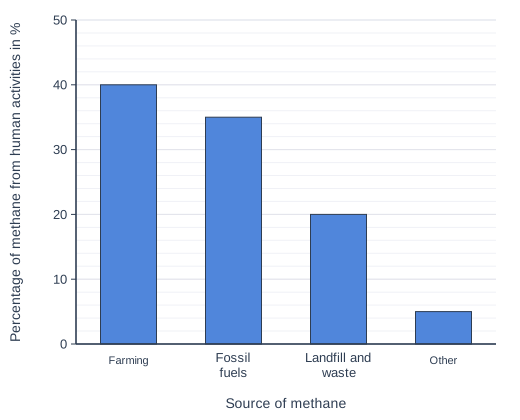
| Methane | Cattle (livestock) farming | Cattle release methane as they digest their food |
| Methane | Rice growing in flooded paddy fields | Microorganisms break down plant material in the waterlogged soil, where there is little oxygen, producing methane |
| Methane | Landfill sites | Microorganisms break down buried waste without oxygen, producing methane |
| Methane | Extracting natural gas and coal | Methane leaks from wells, pipelines and mines |
Making cement from limestone also releases carbon dioxide. Burning fossil fuels is not a source of methane: their complete combustion produces carbon dioxide. Emissions have grown with the world's population, because more people need more energy, food and land.
Why many scientists expect climate change
- Carbon dioxide and methane absorb the long wavelength radiation emitted by the Earth's surface and re-emit it, so more of these gases means less energy escapes into space.
- Records show that the carbon dioxide concentration and the mean global temperature have both risen. A correlation alone does not prove that one causes the other. Scientists' confidence comes from having a mechanism (the greenhouse effect) and from many independent, peer-reviewed studies that agree.
Models, uncertainty and the media
The climate is a very complex system: the oceans, clouds, ice, living things and the Sun all interact. This makes it difficult to model, so scientists use simplified models. Different models, and different guesses about future emissions, give a range of predictions. This leaves room for speculation and opinions in the media, which may be based on only parts of the evidence and may be biased.
There are also uncertainties in the evidence. Older temperature records came from fewer places and less precise instruments, with few readings over the oceans or near the poles. Evidence from the distant past, such as air trapped in ice cores, is indirect and its age is estimated. Natural changes from year to year can hide a long-term trend. Uncertainty means there is a range of possible values, not that the evidence is wrong.
Judging the quality of evidence
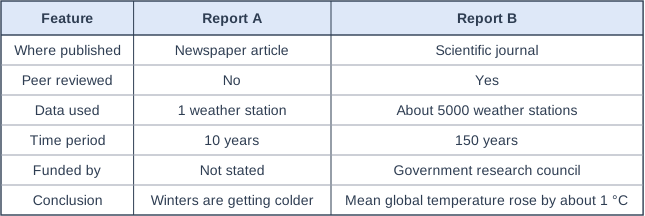
| Ask | Higher quality | Lower quality |
|---|
| Has it been peer reviewed? | yes | no |
| How much data is there? | many measurements | a few readings |
| Is it representative? | many places, on land and at sea | one place |
| How long a period? | decades or more (climate) | one season or year (weather) |
| Who produced it? | no interest in the result | a vested interest, which may cause bias |
Peer review means that other scientists who are experts in the same field check the work before it is published. They check that the methods and conclusions are valid, which helps to stop mistakes, bias and false claims being published.
Results must also be communicated to a wide range of audiences, not only to scientists. Governments, businesses and the public need to understand the evidence to make informed decisions, and clear reporting helps people challenge misleading claims.
Correlation is not the whole story
A student finds that, over the same 40 years, both the number of cattle farmed in the world and the concentration of methane in the atmosphere increased. The student concludes that cattle caused all of the extra methane. Evaluate this conclusion.
- For: the data show a positive correlation, and there is a mechanism: cattle release methane as they digest food.
- Against: a correlation does not prove cause. Other sources of methane, such as rice paddy fields, landfill sites and leaks from natural gas extraction, may also have grown over the same years.
- Better evidence: measurements of how much methane each source releases.
- Judgement: cattle farming probably contributes to the rise, but these data do not show that it caused all of it.
Common mistakes
- Giving "burning fossil fuels" as a source of methane. Methane comes from cattle, rice paddy fields, landfill and gas leaks.
- Giving only one effect of deforestation. Give both: less photosynthesis, and carbon dioxide released when the trees burn or rot.
- Writing "pollution" or "factories" without saying that fuels are burned.
- Using one cold winter, or one hot summer in one town, as evidence about the global climate. That is weather; climate change is a long-term, global trend.
- Thinking that a correlation proves that one thing causes another.
Exam tip
When asked for two activities for a gas, give two clearly different ones and link each to the right gas. To evaluate a report, compare it on peer review, the amount and spread of the data, the time period and possible bias, then make a clear judgement.