Level:
Correct: 0
Incorrect: 0
Marks: 0/0
Exam Practice
Course:
Topics:
AQA GCSE Combined Science (Chemistry Paper 2) Smart practice A mixed round aimed at your weak spots
Unit 6
The rate and extent of chemical change
Unit 7
Organic chemistry
Unit 8
Chemical analysis
Unit 9
Chemistry of the atmosphere
Unit 10
Using resources
Avg
score:
–
Topics
done:
0/38

Potable water

Practise 18 exam-style questions on Potable water for AQA GCSE Combined Science (Chemistry Paper 2). Write your answer as you would in the exam and get it marked in seconds against the mark scheme, point by point, with the Study Helper on hand if you get stuck.

  • 18 questions
  • 1–6 marks each
  • Instant marking
  • No sign-up needed
18 questions, marked as you go

Sample questions with model answers

Here are 4 of the questions in this topic, each with a model answer, an explanation of why it earns the marks and the mark scheme an examiner would use.

Question 1

2 marks

For water to be safe to drink, it must have sufficiently low levels of two types of substance.

Name these two types of substance.

Model answer

Dissolved salts and microbes.

Explanation

High levels of dissolved salts make water harmful to drink (sea water makes you more dehydrated), and microbes in water can cause diseases. Treatment of water reduces both to safe levels.

Mark scheme
  1. 1 mark

    dissolved salts

    allow dissolved solids / minerals / dissolved substances

  2. 1 mark

    microbes

    allow microorganisms / bacteria / pathogens

Question 2

2 marks

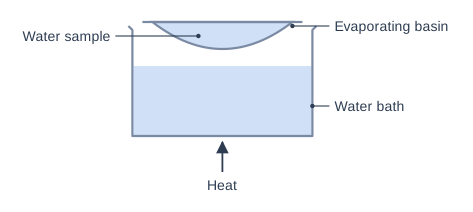
The diagram shows how a student evaporated the water from a water sample to find the mass of dissolved solids.

She heated the evaporating basin, let it cool and weighed it. She repeated this until the mass stayed the same.

Explain why she heated the basin until the mass stayed the same.

Diagram of evaporating a solution over a water bath. "Evaporating basin" labels the shallow dish on top; "Water bath" labels the beaker of water underneath; "Water sample" labels the liquid in the shallow dish.

Model answer

Heating to constant mass makes sure that all the water has evaporated and only the dry solid is left. If some water remained, the mass of the solid would be too high, so the mass of dissolved solids calculated would be too large.

Explanation

When the mass stops changing, nothing more is being lost, so all the water has gone. This is a standard way of making sure a measurement of a dry solid is accurate.

Mark scheme
  1. 1 mark

    to make sure all the water had evaporated

    allow so that the solid is completely dry

  2. 1 mark

    otherwise the mass of dissolved solids calculated would be too high

    allow the result would include the mass of some water

Question 3

3 marks

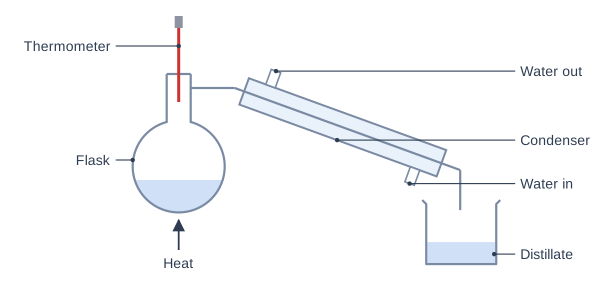
The diagram shows apparatus that a student used to obtain pure water from a sample of sea water.

Describe how this apparatus separates pure water from the sea water.

Diagram of simple distillation apparatus. Labelled parts: Thermometer, Flask, Water out, Condenser, Water in, Distillate.

Model answer

The sea water is heated in the flask until the water boils and turns into water vapour. The vapour passes into the condenser, where it is cooled by cold water flowing around the outside and condenses back into liquid water, which is collected as the distillate. The dissolved salts do not evaporate, so they are left behind in the flask.

Explanation

Distillation separates a liquid from dissolved solids because they have very different boiling points. It is one method of desalination, but heating large volumes of water to boiling needs a lot of energy.

Mark scheme
  1. 1 mark

    the sea water is heated in the flask and the water boils / evaporates to form water vapour (steam)

  2. 1 mark

    the vapour is cooled in the condenser and condenses back to liquid water (the distillate)

    allow cold water flowing round the condenser cools the vapour

  3. 1 mark

    the salts do not evaporate, so they are left behind in the flask

    allow the dissolved solids stay in the flask

Question 4

4 marks

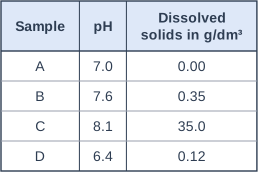
A student analysed four water samples, A, B, C and D. The table shows her results.

Which sample is most likely to be distilled water? Give a reason.
Which sample would need desalination before it could be made into potable water? Give a reason.

Table with columns "Sample", "pH", "Dissolved solids in g/dm³". Sample: A; pH: 7.0; Dissolved solids in g/dm³: 0.00 | Sample: B; pH: 7.6; Dissolved solids in g/dm³: 0.35 | Sample: C; pH: 8.1; Dissolved solids in g/dm³: 35.0 | Sample: D; pH: 6.4; Dissolved solids in g/dm³: 0.12.

Model answer

Sample A is most likely to be distilled water, because it contains no dissolved solids and has a neutral pH of 7.0.
Sample C would need desalination, because it has a very high concentration of dissolved solids (35.0 g/dm³), so it is probably sea water.

Explanation

Distillation removes all the dissolved solids, so distilled water leaves no residue when it is evaporated. Water with a high concentration of dissolved salts, like sea water, cannot be made potable just by filtering and sterilising; the salts must be removed by desalination.

Mark scheme
  1. 1 mark

    A

  2. 1 mark

    it contains no dissolved solids (and has a neutral pH of 7)

  3. 1 mark

    C

  4. 1 mark

    it has a very high concentration of dissolved solids / salts (35 g/dm³), so it is probably sea water

    allow 100 times more dissolved solids than the other samples

Ready to try the rest? Every answer you write is marked against the mark scheme, so you can see exactly where the marks are.

Revision notes

Potable water

The big idea

Water that is safe to drink is called potable water. It must have sufficiently low levels of dissolved salts and microbes. How it is produced depends on the water available and on local conditions: in the UK, fresh water only needs filtering and sterilising, but where fresh water is scarce, salty water must be desalinated, which needs a lot of energy.

Potable water is not pure water

In chemistry, a pure substance contains only one element or compound, so pure water contains nothing but H₂O molecules. Potable water still contains dissolved substances, such as small amounts of salts (minerals) and chlorine. It is safe to drink, but it is a mixture, so it is not pure in the chemical sense.

You can test whether a sample of water is pure:

  • pure water boils at exactly 100 °C (at normal atmospheric pressure); dissolved substances raise the boiling point;
  • evaporating pure water leaves no solid residue.

Producing potable water in the UK

In the UK, rain provides fresh water (water with low levels of dissolved substances). It collects in the ground, as ground water in porous rocks, and in lakes and rivers.

StepWhat happensReason
1. Choose an appropriate sourcePick fresh water that is low in dissolved substances and pollution, with a reliable supplyA cleaner source needs less treatment
2. Filter bedsThe water passes through beds of sand and gravelRemoves solid particles (insoluble substances)
3. SteriliseAdd chlorine or ozone, or pass the water under ultraviolet lightKills microbes

Filtering does not remove dissolved salts, and sterilising does not remove solids, so both steps are needed. Filtering comes first, because solid particles would shield microbes from UV light. Ground water often needs less treatment than river water, because it is filtered naturally as it seeps through the rock and is less exposed to pollution.

Chlorine is toxic, but only a very small concentration is added. Some stays in the water and keeps killing microbes in the pipes. UV light adds no chemicals, but it has no lasting effect after treatment.

Desalination: potable water from salty water

If supplies of fresh water are limited, desalination of salty water or sea water may be needed, because sea water has far too much dissolved salt to drink.

  • Distillation: the salty water is heated so the water boils and evaporates, leaving the salts behind. The water vapour is cooled in a condenser, where it condenses back to liquid water.
  • Reverse osmosis: the salty water is pumped at high pressure against a membrane that lets water molecules through but not the dissolved salts.

Both processes require large amounts of energy (to boil the water, or to pump it at high pressure), so desalination is expensive and is used mainly in dry places with little fresh water. Desalinated water is sterilised too before it is supplied.

Diagram of simple distillation apparatus. Labelled parts: Thermometer, Flask, Water out, Condenser, Water in, Distillate.
Simple distillation: the water vapour condenses in the condenser and is collected, while the salts stay in the flask.

Required practical: Analysis and purification of water samples

  • pH: dip universal indicator paper into the sample and match the colour against a pH chart, or use a calibrated pH meter for a more precise value.
  • Dissolved solids: filter the sample to remove anything insoluble. Weigh an empty, dry evaporating basin, add a measured volume of the filtered water and heat it gently over a water bath until the water has evaporated. Cool, reweigh and heat to constant mass. The mass of dissolved solids is the final mass minus the mass of the empty basin.
  • Distillation: heat the sample in a flask with anti-bumping granules. The thermometer bulb is level with the side arm, so it reads the temperature of the vapour entering the condenser: 100 °C shows that water is being collected. The distillate should leave no residue when evaporated.
  • Errors: water left in the residue makes the mass too high; solid spitting out of the basin makes it too low (gentle heating prevents this).
  • Safety: hot apparatus and steam can burn, so let things cool before touching them, and never heat the flask to dryness.

How much water do you need to evaporate?

The label on a bottle of spring water says it contains 240 mg of dissolved solids in each dm³. A student's balance reads to the nearest 0.01 g. Explain why evaporating 20 cm³ of this water would not give a useful result, and calculate the volume needed to leave 0.10 g of solid.

Convert the units: 240 mg = 0.240 g, and 20 cm³ = 0.020 dm³

Mass of solid in 20 cm³: \(0.240 \times 0.020 = 0.0048\) g

This is less than 0.01 g, the smallest mass the balance can show, so the student could not measure it.

Volume for 0.10 g: \(\dfrac{0.10}{0.240} = 0.42\) dm³ = 420 cm³

Fresh water contains so little dissolved solid that a large volume must be evaporated, a portion at a time.

Common mistakes

  • Saying potable water is "pure" or just "clean" water. It is water that is safe to drink, and it contains dissolved substances.
  • Saying filter beds remove dissolved salts. They remove solid particles only.
  • Writing "osmosis" or "filtering" for the membrane method. It is reverse osmosis, and it needs high pressure.
  • Saying boiling makes sea water safe to drink. Boiling kills microbes, but the salts stay in the water; distillation works because the vapour is condensed and collected.
  • Saying the distillation thermometer measures the liquid in the flask. It measures the vapour going into the condenser.

Exam tip

When asked to describe how potable water is produced, pair every step with its reason: filter beds remove solids, sterilising kills microbes. When comparing ground water with salty water, the key difference is the dissolved salts: only salty water needs desalination, and that needs large amounts of energy.

Study Helper Hints first, answers after you try

Stuck on this one? Ask for a hint and I’ll point you in the right direction, without giving the answer away. Once you’ve checked your answer, I’ll show you how the marks are awarded.