Level:
Correct: 0
Incorrect: 0
Marks: 0/0
Exam Practice
Course:
Topics:
AQA GCSE Combined Science (Chemistry Paper 2) Smart practice A mixed round aimed at your weak spots
Unit 6
The rate and extent of chemical change
Unit 7
Organic chemistry
Unit 8
Chemical analysis
Unit 9
Chemistry of the atmosphere
Unit 10
Using resources
Avg
score:
–
Topics
done:
0/38

Chromatography

Practise 18 exam-style questions on Chromatography for AQA GCSE Combined Science (Chemistry Paper 2). Write your answer as you would in the exam and get it marked in seconds against the mark scheme, point by point, with the Study Helper on hand if you get stuck.

  • 18 questions
  • 1–6 marks each
  • Instant marking
  • No sign-up needed
18 questions, marked as you go

Sample questions with model answers

Here are 4 of the questions in this topic, each with a model answer, an explanation of why it earns the marks and the mark scheme an examiner would use.

Question 1

2 marks

Paper chromatography involves a stationary phase and a mobile phase.

Name the stationary phase and the mobile phase in paper chromatography.

Model answer

The stationary phase is the paper and the mobile phase is the solvent.

Explanation

The stationary phase does not move; the mobile phase moves through it, carrying the substances with it. In paper chromatography the solvent soaks up the paper.

Mark scheme
  1. 1 mark

    stationary phase: the (chromatography) paper

    allow the water held in the paper

  2. 1 mark

    mobile phase: the solvent

    allow a named solvent, e.g. water or ethanol

Question 2

2 marks

A dye has an Rf value of 0.30 when water is the solvent but 0.80 when ethanol is the solvent.

Explain why the Rf values are different.

Model answer

The dye is more soluble in ethanol than in water, so with ethanol as the solvent it spends more of its time in the mobile phase and less attracted to the paper. It therefore moves further up the paper and has a higher Rf value.

Explanation

Different compounds have different Rf values in different solvents because their distribution between the stationary and mobile phases depends on the solvent. That is why the solvent must always be stated with an Rf value.

Mark scheme
  1. 1 mark

    the dye is more soluble in ethanol than in water

    allow the distribution of the dye between the phases is different in different solvents

  2. 1 mark

    so it spends more time in the mobile phase (ethanol) and moves further up the paper

    allow less time attracted to the paper

Question 3

3 marks

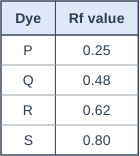
The table shows the Rf values of four dyes in a particular solvent. A student made a chromatogram of an unknown mixture using the same solvent. The mixture produced two spots, 2.4 cm and 4.0 cm from the start line. The solvent front was 5.0 cm from the start line.

Identify the two dyes in the mixture. Show your working.

Table with columns "Dye", "Rf value". Dye: P; Rf value: 0.25 | Dye: Q; Rf value: 0.48 | Dye: R; Rf value: 0.62 | Dye: S; Rf value: 0.80.

Model answer

Rf of first spot = 2.4 ÷ 5.0 = 0.48, which matches dye Q.
Rf of second spot = 4.0 ÷ 5.0 = 0.80, which matches dye S.
The mixture contains dyes Q and S.

Explanation

Rf values are characteristic of a substance in a given solvent, so they can be compared with values from a table. The comparison only works if the same solvent is used.

Mark scheme
  1. 1 mark

    Rf of first spot = 2.4 ÷ 5.0 = 0.48

  2. 1 mark

    Rf of second spot = 4.0 ÷ 5.0 = 0.80

  3. 1 mark

    the dyes are Q and S

    allow ecf from incorrect Rf values; both needed

Question 4

4 marks

A student set up a chromatography experiment to separate the dyes in an ink.

- The start line was drawn in pen.
- The solvent was poured in so that its level was above the start line.

Explain why each of these is a mistake.

Model answer

The start line should be drawn in pencil, not pen. Ink from the pen would dissolve in the solvent and separate into its own dyes, which would move up the paper and be confused with the spots being tested. Pencil (graphite) does not dissolve. The solvent level should be below the start line. If it is above the line, the spots of ink dissolve into the solvent in the beaker instead of being carried up the paper, so no chromatogram forms.

Explanation

Both mistakes would spoil the results by adding or removing dye. Pencil is used because it is insoluble in the solvent, and the solvent must start below the spots so that it can rise up through them.

Mark scheme
  1. 1 mark

    the start line should be drawn in pencil

    allow pen ink is a mistake

  2. 1 mark

    because ink would dissolve in the solvent and separate, mixing with the spots / pencil (graphite) is insoluble

    allow the line's ink would move up the paper and affect the results

  3. 1 mark

    the solvent level should be below the start line

  4. 1 mark

    because otherwise the spots dissolve into the solvent in the beaker instead of moving up the paper

    allow the dyes would wash off the paper

Ready to try the rest? Every answer you write is marked against the mark scheme, so you can see exactly where the marks are.

Revision notes

Chromatography

The big idea

Chromatography separates the substances in a mixture and gives information that helps to identify them. In paper chromatography a solvent soaks up a sheet of paper and carries each substance a different distance. The pattern of spots (the chromatogram) shows how many substances a mixture contains, what they might be, and whether a sample is pure.

How paper chromatography separates a mixture

Every type of chromatography has two phases:

  • the stationary phase, which does not move: in paper chromatography, the paper;
  • the mobile phase, which moves through it: the solvent (for example water or ethanol).

Separation depends on the distribution of each substance between the two phases. Each substance dissolves in the solvent but is also attracted to the paper. A substance that is more soluble in the solvent (or less attracted to the paper) spends more time in the mobile phase, so it travels further up the paper. Different substances have different solubilities and attractions, so they travel different distances and separate into spots.

A substance that is insoluble in the solvent stays on the start line; to study it, use a solvent it dissolves in.

Diagram of a paper chromatography set-up. Labelled parts: Lid, Chromatography paper, Start line (pencil), Spots of ink, Solvent, Beaker.
The solvent soaks up the paper from below the start line, carrying the substances in each spot up the paper.

Rf values

The Rf value of a substance compares how far it moved with how far the solvent moved, both measured from the start line:

\[R_f = \dfrac{\text{distance moved by substance}}{\text{distance moved by solvent}}\]
  • Measure to the centre of each spot, and to the solvent front (the furthest point the solvent reached).
  • Rf is a ratio of two distances, so it has no units. A substance cannot overtake the solvent, so Rf is always less than 1.
  • Give Rf to a sensible number of significant figures: the same as the distances you measured, usually 2.
  • A compound has a fixed Rf value in a particular solvent. Different compounds have different Rf values in different solvents, so comparing Rf values (in the same solvent) helps to identify compounds.

Same dye or not?

Two students test dyes on different days. In the same solvent, student A's dye moves 3.3 cm while the solvent moves 6.0 cm. Student B's dye moves 5.0 cm while the solvent moves 9.1 cm. Could they be the same dye?

Student A: \(R_f = \dfrac{3.3}{6.0} = 0.55\)

Student B: \(R_f = \dfrac{5.0}{9.1} = 0.549... = 0.55\) (2 significant figures)

The dyes moved different distances because the solvent ran further in student B's test, but the Rf values match. The two dyes could be the same substance. This is why chemists compare Rf values, not distances.

Pure or impure? Identifying substances

  • A pure compound produces a single spot in all solvents.
  • A mixture may separate into two or more spots, one for each substance.
  • One spot in one solvent does not prove purity: two substances could have the same Rf value in that solvent and travel together. Testing in other solvents gives stronger evidence.
  • To identify the substances in a mixture, run known substances on the same paper. A spot in the mixture at the same height as a known substance (the same Rf value in the same solvent) is probably that substance. Every spot must match for two mixtures to be the same.
Paper chromatogram. The solvent front is 9 cm above the start line. P: 2 spots at 3 cm, 5.4 cm; D: one spot at 5.4 cm; R: one spot at 3 cm. A centimetre scale is drawn beside the paper.
P is a student's product, D is a pure sample of the dye she was making, and R is the coloured reactant she started from.

Checking a product for purity

A student makes a coloured dye and runs her product (P) alongside pure dye (D) and the reactant (R), as in the chromatogram above. Is her product pure? Calculate the Rf value of each spot in P.

P gives two spots, so it is a mixture: the product is impure.

Upper spot: \(R_f = \dfrac{5.4}{9.0} = 0.60\), the same as D, so P contains the dye.

Lower spot: \(R_f = \dfrac{3.0}{9.0} = 0.33\), the same as R, so P still contains some unreacted reactant.

Required practical: Paper chromatography

  • Draw a start line in pencil about 1.5 cm from the bottom of the paper. Pencil (graphite) is insoluble, so it does not run; ink would dissolve and separate.
  • Use a capillary tube to put a small, concentrated spot of each sample on the line. Large spots spread out and overlap.
  • Stand the paper in a beaker of solvent with the solvent level below the start line, so the spots do not dissolve into the solvent in the beaker. Put a lid on to stop the solvent evaporating.
  • Remove the paper before the solvent reaches the top, and mark the solvent front in pencil straight away, before the solvent evaporates. Let the paper dry.
  • Measure from the start line to the centre of each spot and to the solvent front, then calculate each Rf value.
  • Keep the solvent, the paper and the temperature the same for every sample. Typical result: a black ink separates into several coloured spots.
  • Safety: solvents such as ethanol are flammable, so keep them away from naked flames.
  • Error: if the paper touches the side of the beaker, the solvent rises unevenly, so the solvent front is not level and the Rf values are unreliable.

Colourless substances, such as amino acids, can be shown up after the paper dries by spraying it with a locating agent, which reacts to form coloured spots.

Common mistakes

  • Measuring from the bottom of the paper. Measure from the start line.
  • Putting the distances the wrong way round: an Rf value bigger than 1 is always wrong.
  • Saying a dye "likes the solvent" without the link: it spends more time in the mobile phase, so it travels further.
  • Saying one spot proves a substance is pure. A pure compound gives one spot in all solvents.

Exam tip

In explanations, use the exam words: the stationary phase (paper), the mobile phase (solvent), and how each substance is distributed between them. When reading a chromatogram, write down the distances you measured before you calculate Rf: a correct reading can still earn a mark if the division goes wrong.

Study Helper Hints first, answers after you try

Stuck on this one? Ask for a hint and I’ll point you in the right direction, without giving the answer away. Once you’ve checked your answer, I’ll show you how the marks are awarded.