Level:
Correct: 0
Incorrect: 0
Marks: 0/0
Exam Practice
Course:
Topics:
AQA GCSE Combined Science (Chemistry Paper 2) Smart practice A mixed round aimed at your weak spots
Unit 6
The rate and extent of chemical change
Unit 7
Organic chemistry
Unit 8
Chemical analysis
Unit 9
Chemistry of the atmosphere
Unit 10
Using resources
Avg
score:
–
Topics
done:
0/38

Test for hydrogen

Practise 9 exam-style questions on Test for hydrogen for AQA GCSE Combined Science (Chemistry Paper 2). Write your answer as you would in the exam and get it marked in seconds against the mark scheme, point by point, with the Study Helper on hand if you get stuck.

  • 9 questions
  • 1–4 marks each
  • Instant marking
  • No sign-up needed
9 questions, marked as you go

Sample questions with model answers

Here are 4 of the questions in this topic, each with a model answer, an explanation of why it earns the marks and the mark scheme an examiner would use.

Question 1

2 marks

Describe the test for hydrogen gas. Give the result if hydrogen is present.

Model answer

Hold a burning splint at the open end of a test tube containing the gas. If the gas is hydrogen, it burns rapidly with a pop sound.

Explanation

The splint must be burning (lit), not glowing. The pop is the sound of the hydrogen burning very quickly in the air at the mouth of the tube.

Mark scheme
  1. 1 mark

    hold a burning splint at the open end of a test tube of the gas

    allow lighted / lit splint; do not accept glowing splint

  2. 1 mark

    hydrogen burns rapidly with a (squeaky) pop

    allow squeaky pop; do not accept 'the splint relights'

Question 2

2 marks

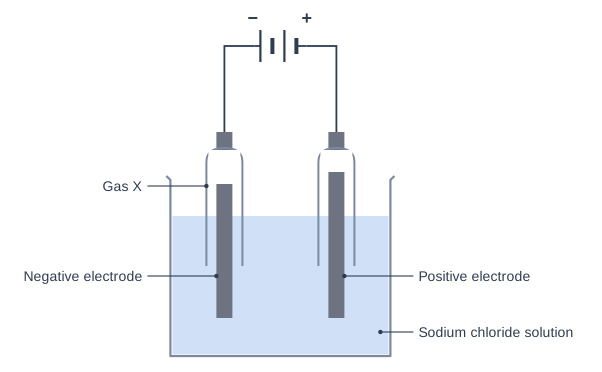
The diagram shows the electrolysis of sodium chloride solution. Gas X is collected over the negative electrode. When a burning splint is held at the mouth of the test tube, gas X burns rapidly with a pop.

Name gas X. Suggest why the test tube must be kept upside down until the test is done.

Diagram of an electrolysis cell. "Negative electrode" labels the left electrode, connected to the negative terminal; "Positive electrode" labels the right electrode, connected to the positive terminal; "Gas X" labels the upside-down test tube over the left electrode; "Sodium chloride solution" labels the liquid in the container.

Model answer

Gas X is hydrogen. The test tube is kept upside down because hydrogen is less dense than air: if the tube were turned the right way up, the hydrogen would rise out of it and escape before it could be tested.

Explanation

The pop with a burning splint identifies hydrogen. Because it is the least dense gas, hydrogen must be kept in an upside-down tube until the splint is brought to the mouth of the tube.

Mark scheme
  1. 1 mark

    hydrogen

    allow H₂

  2. 1 mark

    hydrogen is less dense than air, so it would rise out of / escape from a tube held the right way up

    allow so the gas does not escape before the test

Question 3

3 marks

Explain why a pop sound is heard when a burning splint is held at the open end of a test tube of hydrogen.

Model answer

The flame from the splint ignites the hydrogen, which reacts with oxygen from the air at the mouth of the tube. The reaction is so rapid that it is a small explosion, which makes the pop. The product of the reaction is water vapour.

Explanation

Hydrogen and oxygen react very quickly once ignited, releasing energy suddenly. The rapid burning causes the pop, and the only product is water.

Mark scheme
  1. 1 mark

    hydrogen reacts / burns with oxygen in the air

  2. 1 mark

    the reaction is very rapid / a small explosion

    allow hydrogen burns rapidly

  3. 1 mark

    water (vapour) is formed

    allow the rapid expansion of hot gas causes the sound

Question 4

3 marks

Calcium reacts with water:

Ca(s) + 2H₂O(l) → Ca(OH)₂(aq) + H₂(g)

A student collects the gas produced in a test tube and holds a burning splint at the open end.

Predict what the student will observe. Explain your answer.

Model answer

The gas will burn rapidly with a squeaky pop. The equation shows that the gas produced is hydrogen, and hydrogen burns very rapidly when it reacts with oxygen in the air at the mouth of the tube.

Explanation

Use the equation to identify the gas: H₂(g) is the only gas produced. The burning splint test then gives the characteristic pop for hydrogen.

Mark scheme
  1. 1 mark

    the gas burns rapidly with a (squeaky) pop

  2. 1 mark

    because the gas is hydrogen (H₂), as shown by the equation

  3. 1 mark

    hydrogen burns rapidly when it reacts with oxygen in the air

    allow hydrogen is flammable

Ready to try the rest? Every answer you write is marked against the mark scheme, so you can see exactly where the marks are.

Revision notes

Test for hydrogen

The big idea

Hydrogen is a colourless gas with no smell, so you cannot identify it by looking at it. The test uses a burning splint held at the open end of a test tube of the gas. Hydrogen burns rapidly with a pop sound (often called a "squeaky pop").

The test

  1. Collect the gas in a test tube and keep it stoppered, or upside down, until you test it. Hydrogen is much less dense than air, so it quickly escapes from an open tube.
  2. Remove the bung and hold a burning (lit) splint at the open end of the tube.
  3. A squeaky pop shows the gas is hydrogen.

Why it pops: the flame ignites the hydrogen mixed with air at the mouth of the tube. Hydrogen reacts with oxygen so fast that it makes a tiny explosion, which you hear as the pop. The only product is water:

2H₂(g) + O₂(g) → 2H₂O(l)

Hydrogen is made when a metal above hydrogen in the reactivity series reacts with a dilute acid, when a Group 1 metal reacts with water, and at the negative electrode in some electrolysis. Copper is below hydrogen, so it does not react with dilute acids and gives no pop.

Comparing results with a burning splint

Gas in the tubeWhat happens to a burning splint
HydrogenSqueaky pop
OxygenBurns more brightly
Carbon dioxide, nitrogen and many other gasesGoes out

Only hydrogen pops. If the splint just goes out, the gas is not hydrogen, but you still need another test (such as limewater) to say what it is.

Common mistakes

  • Using a glowing splint. That is the oxygen test; hydrogen needs a burning splint.
  • Writing "the splint relights" for hydrogen. The result is a squeaky pop.
  • Leaving the tube open before testing: the hydrogen escapes and there is no pop.
  • Deciding a gas is carbon dioxide because it put out the burning splint. Many gases do this.
  • Writing H for hydrogen gas. Hydrogen exists as molecules, H₂.

Exam tip

A test answer needs the method and the result: "hold a burning splint at the open end of the tube; hydrogen burns with a squeaky pop". The mark for "pop" is usually only given if the splint was a burning one.

Study Helper Hints first, answers after you try

Stuck on this one? Ask for a hint and I’ll point you in the right direction, without giving the answer away. Once you’ve checked your answer, I’ll show you how the marks are awarded.