Level:
Correct: 0
Incorrect: 0
Marks: 0/0
Exam Practice
Course:
Topics:
AQA GCSE Combined Science (Chemistry Paper 2) Smart practice A mixed round aimed at your weak spots
Unit 6
The rate and extent of chemical change
Unit 7
Organic chemistry
Unit 8
Chemical analysis
Unit 9
Chemistry of the atmosphere
Unit 10
Using resources
Avg
score:
–
Topics
done:
0/38

Atmospheric pollutants from fuels

Practise 12 exam-style questions on Atmospheric pollutants from fuels for AQA GCSE Combined Science (Chemistry Paper 2). Write your answer as you would in the exam and get it marked in seconds against the mark scheme, point by point, with the Study Helper on hand if you get stuck.

  • 12 questions
  • 1–6 marks each
  • Instant marking
  • No sign-up needed
12 questions, marked as you go

Sample questions with model answers

Here are 4 of the questions in this topic, each with a model answer, an explanation of why it earns the marks and the mark scheme an examiner would use.

Question 1

2 marks

At the high temperatures in a car engine, nitrogen reacts with oxygen to produce nitrogen monoxide, NO.

Write a balanced symbol equation for this reaction.

Model answer

N₂ + O₂ → 2NO

Explanation

Nitrogen and oxygen are both diatomic gases, so their formulae are N₂ and O₂. Each molecule of NO contains one nitrogen atom and one oxygen atom, so two NO molecules are formed.

Mark scheme
  1. 1 mark

    N₂ + O₂ → NO

    correct formulae; an answer of N₂ + O₂ → 2NO scores 2 marks

  2. 1 mark

    N₂ + O₂ → 2NO

    balanced; allow multiples; ignore state symbols

Question 2

2 marks

Diesel engines release more soot (carbon particles) than petrol engines. Diesel fuel contains larger hydrocarbon molecules than petrol.

Suggest why diesel engines release more soot.

Model answer

Diesel contains larger hydrocarbon molecules, which are less flammable and harder to burn completely. So more of the fuel undergoes incomplete combustion, and some carbon is released as soot instead of forming carbon dioxide.

Explanation

As hydrocarbon molecules get bigger, they become less volatile and less flammable. Fuels made of large molecules are more likely to burn incompletely, producing soot and unburned hydrocarbons that form particulates in the air.

Mark scheme
  1. 1 mark

    larger hydrocarbon molecules are less flammable / harder to burn completely

    allow less volatile / more viscous

  2. 1 mark

    so more incomplete combustion, leaving unburned carbon (soot)

    allow not enough oxygen reaches all the fuel

Question 3

3 marks

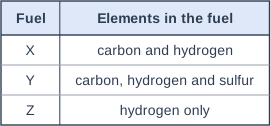
The table shows the elements in three fuels, X, Y and Z.

Fuel Y burns completely in air at a high temperature in a power station.

Predict all the gases produced. Give reasons for your answer.

Table with columns "Fuel", "Elements in the fuel". Fuel: X; Elements in the fuel: carbon and hydrogen | Fuel: Y; Elements in the fuel: carbon, hydrogen and sulfur | Fuel: Z; Elements in the fuel: hydrogen only.

Model answer

Carbon dioxide and water vapour, formed from the carbon and hydrogen in the fuel. Sulfur dioxide, because the fuel contains sulfur. Oxides of nitrogen, because at the high temperature in the furnace nitrogen and oxygen from the air react together.

Explanation

To predict combustion products, look at the elements in the fuel and the conditions. Each element in the fuel forms its oxide; complete combustion means no carbon monoxide or soot; and a high temperature means oxides of nitrogen form from the air.

Mark scheme
  1. 1 mark

    carbon dioxide and water vapour (from the carbon and hydrogen in the fuel)

    both needed

  2. 1 mark

    sulfur dioxide, because the fuel contains sulfur

  3. 1 mark

    oxides of nitrogen, because nitrogen and oxygen from the air react at the high temperature

    allow nitrogen monoxide / nitrogen dioxide; do not accept carbon monoxide or soot (combustion is complete)

Question 4

4 marks

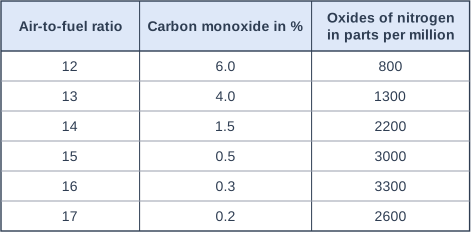
The table shows the percentage of carbon monoxide and the concentration of oxides of nitrogen in the exhaust gases from a petrol engine at different air-to-fuel ratios. A higher air-to-fuel ratio means more air for the same mass of fuel.

Describe and explain how the percentage of carbon monoxide changes as the air-to-fuel ratio increases.
Suggest why the concentration of oxides of nitrogen increases between ratios of 12 and 16.

Table with columns "Air-to-fuel ratio", "Carbon monoxide in %", "Oxides of nitrogen in parts per million". Air-to-fuel ratio: 12; Carbon monoxide in %: 6.0; Oxides of nitrogen in parts per million: 800 | Air-to-fuel ratio: 13; Carbon monoxide in %: 4.0; Oxides of nitrogen in parts per million: 1300 | Air-to-fuel ratio: 14; Carbon monoxide in %: 1.5; Oxides of nitrogen in parts per million: 2200 | Air-to-fuel ratio: 15; Carbon monoxide in %: 0.5; Oxides of nitrogen in parts per million: 3000 | Air-to-fuel ratio: 16; Carbon monoxide in %: 0.3; Oxides of nitrogen in parts per million: 3300 | Air-to-fuel ratio: 17; Carbon monoxide in %: 0.2; Oxides of nitrogen in parts per million: 2600.

Model answer

As the air-to-fuel ratio increases, the percentage of carbon monoxide decreases, from 6.0% at a ratio of 12 to 0.2% at a ratio of 17. This is because there is more oxygen, so more of the fuel burns completely and more of the carbon forms carbon dioxide instead of carbon monoxide.
Between 12 and 16 there is more oxygen available to react with nitrogen, and more complete combustion makes the engine hotter; nitrogen and oxygen react at high temperatures, so more oxides of nitrogen form.

Explanation

Engine designers face a trade-off: more air reduces carbon monoxide from incomplete combustion but can increase oxides of nitrogen. With a lot of excess air (ratio 17) the oxides of nitrogen fall again, because the extra air cools the burning mixture.

Mark scheme
  1. 1 mark

    carbon monoxide decreases as the ratio increases, from 6.0% at 12 to 0.2% at 17

    data needed for this mark

  2. 1 mark

    more oxygen is available, so combustion is more complete / less incomplete combustion

    allow more carbon forms carbon dioxide instead of carbon monoxide

  3. 1 mark

    more oxygen is available to react with nitrogen

    max 2 for the oxides of nitrogen

  4. 1 mark

    more complete combustion releases more energy / the temperature in the engine is higher, and nitrogen and oxygen react at high temperatures

Ready to try the rest? Every answer you write is marked against the mark scheme, so you can see exactly where the marks are.

Revision notes

Atmospheric pollutants from fuels

The big idea

The combustion of fuels is a major source of atmospheric pollutants. Most fuels, including coal, contain carbon and/or hydrogen, and many also contain some sulfur. What comes out of a chimney or exhaust depends on what is in the fuel and on the conditions: how much oxygen there is and how hot the fuel burns.

What burning a fuel can release

ProductWhere it comes fromWhen it forms
Carbon dioxide, CO₂carbon in the fuel + oxygencomplete combustion (plenty of oxygen)
Water vapour, H₂Ohydrogen in the fuel + oxygenwhenever the fuel contains hydrogen
Carbon monoxide, COcarbon that is only partly oxidisedincomplete combustion (not enough oxygen)
Soot (carbon particles) and unburned hydrocarbonscarbon not oxidised at all, or fuel that did not burnincomplete combustion; they form particulates in the air
Sulfur dioxide, SO₂sulfur in the fuel + oxygenwhenever the fuel contains sulfur
Oxides of nitrogen, such as NO and NO₂nitrogen and oxygen from the airat the high temperatures in engines and furnaces

How each pollutant is produced

Carbon monoxide and soot. With plenty of oxygen, all the carbon in a hydrocarbon becomes carbon dioxide. With a limited supply of air, some carbon is only partly oxidised, to carbon monoxide, and some is not oxidised at all and is released as soot. For ethane:

  • complete combustion: 2C₂H₆(g) + 7O₂(g) → 4CO₂(g) + 6H₂O(g)
  • less oxygen, forming carbon monoxide: 2C₂H₆(g) + 5O₂(g) → 4CO(g) + 6H₂O(g)
  • very little oxygen, forming soot: 2C₂H₆(g) + 3O₂(g) → 4C(s) + 6H₂O(g)

The hydrogen still forms water each time; it is the carbon that gets less oxygen.

Sulfur dioxide. The sulfur comes from the fuel and the oxygen comes from the air: S(s) + O₂(g) → SO₂(g). Removing sulfur from fuels such as diesel before they are sold cuts sulfur dioxide pollution.

Oxides of nitrogen. These do not come from the fuel. Air contains nitrogen and oxygen. Nitrogen is very unreactive, but at the high temperatures inside engines and furnaces it reacts with oxygen: N₂(g) + O₂(g) → 2NO(g). Nitrogen monoxide then reacts with more oxygen to form nitrogen dioxide, NO₂. So a fuel burned hot in air can produce oxides of nitrogen even if it contains no nitrogen.

Predicting the products

  1. Go through the elements in the fuel: carbon gives carbon dioxide, hydrogen gives water and sulfur gives sulfur dioxide.
  2. Check the oxygen supply: if it is limited, add carbon monoxide and soot.
  3. Check the temperature: if the fuel burns hot in air, add oxides of nitrogen.

Predicting the products of burning biogas

Biogas is about 60% methane (CH₄) and 40% carbon dioxide, with a trace of hydrogen sulfide (H₂S). Predict the products when biogas burns in a hot flame with plenty of air.

  • The methane burns completely, forming carbon dioxide and water vapour.
  • The carbon dioxide already in the biogas does not burn, so it passes out unchanged.
  • Hydrogen sulfide contains sulfur, so it forms sulfur dioxide (and water).
  • The flame is hot and burns in air, so some oxides of nitrogen form.
  • There is plenty of air, so very little carbon monoxide or soot is produced.

Common mistakes

  • Saying the nitrogen in oxides of nitrogen comes from the fuel. It comes from the air, and reacts because of the high temperature.
  • Saying sulfur dioxide forms when sulfur reacts with nitrogen. Sulfur from the fuel reacts with oxygen.
  • Writing "sulfur oxide" or "sulfuric acid" when the answer is sulfur dioxide.
  • Saying carbon monoxide forms because the fuel burns too hot. It forms when there is not enough oxygen.
  • Forgetting water vapour when a fuel contains hydrogen.

Exam tip

In 6-mark questions, explain each pollutant in its own sentence, saying where its elements come from (the fuel or the air) and the condition that forms it; one sentence about "burning fuels" covers none of them. In "predict" questions, use both the composition of the fuel and the conditions it burns in.

Study Helper Hints first, answers after you try

Stuck on this one? Ask for a hint and I’ll point you in the right direction, without giving the answer away. Once you’ve checked your answer, I’ll show you how the marks are awarded.