Level:
Correct: 0
Incorrect: 0
Marks: 0/0
Exam Practice
Course:
Topics:
AQA GCSE Combined Science (Chemistry Paper 2) Smart practice A mixed round aimed at your weak spots
Unit 6
The rate and extent of chemical change
Unit 7
Organic chemistry
Unit 8
Chemical analysis
Unit 9
Chemistry of the atmosphere
Unit 10
Using resources
Avg
score:
–
Topics
done:
0/38

Cracking and alkenes

Practise 17 exam-style questions on Cracking and alkenes for AQA GCSE Combined Science (Chemistry Paper 2). Write your answer as you would in the exam and get it marked in seconds against the mark scheme, point by point, with the Study Helper on hand if you get stuck.

  • 17 questions
  • 1–6 marks each
  • Instant marking
  • No sign-up needed
17 questions, marked as you go

Sample questions with model answers

Here are 4 of the questions in this topic, each with a model answer, an explanation of why it earns the marks and the mark scheme an examiner would use.

Question 1

1 mark

This equation for a cracking reaction is not balanced:

C₁₆H₃₄ → C₈H₁₈ + C₂H₄

Write the balanced equation.

Model answer

C₁₆H₃₄ → C₈H₁₈ + 4C₂H₄
Check: carbon 16 = 8 + (4 × 2); hydrogen 34 = 18 + (4 × 4)

Explanation

After making C₈H₁₈, there are 8 carbon atoms and 16 hydrogen atoms left over, which is exactly four molecules of C₂H₄. Always check that both carbon and hydrogen balance.

Mark scheme
  1. 1 mark

    C₁₆H₃₄ → C₈H₁₈ + 4C₂H₄

    allow multiples

Question 2

2 marks

A student cracked liquid paraffin in the laboratory by heating its vapour over hot pieces of broken pottery. The gas produced was collected in a test tube over water, using a delivery tube.

Explain why the student must remove the delivery tube from the water before stopping heating.

Model answer

If the heating stopped while the delivery tube was still in the water, the gas in the tube would cool and contract, and cold water would be sucked back into the hot boiling tube. The sudden cooling could crack the hot glass.

Explanation

Suck-back happens when a heated gas cools and its pressure drops. Lifting the delivery tube out of the water first is an important safety step whenever a gas is collected over water from a heated tube.

Mark scheme
  1. 1 mark

    otherwise cold water would be sucked back into the hot boiling tube

    allow suck-back

  2. 1 mark

    which could crack / shatter the hot glass

    allow could cause the apparatus to break

Question 3

3 marks

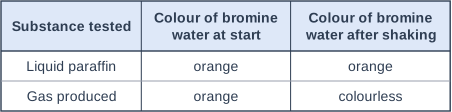
A student heated liquid paraffin (a mixture of alkanes) to crack it and collected the gas produced. The student then shook samples of the liquid paraffin and of the gas with bromine water. The table shows the results.

Explain what the results show.

Table with columns "Substance tested", "Colour of bromine water at start", "Colour of bromine water after shaking". Substance tested: Liquid paraffin; Colour of bromine water at start: orange; Colour of bromine water after shaking: orange | Substance tested: Gas produced; Colour of bromine water at start: orange; Colour of bromine water after shaking: colourless.

Model answer

The liquid paraffin left the bromine water orange, so it contains no alkenes (it is made of alkanes). The gas turned the bromine water from orange to colourless, so it contains alkenes. Therefore the alkenes must have been produced when the alkanes in the liquid paraffin were cracked.

Explanation

Testing the starting material as well as the product acts as a control: it shows that the alkenes were not there before cracking, so they must have been formed by the cracking reaction.

Mark scheme
  1. 1 mark

    liquid paraffin does not decolourise bromine water, so it contains no alkenes

    allow it contains only alkanes

  2. 1 mark

    the gas decolourises bromine water, so it contains alkenes

  3. 1 mark

    so alkenes were produced by cracking the alkanes in liquid paraffin

    allow cracking produces alkenes

Question 4

4 marks

A student says: "We should stop using crude oil completely."

Use your knowledge of hydrocarbons to explain how modern life depends on hydrocarbons from crude oil, and why stopping their use completely would be difficult.

Model answer

Modern life depends on hydrocarbons from crude oil in many ways. Most transport uses fuels from crude oil: petrol and diesel oil for cars and lorries and kerosene for aircraft. Hydrocarbons are also burned for heating, cooking and in some power stations. The petrochemical industry uses hydrocarbons, including alkenes from cracking, to make polymers for packaging, clothing and medical equipment, as well as solvents, lubricants and detergents. Stopping completely would mean finding alternative fuels and alternative raw materials for all of these products at the same time, which would be very difficult and expensive.

Explanation

Crude oil is both a source of fuels and the feedstock for many materials. Even if electric vehicles replace much of the demand for fuels, hydrocarbons would still be needed to make polymers and other chemicals.

Mark scheme
  1. 1 mark

    most transport depends on fuels from crude oil, e.g. petrol, diesel oil, kerosene for aircraft

    max 4

  2. 1 mark

    hydrocarbons are used for heating / cooking / generating electricity

    allow LPG, heavy fuel oil in power stations or ships

  3. 1 mark

    polymers / plastics are made from hydrocarbons (alkenes from cracking) and are used in packaging, clothes, medical equipment and many other products

  4. 1 mark

    many other materials, e.g. solvents, lubricants, detergents, come from crude oil

  5. 1 mark

    alkenes from cracking are starting materials for producing many other chemicals

  6. 1 mark

    alternatives would be needed for all of these uses, which would take time / be expensive

    allow alternatives exist for some uses, e.g. electric cars, but not yet for all

Ready to try the rest? Every answer you write is marked against the mark scheme, so you can see exactly where the marks are.

Revision notes

Cracking and alkenes

The big idea

Fractional distillation gives more large hydrocarbon molecules than we need, and not enough small ones. Cracking breaks large hydrocarbon molecules down into smaller, more useful molecules. The products include short alkanes for fuels and a new type of hydrocarbon, the alkenes, which are used to make polymers and many other chemicals.

What cracking is

Cracking is a thermal decomposition reaction: heat breaks large molecules down into smaller ones. It is a chemical change, because covalent bonds inside the molecules break and new substances form. (Fractional distillation, by contrast, only separates the substances already in crude oil.)

There are two main methods. In both, the hydrocarbon is first heated so that it vaporises.

FeatureCatalytic crackingSteam cracking
What is doneThe hot vapour is passed over a hot catalyst, such as a zeolite (aluminium oxide is also used)The vapour is mixed with steam
TemperatureHigh, about 550 °CVery high, about 850 °C
CatalystYesNo

The products: alkanes and alkenes

Cracking an alkane gives a smaller alkane and at least one alkene. Alkenes are hydrocarbons with a carbon-carbon double bond (C=C).

Displayed formula of hexane (labelled "Hexane") arrow to displayed formula of propane (labelled "Propane") plus displayed formula of propene (labelled "Propene"). (Hexane = hexane; Propane = propane; Propene = propene.)
One way hexane can crack: C₆H₁₄ → C₃H₈ + C₃H₆. The product with the C=C double bond is an alkene.

Why is an alkene always made? An alkane already holds the maximum number of hydrogen atoms for its carbon atoms. Splitting it into two alkanes would need two extra hydrogen atoms, and there are none spare, so one product must have fewer hydrogen atoms and a C=C double bond instead.

Cracking equations must balance: the carbon atoms and the hydrogen atoms on each side must add up to the same totals.

Spotting an impossible cracking equation

A student writes this equation for cracking decane: C₁₀H₂₂ → 2C₅H₁₂. Explain why it cannot be right, and correct it.

Carbon: left 10, right \(2 \times 5 = 10\). This balances.

Hydrogen: left 22, right \(2 \times 12 = 24\). There are 2 more hydrogen atoms on the right, which is impossible.

So one of the C₅ products must have 2 fewer hydrogen atoms (an alkene): C₁₀H₂₂ → C₅H₁₂ + C₅H₁₀

Check hydrogen: \(12 + 10 = 22\). Both elements now balance.

The test for alkenes

Alkenes are more reactive than alkanes because of their C=C double bond. Shake the hydrocarbon with bromine water:

  • an alkene turns bromine water from orange to colourless;
  • an alkane does not react, so the bromine water stays orange.

Chemistry only: you also need the names and formulae of individual alkenes, such as ethene (C₂H₄) and propene (C₃H₆), and their general formula, CₙH₂ₙ. Combined Science students do not need to learn these names and formulae.

Why cracking is useful

  • There is a high demand for fuels with small molecules, such as petrol, which ignite and flow easily. Crude oil contains more large molecules than are needed, so cracking turns the surplus into fuels that are in demand.
  • Alkenes are used to make polymers (plastics such as poly(ethene)) and as starting materials for many other chemicals, such as ethanol. Crude oil itself contains very few alkenes.

Modern life depends on hydrocarbons: as fuels for transport, heating and generating electricity, and as raw materials for plastics, solvents, detergents, medicines and much more.

Cracking in the laboratory

Liquid paraffin (a mixture of long-chain alkanes) is soaked into mineral wool at the end of a boiling tube. Broken porcelain or aluminium oxide is placed in the middle as the catalyst and heated strongly, then the paraffin is warmed so its vapour passes over the hot catalyst. The gas is collected over water. The first tube is mostly air, so it is thrown away. Bromine water turns the gas from orange to colourless, showing alkenes. Before you stop heating, take the delivery tube out of the water: otherwise cold water is sucked back into the hot tube, which can crack it.

Common mistakes

  • Defining cracking as "separating hydrocarbons". Cracking breaks down large molecules into smaller ones.
  • Saying the bromine water turns "clear". It turns colourless: orange bromine water is already clear.
  • Writing "bromide water". The test uses bromine water.
  • Saying alkenes are used as fuels. Their main uses are making polymers and other chemicals.
  • Forgetting to check the hydrogen atoms when balancing a cracking equation.

Exam tip

For "describe the conditions", name the key condition for each method: catalytic cracking uses a hot catalyst, steam cracking uses steam at a very high temperature, and both start by heating the hydrocarbon to vaporise it. For the bromine water test, give both colours: "orange to colourless".

Study Helper Hints first, answers after you try

Stuck on this one? Ask for a hint and I’ll point you in the right direction, without giving the answer away. Once you’ve checked your answer, I’ll show you how the marks are awarded.