Level:
Correct: 0
Incorrect: 0
Marks: 0/0
Exam Practice
Course:
Topics:
AQA GCSE Combined Science (Chemistry Paper 2) Smart practice A mixed round aimed at your weak spots
Unit 6
The rate and extent of chemical change
Unit 7
Organic chemistry
Unit 8
Chemical analysis
Unit 9
Chemistry of the atmosphere
Unit 10
Using resources
Avg
score:
–
Topics
done:
0/38

Life cycle assessment

Practise 14 exam-style questions on Life cycle assessment for AQA GCSE Combined Science (Chemistry Paper 2). Write your answer as you would in the exam and get it marked in seconds against the mark scheme, point by point, with the Study Helper on hand if you get stuck.

  • 14 questions
  • 1–6 marks each
  • Instant marking
  • No sign-up needed
14 questions, marked as you go

Sample questions with model answers

Here are 4 of the questions in this topic, each with a model answer, an explanation of why it earns the marks and the mark scheme an examiner would use.

Question 1

2 marks

What is a life cycle assessment (LCA) of a product?

Model answer

A life cycle assessment is an assessment of the environmental impact of a product at each stage of its life, from extracting and processing the raw materials, through manufacture and use, to its disposal.

Explanation

An LCA looks at the whole life of a product, not just one part of it. It considers things such as the use of water, resources and energy, and the waste and pollution produced, including transport at each stage.

Mark scheme
  1. 1 mark

    an assessment of the environmental impact of a product

    allow an analysis of the effect of a product on the environment

  2. 1 mark

    at each stage of its life / from obtaining the raw materials to its disposal

    allow over its whole lifetime

Question 2

2 marks

Making one cotton 'bag for life' releases 2100 g of carbon dioxide. Making one single-use plastic bag releases 35 g of carbon dioxide.

Calculate how many times the cotton bag must be used before the carbon dioxide released per use is the same as for a plastic bag used once.

Model answer

2100 ÷ 35 = 60
The cotton bag must be used 60 times.

Explanation

A product with a large manufacturing impact can still be a good choice if it is used many times. A cotton bag only has a lower carbon dioxide impact per use than single-use plastic bags if it is used more than 60 times, which is why simple claims that one type of bag is 'greener' can be misleading.

Mark scheme
  1. 1 mark

    2100 ÷ 35

    an answer of 60 scores 2 marks

  2. 1 mark

    = 60 (times)

Question 3

3 marks

A company that makes plastic shopping bags paid for a shortened life cycle assessment that looked only at the manufacturing stage. The company then advertised: "Plastic bags have a lower environmental impact than paper bags."

Explain why this claim may be misleading.

Model answer

The LCA was selective: it looked only at the manufacturing stage. It ignored other stages, such as the raw material (plastic comes from crude oil, a finite resource) and disposal (plastic bags are not biodegradable and can last for hundreds of years as litter or in landfill). The company makes plastic bags, so it may have chosen to look only at the stage that supports the conclusion it wanted for its advertising.

Explanation

Selective or abbreviated LCAs can be useful, but they can be misused to reach pre-determined conclusions, for example to support advertising claims. A fair comparison needs all four stages for both products.

Mark scheme
  1. 1 mark

    the LCA was selective / abbreviated: it looked at only one stage of the life cycle

  2. 1 mark

    it ignored other stages, e.g. plastic is made from crude oil (a finite resource) or plastic bags are not biodegradable at disposal

    allow any relevant stage that was left out

  3. 1 mark

    the company benefits from the result, so the stages may have been chosen to reach a pre-determined conclusion / the claim may be biased

Question 4

4 marks

A shop advertises: "Our paper bags are better for the environment than plastic bags because they are made from a renewable resource and they are biodegradable."

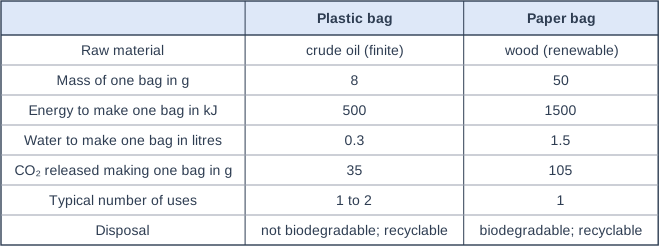
The table gives information from life cycle assessments of plastic and paper shopping bags.

Evaluate the shop's claim. Use the information in the table.

Table with columns (row headings), "Plastic bag", "Paper bag". Raw material; Plastic bag: crude oil (finite); Paper bag: wood (renewable) | Mass of one bag in g; Plastic bag: 8; Paper bag: 50 | Energy to make one bag in kJ; Plastic bag: 500; Paper bag: 1500 | Water to make one bag in litres; Plastic bag: 0.3; Paper bag: 1.5 | CO₂ released making one bag in g; Plastic bag: 35; Paper bag: 105 | Typical number of uses; Plastic bag: 1 to 2; Paper bag: 1 | Disposal; Plastic bag: not biodegradable; recyclable; Paper bag: biodegradable; recyclable.

Model answer

The claim is partly true: paper bags are made from wood, which is a renewable resource, and they are biodegradable. However, the table shows that making a paper bag uses three times as much energy and five times as much water as a plastic bag, and releases three times as much carbon dioxide (105 g compared with 35 g). The shop has only considered the raw material and disposal stages, which is a selective LCA used to support an advertising claim. So the claim is misleading: overall, the paper bag does not clearly have a lower environmental impact.

Explanation

Advertisers may choose only the stages of an LCA that support the conclusion they want. To evaluate a claim, check which stages have been left out and use the data for every stage.

Mark scheme
  1. 1 mark

    the claim is partly true: paper is made from wood, which is renewable, and paper bags are biodegradable

    max 4

  2. 1 mark

    but making a paper bag uses more energy (1500 kJ compared with 500 kJ) and more water (1.5 compared with 0.3 litres)

  3. 1 mark

    and releases three times as much carbon dioxide (105 g compared with 35 g)

  4. 1 mark

    the claim is based on only some stages (raw materials and disposal): a selective / abbreviated LCA used to support an advertising claim

  5. 1 mark

    conclusion: the claim is misleading / not fully supported by the data

Ready to try the rest? Every answer you write is marked against the mark scheme, so you can see exactly where the marks are.

Revision notes

Life cycle assessment

The big idea

A life cycle assessment (LCA) assesses the environmental impact of a product at every stage of its life, from getting the raw materials to throwing it away. Comparing LCAs helps people decide which of two products is better for the environment. But some impacts are hard to put numbers on, and an LCA can be written to give the answer someone wants, so you need to read them critically.

The four stages

StageWhat is counted (examples)
1. Extracting and processing raw materialsMining, quarrying, drilling for oil or cutting down trees; the energy used, damage to habitats, waste rock
2. Manufacturing and packagingEnergy, water and other resources used in the factory; waste and pollution produced
3. Use and operation during its lifetimeFuel, electricity, water or detergent the product uses while it works
4. Disposal at the end of its useful lifeLandfill, incineration or recycling; land used, pollution, materials lost

Transport and distribution are not a separate stage: they are included at each stage. Every journey by lorry, ship or plane burns fuel, which uses up finite resources and releases carbon dioxide and other pollutants.

For products that use fuel or electricity, such as cars and washing machines, the use stage often has the largest impact. For products used once, such as packaging, raw materials, manufacture and disposal matter most.

Numbers and value judgements

Some effects can be fairly easily quantified (given a number):

  • the use of water;
  • the use of resources (raw materials);
  • the use of energy sources;
  • the production of some wastes.

The effects of pollutants are much harder. How much harm does a gas do to people's health, or litter to wildlife? Allocating numerical values to these effects is not straightforward and requires value judgements, so an LCA is not a purely objective process. Two groups studying the same product can reach different conclusions.

Selective LCAs

A selective or abbreviated LCA looks at only some of the stages or impacts. These can be useful for a quick comparison, but they can be misused to reach pre-determined conclusions, for example to support an advertising claim. A company could include only the stages where its product does well and leave out the rest. When you judge a claim based on an LCA, ask which stages and impacts have been left out, and who carried out the assessment.

Comparing plastic and paper shopping bags

StagePlastic bag (poly(ethene))Paper bag
Raw materialsCrude oil, a finite resource, processed by fractional distillation and crackingWood from trees, a renewable resource, although forests are cut down
ManufacturePolymerisation uses energy, but less energy and water than making paperPulping wood uses more energy and much more water
TransportLight and thin, so less fuel is usedHeavier and bulkier, so more fuel is used
UseStrong and waterproof, so it can be reused many timesTears easily, especially when wet, so it is often used only once
DisposalNot biodegradable: lasts a very long time in landfill, and litter harms wildlife; can be recycledBiodegradable; can be recycled or composted

Neither bag is better at every stage. Paper usually has the larger impact in manufacture and transport, and plastic the larger impact at disposal, so the overall result depends heavily on how many times each bag is used.

Keeping a laptop for longer

An LCA for a laptop gives these values: raw materials and manufacturing 300 kg of carbon dioxide; use (electricity) 20 kg of carbon dioxide per year; disposal 10 kg. Compare the carbon dioxide released per year of use if the laptop is kept for 3 years or for 6 years.

Kept 3 years: total \(= 300 + (3 \times 20) + 10 = 370\) kg, so per year \(= 370 \div 3 = 123\) kg

Kept 6 years: total \(= 300 + (6 \times 20) + 10 = 430\) kg, so per year \(= 430 \div 6 = 72\) kg

Keeping the laptop twice as long cuts its carbon dioxide per year by about 40%. Most of the impact comes from making it, so repairing products and using them for longer reduces their impact far more than saving electricity during use. The data cover only carbon dioxide, not other impacts such as the metals mined.

Remember

  • The four stages: raw materials, manufacturing and packaging, use, disposal, with transport at every stage.
  • Water, resources, energy and some wastes are fairly easy to quantify; the effects of pollutants need value judgements.
  • So an LCA is not purely objective, and selective LCAs can be misused, for example in advertising.

Common mistakes

  • Naming transport as a separate stage. It is included within every stage.
  • Including the cost of the product or how well it works. An LCA is about environmental impact.
  • Saying an LCA is objective because it uses data. Giving values to pollutant effects needs value judgements.
  • Quoting values from a table without comparing them. Use comparison words: "one product uses twice as much water as the other".
  • Assuming the paper bag is better because it is renewable and biodegradable. It has a larger impact during manufacture and transport.

Exam tip

In a six-mark question comparing two products, work through each stage for both products, then give a balanced conclusion. When evaluating an advertising claim, say what is true in it, name the stages it ignores, and conclude that a full LCA is needed.

Study Helper Hints first, answers after you try

Stuck on this one? Ask for a hint and I’ll point you in the right direction, without giving the answer away. Once you’ve checked your answer, I’ll show you how the marks are awarded.