Level:
Correct: 0
Incorrect: 0
Marks: 0/0
Exam Practice
Course:
Topics:
AQA GCSE Combined Science (Chemistry Paper 2) Smart practice A mixed round aimed at your weak spots
Unit 6
The rate and extent of chemical change
Unit 7
Organic chemistry
Unit 8
Chemical analysis
Unit 9
Chemistry of the atmosphere
Unit 10
Using resources
Avg
score:
–
Topics
done:
0/38

Greenhouse gases

Practise 9 exam-style questions on Greenhouse gases for AQA GCSE Combined Science (Chemistry Paper 2). Write your answer as you would in the exam and get it marked in seconds against the mark scheme, point by point, with the Study Helper on hand if you get stuck.

  • 9 questions
  • 1–4 marks each
  • Instant marking
  • No sign-up needed
9 questions, marked as you go

Sample questions with model answers

Here are 4 of the questions in this topic, each with a model answer, an explanation of why it earns the marks and the mark scheme an examiner would use.

Question 1

2 marks

Name three greenhouse gases that are found in the Earth's atmosphere.

Model answer

Water vapour, carbon dioxide and methane.

Explanation

These three gases absorb long wavelength radiation emitted by the Earth's surface and so keep the Earth warm. Oxygen and nitrogen, the main gases in the atmosphere, are not greenhouse gases.

Mark scheme
  1. 1 mark

    any two of: water vapour, carbon dioxide, methane

    allow H₂O, CO₂, CH₄; all three correct scores 2 marks; two correct scores 1 mark

  2. 1 mark

    all three of: water vapour, carbon dioxide, methane

    ignore oxygen and nitrogen only if three correct gases are also given; do not accept ozone as one of the three

Question 2

2 marks

Most of the radiation from the Sun has wavelengths of about 0.5 μm. Most of the radiation emitted by the Earth's surface has wavelengths of about 10 μm.

Calculate how many times longer the wavelength of the radiation emitted by the Earth is.
State which of these two types of radiation is absorbed by greenhouse gases.

Model answer

10 ÷ 0.5 = 20, so the wavelength of the radiation emitted by the Earth is 20 times longer.
Greenhouse gases absorb the long wavelength radiation emitted by the Earth.

Explanation

Short wavelength radiation from the Sun passes through the atmosphere without being absorbed by greenhouse gases. The Earth's surface, being much cooler than the Sun, emits long wavelength (infrared) radiation, and this is what greenhouse gases absorb.

Mark scheme
  1. 1 mark

    10 ÷ 0.5 = 20 (times)

  2. 1 mark

    the radiation emitted by the Earth / the long wavelength (10 μm) radiation

    allow infrared radiation from the Earth

Question 3

3 marks

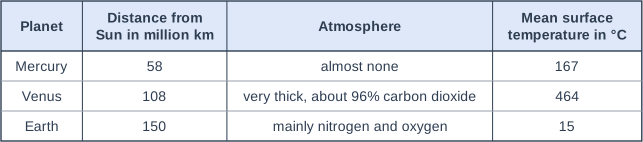
The table gives information about three planets.

Mercury is closer to the Sun than Venus, but the mean surface temperature of Venus is much higher.

Suggest why. Use the information in the table and your knowledge of the greenhouse effect.

Table with columns "Planet", "Distance from Sun in million km", "Atmosphere", "Mean surface temperature in °C". Planet: Mercury; Distance from Sun in million km: 58; Atmosphere: almost none; Mean surface temperature in °C: 167 | Planet: Venus; Distance from Sun in million km: 108; Atmosphere: very thick, about 96% carbon dioxide; Mean surface temperature in °C: 464 | Planet: Earth; Distance from Sun in million km: 150; Atmosphere: mainly nitrogen and oxygen; Mean surface temperature in °C: 15.

Model answer

Venus has a very thick atmosphere made mainly of carbon dioxide, a greenhouse gas. The carbon dioxide absorbs the long wavelength radiation emitted by the surface of Venus and re-emits much of it back towards the surface, so the planet is kept very hot. Mercury has almost no atmosphere, so the long wavelength radiation emitted by its surface escapes straight into space, and it is cooler even though it is closer to the Sun.

Explanation

Distance from the Sun is not the only factor that decides a planet's temperature. Venus shows a very strong greenhouse effect, which is why its surface is hotter than Mercury's. The Earth's thinner atmosphere, with small amounts of greenhouse gases, gives a much smaller warming effect.

Mark scheme
  1. 1 mark

    Venus has a very thick atmosphere of (mainly) carbon dioxide, which is a greenhouse gas

    must use the information about the atmosphere

  2. 1 mark

    the carbon dioxide absorbs long wavelength (infrared) radiation emitted by the surface of Venus and re-emits it back towards the surface

    allow less energy escapes to space

  3. 1 mark

    Mercury has almost no atmosphere, so the long wavelength radiation from its surface escapes into space

    allow no greenhouse effect on Mercury

Question 4

4 marks

Describe the greenhouse effect in terms of the interaction of short and long wavelength radiation with matter.

Model answer

Short wavelength radiation from the Sun passes through the atmosphere and is absorbed by the Earth's surface, which warms up. The warm surface emits long wavelength (infrared) radiation. Greenhouse gases in the atmosphere, such as carbon dioxide, methane and water vapour, absorb some of this long wavelength radiation and re-emit it in all directions, including back towards the Earth's surface. This keeps the Earth warmer than it would be without these gases.

Explanation

The key is the change of wavelength: greenhouse gases let short wavelength radiation through, but absorb long wavelength radiation. A common mistake is to say the radiation is 'reflected' by the greenhouse gases or bounces off the ozone layer; it is absorbed and re-emitted.

Mark scheme
  1. 1 mark

    short wavelength radiation from the Sun passes through the atmosphere

    max 4; allow visible light / ultraviolet for short wavelength radiation

  2. 1 mark

    it is absorbed by the Earth's surface, which warms up

  3. 1 mark

    the Earth's surface emits long wavelength (infrared) radiation

    do not accept 'the radiation is reflected' as the surface emitting long wavelength radiation

  4. 1 mark

    greenhouse gases (in the atmosphere) absorb some of the long wavelength radiation

    do not accept greenhouse gases absorb short wavelength radiation; do not accept 'trap' alone without absorb

  5. 1 mark

    they re-emit it in all directions, including back towards the Earth, so the atmosphere / surface is kept warmer

Ready to try the rest? Every answer you write is marked against the mark scheme, so you can see exactly where the marks are.

Revision notes

Greenhouse gases

The big idea

Greenhouse gases in the atmosphere keep the Earth's temperature high enough to support life. The main ones are water vapour (H₂O), carbon dioxide (CO₂) and methane (CH₄). To explain how they work, you describe how short and long wavelength radiation interact with the Earth's surface and with the gases in the air.

Which gases are greenhouse gases?

  • Water vapour, carbon dioxide and methane are greenhouse gases, even though together they make up only a small proportion of the air.
  • Nitrogen and oxygen, about 99% of the air, are not greenhouse gases, and neither is argon.

How the greenhouse effect works

  1. The Sun gives out short wavelength radiation, such as visible light.
  2. Much of this radiation passes through the atmosphere, because greenhouse gases absorb very little of it.
  3. The Earth's surface absorbs it and warms up.
  4. The warm surface emits long wavelength radiation (infrared).
  5. Greenhouse gas molecules absorb some of this long wavelength radiation...
  6. ...and re-emit it in all directions, including back towards the Earth. Less energy escapes into space, so the surface and the lower atmosphere stay warmer.
Short wavelength radiationLong wavelength radiation
Given out bythe Sunthe warm surface of the Earth
Examplevisible lightinfrared
What greenhouse gases dolet most of it throughabsorb it and re-emit it

More greenhouse gas, more warming

If the amounts of greenhouse gases increase, more of the long wavelength radiation from the surface is absorbed and re-emitted, less energy escapes into space, and the Earth's mean surface temperature rises. The natural greenhouse effect is essential for life; the concern is that it is being made stronger (see also: Human activities which contribute to an increase in greenhouse gases in the atmosphere).

Evaluating a claim

A student says: "The greenhouse effect is harmful, so it would be best to remove all greenhouse gases from the atmosphere." Evaluate this statement.

  • Greenhouse gases absorb long wavelength radiation emitted by the Earth's surface and re-emit some of it back, so less energy escapes into space.
  • Without them the Earth would be much colder: most of its water would freeze, and it would be too cold for most living things.
  • The problem is not the greenhouse effect itself but an increase in greenhouse gases, which strengthens it and raises the mean surface temperature.
  • Judgement: the statement is wrong. The natural greenhouse effect is needed; the aim should be to stop the amounts of greenhouse gases rising.

Common mistakes

  • Saying greenhouse gases "trap the Sun's rays". The Sun's short wavelength radiation mostly passes through; the gases absorb the long wavelength radiation from the Earth.
  • Saying the Earth "reflects" infrared radiation. The warm surface emits it.
  • Mixing up the greenhouse effect with the ozone layer, which absorbs ultraviolet radiation. They are different things.
  • Naming nitrogen or oxygen as greenhouse gases.
  • Swapping the wavelengths. Short wavelengths come in from the Sun; long wavelengths go out from the Earth.

Exam tip

Say "short wavelength" and "long wavelength" every time, never just "heat" or "rays", and use the verbs absorb, emit and re-emit. "The gases trap heat" explains nothing, and saying the gases "reflect" radiation is wrong.

Study Helper Hints first, answers after you try

Stuck on this one? Ask for a hint and I’ll point you in the right direction, without giving the answer away. Once you’ve checked your answer, I’ll show you how the marks are awarded.