Level:
Correct: 0
Incorrect: 0
Marks: 0/0
Exam Practice
Course:
Topics:
AQA GCSE Combined Science (Chemistry Paper 2) Smart practice A mixed round aimed at your weak spots
Unit 6
The rate and extent of chemical change
Unit 7
Organic chemistry
Unit 8
Chemical analysis
Unit 9
Chemistry of the atmosphere
Unit 10
Using resources
Avg
score:
–
Topics
done:
0/38

Formulations

Practise 12 exam-style questions on Formulations for AQA GCSE Combined Science (Chemistry Paper 2). Write your answer as you would in the exam and get it marked in seconds against the mark scheme, point by point, with the Study Helper on hand if you get stuck.

  • 12 questions
  • 1–6 marks each
  • Instant marking
  • No sign-up needed
12 questions, marked as you go

Sample questions with model answers

Here are 4 of the questions in this topic, each with a model answer, an explanation of why it earns the marks and the mark scheme an examiner would use.

Question 1

2 marks

Give two examples of products that are formulations.

Model answer

Paint and medicines (for example tablets).

Explanation

Formulations include fuels, cleaning agents, paints, medicines, alloys, fertilisers and foods. In each, several substances are mixed in fixed proportions to make a product that does a particular job.

Mark scheme
  1. 1 mark

    any one from: fuels, cleaning agents, paints, medicines, alloys, fertilisers, foods

    max 2; allow named examples, e.g. washing-up liquid, petrol, brass, tablets, toothpaste, soft drinks

  2. 1 mark

    a second correct example

    do not accept water, salt or other pure substances

Question 2

2 marks

Petrol sold for cars is a formulation. Small amounts of several additives are mixed into the petrol.

Suggest why each additive is added in a carefully measured amount.

Model answer

Each additive has a particular job, such as keeping the engine clean or helping it to run smoothly. It must be added in the right amount: too little would not work, and too much could change the properties of the fuel or damage the engine.

Explanation

Fuels are formulations: the main hydrocarbons are mixed with measured amounts of other substances so that the fuel has exactly the properties needed.

Mark scheme
  1. 1 mark

    each additive has a particular purpose / gives the petrol a particular property

    allow e.g. to keep the engine clean / help the engine run smoothly

  2. 1 mark

    too little would not do its job and too much could damage the engine / change the properties of the fuel

    allow so the fuel has the required properties

Question 3

3 marks

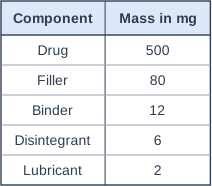
The table shows the components of a medicine tablet.

Calculate the percentage by mass of the drug in the tablet.
Give your answer to 3 significant figures.

Table with columns "Component", "Mass in mg". Component: Drug; Mass in mg: 500 | Component: Filler; Mass in mg: 80 | Component: Binder; Mass in mg: 12 | Component: Disintegrant; Mass in mg: 6 | Component: Lubricant; Mass in mg: 2.

Model answer

Total mass of tablet = 500 + 80 + 12 + 6 + 2 = 600 mg
Percentage of drug = (500 ÷ 600) × 100 = 83.33...%
= 83.3% (3 significant figures)

Explanation

Medicines are formulations: as well as the drug, a tablet contains other substances to help it hold together, break up in the stomach and pass through machines. The exact amount of each must be controlled so that every tablet gives the correct dose.

Mark scheme
  1. 1 mark

    total mass = 500 + 80 + 12 + 6 + 2 = 600 (mg)

    an answer of 83.3 (%) scores 3 marks

  2. 1 mark

    percentage = 500 ÷ 600 × 100 (= 83.33...)

    allow ecf from an incorrect total

  3. 1 mark

    83.3 (%)

    answer to 3 significant figures; allow ecf

Question 4

3 marks

A cleaning spray is a formulation. Each 250 cm³ bottle contains 4.0% detergent by volume.

Calculate the volume of detergent needed to fill 5000 bottles. Give your answer in dm³.

Model answer

Volume of detergent in one bottle = (4.0 ÷ 100) × 250 = 10 cm³
Volume for 5000 bottles = 10 × 5000 = 50 000 cm³
50 000 cm³ ÷ 1000 = 50 dm³

Explanation

Formulations are made by measuring out each component carefully, so manufacturers need these calculations to scale up a recipe. Remember that 1 dm³ = 1000 cm³.

Mark scheme
  1. 1 mark

    volume of detergent in one bottle = 4.0 ÷ 100 × 250 = 10 (cm³)

    an answer of 50 (dm³) scores 3 marks

  2. 1 mark

    volume for 5000 bottles = 10 × 5000 = 50 000 (cm³)

    allow ecf

  3. 1 mark

    50 (dm³)

    allow ecf for correct conversion from cm³ to dm³ (÷ 1000)

Ready to try the rest? Every answer you write is marked against the mark scheme, so you can see exactly where the marks are.

Revision notes

Formulations

The big idea

A formulation is a mixture that has been designed as a useful product. Each chemical in it has a particular purpose, and the components are mixed in carefully measured quantities so that the product has the required properties. Paints, medicines, fuels, cleaning agents, alloys, fertilisers and foods are all formulations.

Is it a formulation?

To identify a formulation from information in a question, look for all three features:

  1. It is a mixture. A pure element or compound can never be a formulation.
  2. It has been designed as a useful product, and each component has a job to do.
  3. The components are added in carefully measured quantities (fixed percentages, masses or proportions).

Being a mixture is not enough. Air, seawater and crude oil are mixtures, but they are natural mixtures that nobody designed, so they are not formulations. Petrol made from crude oil is a formulation, because hydrocarbons and additives are blended in measured amounts so that it burns well in an engine.

Examples and the jobs of their components

You do not need to know the names of the chemicals in branded products, but you should be able to suggest what each type of component is for.

FormulationComponents and their purposes
PaintPigment gives the colour; binder sticks the pigment to the surface and forms a film as the paint dries; solvent makes the paint runny enough to spread, then evaporates
Medicine tabletActive ingredient has the medical effect and must give the right dose; a filler bulks out the tablet; a binder holds it together; a coating makes it easier to swallow
AlloyThe proportion of each metal decides properties such as hardness, strength and melting point
FertiliserCompounds mixed to give set percentages of nitrogen, phosphorus and potassium
Cleaning productDetergent removes grease; a thickener, perfume and colouring make it pleasant to use
Food or drinkIngredients chosen for taste, energy, texture and shelf life, in fixed amounts

Why the quantities must be carefully measured

The properties of a formulation depend on its exact composition. Change the amount of one component and the whole product changes:

  • Medicines: too much active ingredient could be harmful; too little would not work.
  • Paint: too much solvent makes it runny so it drips; too little binder and it flakes off.
  • Alloys: a different proportion of metals gives a different hardness or melting point.

Measuring carefully also means every batch is the same, so the product works the same way each time and meets safety standards.

Calculations with formulations

The amount of each component is often given as a percentage by mass:

\[\text{percentage by mass} = \dfrac{\text{mass of component}}{\text{total mass of product}} \times 100\]

Scaling up a formulation

A test batch of hand cream contains 15.0 g of oil, 6.0 g of emulsifier, 78.5 g of water and 0.5 g of perfume. A factory makes the same cream in batches of 250 kg. What mass of oil does it need for one batch?

Total mass of the test batch: \(15.0 + 6.0 + 78.5 + 0.5 = 100.0\) g

Percentage of oil: \(\dfrac{15.0}{100.0} \times 100 = 15.0\%\)

Mass of oil in 250 kg: \(\dfrac{15.0}{100} \times 250 = 37.5\) kg

Every component must be scaled by the same factor, so the cream has exactly the same properties as the test batch.

Mixing a fuel in the right ratio

A small two-stroke petrol engine, such as a chainsaw's, needs a fuel made of petrol and oil in the ratio 50 : 1 by volume. How much oil should be added to 4.0 dm³ of petrol?

Change to cm³: \(4.0 \times 1000 = 4000\) cm³ of petrol

The oil is \(\dfrac{1}{50}\) of the volume of petrol: \(4000 \div 50 = 80\) cm³ of oil

Too little oil and the engine wears out; too much and it burns with smoky exhaust. The fuel mix is a formulation because the ratio is measured to suit the engine.

Common mistakes

  • Defining a formulation as just "a mixture". It must be designed as a useful product, with components in measured quantities.
  • Calling crude oil, air or seawater formulations. They are natural mixtures that were not designed.
  • Calling a pure compound, such as citric acid, a formulation. It is not a mixture.
  • Working out a percentage using the mass of one other component instead of the total mass.
  • Forgetting unit changes: 1 g = 1000 mg and 1 kg = 1000 g.

Exam tip

For "explain why this product is a formulation", use evidence from the question for each feature: it is a mixture; it is designed for a use (say which); the amounts are measured (quote the percentages or masses). One sentence per feature usually earns a mark each.

Study Helper Hints first, answers after you try

Stuck on this one? Ask for a hint and I’ll point you in the right direction, without giving the answer away. Once you’ve checked your answer, I’ll show you how the marks are awarded.