Level:
Correct: 0
Incorrect: 0
Marks: 0/0
Exam Practice
Course:
Topics:
AQA GCSE Combined Science (Chemistry Paper 2) Smart practice A mixed round aimed at your weak spots
Unit 6
The rate and extent of chemical change
Unit 7
Organic chemistry
Unit 8
Chemical analysis
Unit 9
Chemistry of the atmosphere
Unit 10
Using resources
Avg
score:
–
Topics
done:
0/38

Alternative methods of extracting metals (HT only)

Practise 14 exam-style questions on Alternative methods of extracting metals (HT only) for AQA GCSE Combined Science (Chemistry Paper 2). Write your answer as you would in the exam and get it marked in seconds against the mark scheme, point by point, with the Study Helper on hand if you get stuck.

  • 14 questions
  • 1–6 marks each
  • Instant marking
  • No sign-up needed
14 questions, marked as you go

Sample questions with model answers

Here are 4 of the questions in this topic, each with a model answer, an explanation of why it earns the marks and the mark scheme an examiner would use.

Question 1

2 marks

Copper ores are becoming scarce.

Explain why scientists are developing new ways of extracting copper from low-grade ores.

Model answer

The Earth's resources of metal ores are limited, and the high-grade copper ores are running out. The remaining low-grade ores contain very little copper, so extracting it by traditional mining would mean digging, moving and disposing of huge amounts of rock for a small amount of copper.

Explanation

As demand for copper increases and the richest ores are used up, it becomes worthwhile to extract copper from low-grade ores and even mine waste. Phytomining and bioleaching do this without traditional mining.

Mark scheme
  1. 1 mark

    high-grade copper ores are running out / metal ores are a limited (finite) resource

  2. 1 mark

    low-grade ores contain very little copper, so traditional mining would mean digging, moving and disposing of very large amounts of rock

    allow traditional methods would be too expensive / use too much energy for the copper obtained

Question 2

2 marks

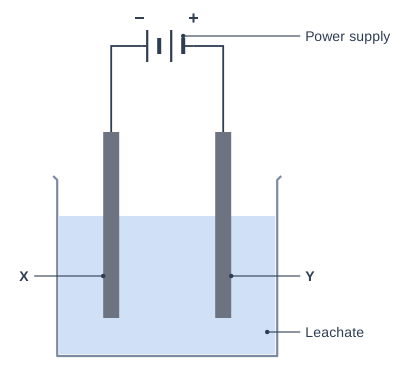
The diagram shows how copper can be obtained from the leachate produced by bioleaching, using electrolysis. The leachate contains copper ions, Cu²⁺.

Write a half equation for the reaction at electrode X.

Diagram of an electrolysis cell. Label X points to the left electrode, connected to the negative terminal; label Y points to the right electrode, connected to the positive terminal; "Leachate" labels the liquid in the container; "Power supply" labels the power supply symbol at the top.

Model answer

Cu²⁺ + 2e⁻ → Cu

Explanation

Electrode X is the cathode (the negative electrode). The positive copper ions are attracted to it, and each gains two electrons to form a copper atom, so copper metal is deposited on the cathode. Gaining electrons is reduction.

Mark scheme
  1. 1 mark

    Cu²⁺ + e⁻ → Cu (correct species)

    copper ions and electrons on the left, copper on the right; an answer of Cu²⁺ + 2e⁻ → Cu scores 2 marks

  2. 1 mark

    Cu²⁺ + 2e⁻ → Cu

    fully balanced; ignore state symbols

Question 3

3 marks

Scrap iron is used to displace copper from a solution of copper ions.

Write an ionic equation for the reaction between iron atoms and copper ions (Cu²⁺). Iron forms Fe²⁺ ions.
Identify which species is oxidised and which is reduced. Explain your answer in terms of electrons.

Model answer

Fe + Cu²⁺ → Fe²⁺ + Cu
Iron atoms are oxidised, because each iron atom loses two electrons to form an Fe²⁺ ion. Copper ions are reduced, because each Cu²⁺ ion gains two electrons to form a copper atom.

Explanation

Oxidation is loss of electrons and reduction is gain of electrons. The sulfate ions do not change, so they are spectator ions and are left out of the ionic equation.

Mark scheme
  1. 1 mark

    Fe + Cu²⁺ → Fe²⁺ + Cu

    ignore state symbols; do not accept equations including sulfate ions

  2. 1 mark

    iron (atoms) are oxidised because they lose electrons

  3. 1 mark

    copper ions are reduced because they gain electrons

Question 4

4 marks

Phytomining and bioleaching are both biological methods of extracting copper.

Compare phytomining and bioleaching.

Model answer

Both methods are used to extract copper from low-grade ores, and both avoid the need to dig, move and dispose of large amounts of rock. Phytomining uses plants, which absorb copper compounds and are then harvested and burned to give ash containing copper compounds. Bioleaching uses bacteria, which produce a leachate solution containing copper compounds. Phytomining is slow, because the plants take time to grow, and it needs large areas of land, whereas the leachate from bioleaching can be toxic and may pollute water if it escapes.

Explanation

A comparison needs points about both methods: what they have in common and how they differ. Using 'whereas' or 'but' links the two methods in the same sentence.

Mark scheme
  1. 1 mark

    similarity: both are used to extract copper from low-grade ores

    max 4; for full marks at least one similarity and one difference are needed

  2. 1 mark

    similarity: both avoid digging, moving and disposing of large amounts of rock

  3. 1 mark

    difference: phytomining uses plants, whereas bioleaching uses bacteria

  4. 1 mark

    difference: phytomining produces ash containing copper compounds, whereas bioleaching produces a solution (leachate)

  5. 1 mark

    difference: phytomining is slow because the plants take time to grow / needs large areas of land

  6. 1 mark

    difference: the leachate from bioleaching can be toxic and may pollute water

Ready to try the rest? Every answer you write is marked against the mark scheme, so you can see exactly where the marks are.

Revision notes

Alternative methods of extracting metals (HT only)

The big idea

The Earth's resources of metal ores are limited. Copper ores are becoming scarce: most of the copper-rich (high-grade) ore has been mined, so copper now has to come from low-grade ores that contain only a small percentage of copper. Phytomining and bioleaching use living things to extract copper compounds from these ores, avoiding the huge amounts of rock moved in traditional mining.

Why low-grade ores are a problem

If an ore is 0.5% copper, every tonne of copper needs 200 tonnes of rock, and 199 tonnes of it is waste. Traditional mining of such an ore means digging, moving and disposing of large amounts of rock:

  • digging destroys habitats, scars the landscape and causes noise and dust;
  • moving the rock burns a lot of fuel;
  • the waste rock ends up in large heaps.

Phytomining and bioleaching avoid this, and they can obtain copper from ores and mine waste that would be uneconomic to mine.

Phytomining

Phytomining uses plants to absorb metal compounds.

  1. Plants are grown on soil that contains low concentrations of copper compounds (low-grade ore, mine waste or contaminated land).
  2. The plants absorb copper compounds through their roots, and the compounds build up in the plants.
  3. The plants are harvested and burned.
  4. The ash contains copper compounds, which are processed to obtain the metal.

Burning removes most of the plant material as carbon dioxide and water, so the copper compounds are much more concentrated in the small mass of ash, which makes the ash cheaper to process. The energy released can be used to generate electricity. The ash is then dissolved in an acid to give a solution of copper compounds.

On contaminated land, phytomining also cleans up the soil so that it can be used again.

Bioleaching

Bioleaching uses bacteria to produce leachate solutions that contain metal compounds. The bacteria grow on a heap of low-grade ore and break it down, releasing copper ions into solution. This solution, the leachate, is collected. Leachate is acidic and contains toxic metal compounds, so the site must be designed to stop it leaking into soil, rivers or ground water.

From metal compounds to copper metal

Both methods produce metal compounds, not the metal itself. Copper can be obtained from a solution of copper compounds in two ways.

Displacement using scrap iron. Iron is more reactive than copper, so it displaces copper from its compounds:

Fe(s) + CuSO₄(aq) → FeSO₄(aq) + Cu(s)

As an ionic equation: Fe(s) + Cu²⁺(aq) → Fe²⁺(aq) + Cu(s)

This is a redox reaction. Iron atoms lose electrons and are oxidised (Fe → Fe²⁺ + 2e⁻); copper ions gain electrons and are reduced (Cu²⁺ + 2e⁻ → Cu). Scrap iron is used because it is cheap, it does not need to be pure, and using it recycles waste metal.

Electrolysis. The solution is the electrolyte. Positive copper ions are attracted to the negative electrode (the cathode), where they gain electrons and copper metal is deposited:

Cu²⁺ + 2e⁻ → Cu

Electrolysis gives purer copper than displacement, but it needs large amounts of electricity.

Diagram of an electrolysis cell. "d.c. power supply" labels the power supply symbol at the top; "Cathode: copper forms" labels the left electrode, connected to the negative terminal; "Anode" labels the right electrode, connected to the positive terminal; "Leachate" labels the liquid in the container.
Copper ions in the leachate move to the negative electrode (cathode), where copper metal is deposited.

Evaluating the biological methods

AdvantagesDisadvantages
Avoid digging, moving and disposing of large amounts of rockSlow: crops take months to grow; bioleaching can take years
Less damage to landscapes and habitats; less noise and dustOnly small amounts of metal are obtained
Can use low-grade ores and mine waste that would be uneconomic to minePhytomining needs a large area of land
Use less energy than crushing and smelting ore; bioleaching releases no sulfur dioxideThe metal compounds still need processing by displacement or electrolysis
Plants absorb carbon dioxide as they growLeachate can pollute if it escapes; burning plants releases carbon dioxide

How much land does phytomining need?

A company wants to obtain 1.5 tonnes of copper each year by phytomining. Each hectare of land produces 12 tonnes of dried plants a year, and the dried plants contain 0.25% copper by mass. Calculate the area of land needed.

Copper from one hectare: \(12 \times \dfrac{0.25}{100} = 0.030\) tonnes (30 kg)

Area needed: \(\dfrac{1.5}{0.030} = 50\) hectares

This shows a disadvantage of phytomining: a large area of land is needed to produce a small mass of copper.

Common mistakes

  • Saying plants absorb copper metal. They absorb copper compounds (copper ions) from the soil.
  • Mixing up the two methods. Phytomining uses plants; bioleaching uses bacteria.
  • Saying iron is more reactive than "copper sulfate". Compare the metals: iron is more reactive than copper.
  • Saying copper forms at the anode. Copper ions are positive, so copper is deposited at the cathode.
  • Writing "better for the environment" with no detail. Say how: for example, no large amounts of rock are dug up, moved and dumped.

Exam tip

"Evaluate" questions give you data on two methods. Use the numbers for both sides (speed, energy, pollution, how much metal is recovered), then give a conclusion with a reason; a conclusion with no reason does not earn the last mark. In half equations, show the electrons as 2e⁻ and check the charges balance.

Study Helper Hints first, answers after you try

Stuck on this one? Ask for a hint and I’ll point you in the right direction, without giving the answer away. Once you’ve checked your answer, I’ll show you how the marks are awarded.