Level:
Correct: 0
Incorrect: 0
Marks: 0/0
Exam Practice
Course:
Topics:
AQA GCSE Combined Science (Chemistry Paper 2) Smart practice A mixed round aimed at your weak spots
Unit 6
The rate and extent of chemical change
Unit 7
Organic chemistry
Unit 8
Chemical analysis
Unit 9
Chemistry of the atmosphere
Unit 10
Using resources
Avg
score:
–
Topics
done:
0/38

Properties of hydrocarbons

Practise 14 exam-style questions on Properties of hydrocarbons for AQA GCSE Combined Science (Chemistry Paper 2). Write your answer as you would in the exam and get it marked in seconds against the mark scheme, point by point, with the Study Helper on hand if you get stuck.

  • 14 questions
  • 1–6 marks each
  • Instant marking
  • No sign-up needed
14 questions, marked as you go

Sample questions with model answers

Here are 4 of the questions in this topic, each with a model answer, an explanation of why it earns the marks and the mark scheme an examiner would use.

Question 1

2 marks

Describe how the viscosity and the flammability of hydrocarbons change as the size of their molecules increases.

Model answer

As the molecules get larger, the viscosity increases (the hydrocarbon becomes thicker and flows less easily) and the flammability decreases (it becomes harder to ignite).

Explanation

Small hydrocarbon molecules are runny and catch fire easily; large ones are thick, sticky and hard to light. These trends decide how each fraction is used.

Mark scheme
  1. 1 mark

    viscosity increases

    allow larger molecules are thicker / flow less easily

  2. 1 mark

    flammability decreases

    allow larger molecules are harder to ignite / burn less easily

Question 2

2 marks

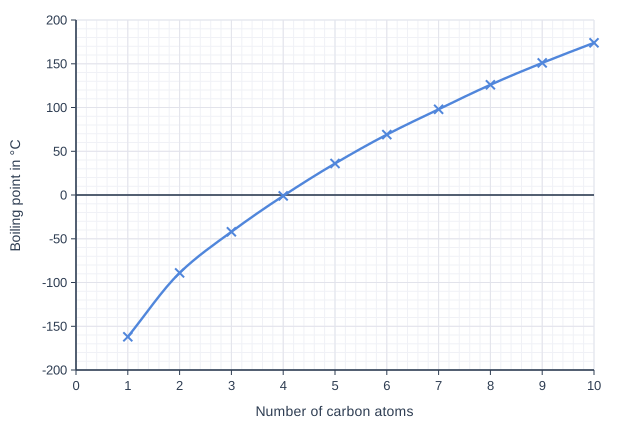
The graph shows the boiling points of the alkanes with 1 to 10 carbon atoms.

Room temperature is 20 °C. Use the graph to determine how many of these alkanes are gases at room temperature. Give a reason for your answer.

Line graph of boiling point in °C (y-axis, -200 to 200) against number of carbon atoms (x-axis, 0 to 10). The line is a smooth curve through (1, -162), (2, -89), (3, -42), (4, -1), (5, 36), (6, 69), (7, 98), (8, 126), (9, 151), (10, 174).

Model answer

Four alkanes are gases at room temperature: those with 1 to 4 carbon atoms, because their boiling points are below 20 °C. The alkane with 5 carbon atoms boils at 36 °C, so it is a liquid at room temperature.

Explanation

A substance is a gas at a temperature above its boiling point. The graph shows boiling point rising with the number of carbon atoms, crossing 20 °C between 4 and 5 carbon atoms.

Mark scheme
  1. 1 mark

    4

    allow the first four / methane, ethane, propane and butane

  2. 1 mark

    their boiling points are below 20 °C

    allow only alkanes with 1 to 4 carbon atoms have boiling points below room temperature

Question 3

3 marks

Butane, C₄H₁₀, is used as a fuel in gas lighters.

Write a balanced symbol equation for the complete combustion of butane. Use whole numbers.

Model answer

2C₄H₁₀ + 13O₂ → 8CO₂ + 10H₂O

Explanation

One butane molecule makes 4CO₂ and 5H₂O, which contain 8 + 5 = 13 oxygen atoms, or 6½ O₂ molecules. Doubling every number gives whole numbers: 2C₄H₁₀ + 13O₂ → 8CO₂ + 10H₂O.

Mark scheme
  1. 1 mark

    C₄H₁₀ + O₂ → CO₂ + H₂O

    correct formulae

  2. 1 mark

    4CO₂ and 5H₂O for each C₄H₁₀

    allow C₄H₁₀ + 6½O₂ → 4CO₂ + 5H₂O for 2 marks

  3. 1 mark

    2C₄H₁₀ + 13O₂ → 8CO₂ + 10H₂O

    whole numbers needed for the third mark

Question 4

4 marks

Methane burns completely in oxygen:

CH₄ + 2O₂ → CO₂ + 2H₂O

Relative atomic masses (Ar): H = 1, C = 12, O = 16

Calculate the mass of carbon dioxide produced when 32 g of methane burns completely.

Model answer

Mr of CH₄ = 12 + (4 × 1) = 16
Mr of CO₂ = 12 + (2 × 16) = 44
Moles of CH₄ = 32 ÷ 16 = 2.0 mol
The equation shows 1 mol CH₄ gives 1 mol CO₂, so moles of CO₂ = 2.0 mol
Mass of CO₂ = 2.0 × 44 = 88 g

Explanation

Convert the mass of methane to moles, use the balanced equation to find the moles of carbon dioxide, then convert back to mass. The mass of carbon dioxide is greater than the mass of methane because each carbon atom gains two oxygen atoms.

Mark scheme
  1. 1 mark

    Mr of CH₄ = 16 and Mr of CO₂ = 44

    an answer of 88 (g) scores 4 marks

  2. 1 mark

    moles of CH₄ = 32 ÷ 16 = 2.0 (mol)

    allow ecf from an incorrect Mr

  3. 1 mark

    moles of CO₂ = 2.0 (mol) (1 : 1 ratio)

    allow ecf

  4. 1 mark

    mass of CO₂ = 2.0 × 44 = 88 (g)

    allow ecf

Ready to try the rest? Every answer you write is marked against the mark scheme, so you can see exactly where the marks are.

Revision notes

Properties of hydrocarbons

The big idea

How a hydrocarbon behaves depends on the size of its molecules. As the molecules get bigger, the boiling point and viscosity go up and the flammability goes down. These three properties decide which hydrocarbons make good fuels. When a hydrocarbon fuel burns, it releases energy, and complete combustion produces carbon dioxide and water.

Three properties that depend on molecule size

PropertyWhat it meansAs the molecules get bigger
Boiling pointThe temperature at which the liquid boilsIncreases
ViscosityHow easily a liquid flows (its resistance to flowing): a viscous liquid is thick, like treacleIncreases, so the liquid flows less easily
FlammabilityHow easily the substance catches fire (ignites)Decreases, so it is harder to ignite

Why the trends happen. Bigger hydrocarbon molecules have stronger intermolecular forces (forces between the molecules). More energy is needed to overcome these forces, so the boiling point is higher. The stronger forces also stop the molecules sliding past each other easily, so the liquid is more viscous. Big molecules do not evaporate easily, and a fuel must form a vapour that mixes with air before it can burn, so bigger hydrocarbons are harder to ignite.

When a hydrocarbon boils, only the forces between molecules are overcome. The covalent bonds inside the molecules do not break.

How the properties affect uses as fuels

  • Small molecules (such as those in LPG and petrol) have low boiling points, flow easily and ignite easily. Petrol suits a car engine, where the fuel must vaporise and catch fire quickly.
  • Large molecules (such as those in heavy fuel oil) have high boiling points, are very viscous and are hard to ignite. Heavy fuel oil has to be heated to make it flow, so it is used where it can burn steadily in large engines and boilers, such as in ships and power stations.
  • A hydrocarbon is a gas at a given temperature if its boiling point is below that temperature. The smallest alkanes (methane to butane) are gases at room temperature.

Combustion

The combustion of hydrocarbon fuels releases energy. During combustion, the carbon and hydrogen in the fuel are oxidised: they gain oxygen. With plenty of oxygen, complete combustion happens:

hydrocarbon + oxygen → carbon dioxide + water

For example, for propane: C₃H₈ + 5O₂ → 3CO₂ + 4H₂O

To balance a combustion equation for any hydrocarbon:

  1. Write the formulae: hydrocarbon + O₂ → CO₂ + H₂O.
  2. Balance the carbon: one CO₂ for each carbon atom.
  3. Balance the hydrogen: one H₂O for every two hydrogen atoms.
  4. Count the oxygen atoms on the right, and halve the number to get the O₂ needed. If you get a half, double every number.

Checking a student's combustion equation

A student writes this equation for the complete combustion of hexane: C₆H₁₄ + 9O₂ → 6CO₂ + 7H₂O. Is it balanced? If not, correct it.

Carbon: 6 atoms on each side. Hydrogen: 14 on the left and \(7 \times 2 = 14\) on the right. Both balance.

Oxygen: \(9 \times 2 = 18\) atoms on the left, but \((6 \times 2) + 7 = 19\) on the right. The oxygen does not balance.

19 oxygen atoms are needed, which is \(19 \div 2 = 9\tfrac{1}{2}\) O₂: C₆H₁₄ + 9½O₂ → 6CO₂ + 7H₂O

Double every number to remove the half: 2C₆H₁₄ + 19O₂ → 12CO₂ + 14H₂O

With state symbols at room temperature, where hexane and water are liquids: 2C₆H₁₄(l) + 19O₂(g) → 12CO₂(g) + 14H₂O(l)

You can show the products of combustion in the lab: draw the gases from a flame through a cooled tube, where the water condenses and turns white anhydrous copper sulfate blue, then through limewater, which turns milky, showing carbon dioxide.

Remember

  • Bigger molecules: higher boiling point, higher viscosity, lower flammability.
  • Viscosity is how easily a liquid flows.
  • Combustion releases energy; the carbon and hydrogen in the fuel are oxidised.
  • Complete combustion of a hydrocarbon gives carbon dioxide and water only.

Common mistakes

  • Getting the flammability trend the wrong way round. Bigger molecules are less flammable.
  • Saying covalent bonds break when a hydrocarbon boils. Only the intermolecular forces are overcome.
  • Giving carbon monoxide, carbon or hydrogen as products of complete combustion. The products are carbon dioxide and water.
  • Writing O instead of O₂, or leaving a half in an equation when the question wants whole numbers.
  • Saying burning a fuel "makes energy". Combustion releases energy.

Exam tip

"Compare" questions need comparative words for both fuels: "kerosene has smaller molecules than diesel oil, so it has a lower boiling point, a lower viscosity and is more flammable". Then link each property to how the fuel is used.

Study Helper Hints first, answers after you try

Stuck on this one? Ask for a hint and I’ll point you in the right direction, without giving the answer away. Once you’ve checked your answer, I’ll show you how the marks are awarded.