Level:
Correct: 0
Incorrect: 0
Marks: 0/0
Practice
Course:
Topics:
Year 8 Maths Smart practice A mixed round aimed at your weak spots
Unit 1
Number: accuracy, powers and standard form
Unit 2
Fractions, decimals and percentages
Unit 3
Algebraic expressions
Unit 4
Equations, inequalities and formulae
Unit 5
Sequences and graphs
Unit 6
Ratio, proportion and rates of change
Unit 7
Circles, area and volume
Unit 8
Angles and constructions
Unit 9
Transformations and symmetry
Unit 10
Probability
Unit 11
Statistics
Avg
score:
–
Topics
done:
0/50

Volume of prisms

Practise 25 questions on Volume of prisms for Year 8 Maths. Write your answer and get it marked in seconds against the mark scheme, point by point, with the Study Helper on hand if you get stuck.

  • 25 questions
  • 1–5 marks each
  • Instant marking
  • No sign-up needed
20 questions, marked as you go

Sample questions with model answers

Here are 4 of the questions in this topic, each with a model answer, an explanation of why it earns the marks and the mark scheme.

Question 1

1 mark

A fish bowl holds 6500 cm³ of water.

How many litres of water does the fish bowl hold?

Model answer

1 litre = 1000 cm³
\(6500 \div 1000 = 6.5\)
6.5 litres

Explanation

There are 1000 cm³ in 1 litre, so divide the number of cm³ by 1000. Dividing by 1000 moves every digit three places to the right, so 6500 becomes 6.5. A common mistake is to divide by 100 and get 65 litres, which is far too much for a fish bowl.

Mark scheme
  1. 1 mark

    6.5 (litres)

    1 litre = 1000 cm³, so \(6500 \div 1000 = 6.5\). Accept \(6\dfrac{1}{2}\). The unit is given in the question, so 6.5 on its own scores the mark. Do not accept 65 (dividing by 100) or 6500. A correct answer with no working scores full marks.

Question 2

2 marks

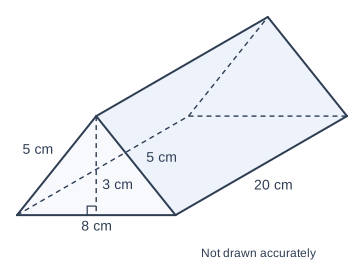
The diagram shows a pencil case in the shape of a triangular prism.

Work out the volume of the pencil case.

A triangular prism drawn in 3D with hidden edges shown as dashed lines. Its end is an isosceles triangle. The base of the triangle is labelled 8 cm (along the bottom edge of the front triangle). The height of the triangle is labelled 3 cm (on a dashed line from the top vertex of the front triangle down to its base, at right angles to the base). The length of the prism is labelled 20 cm (along the bottom edge going back from the front triangle). The left-hand side of the triangular end is labelled 5 cm (along the left side of the front triangle). The right-hand side of the triangular end is labelled 5 cm (along the right side of the front triangle). The diagram is labelled "Not drawn accurately".

Model answer

Area of cross-section = \(\dfrac{1}{2} \times 8 \times 3 = 12\) cm²
Volume = \(12 \times 20 = 240\) cm³

Explanation

The height of the triangle is the dashed line at right angles to the base, 3 cm. The sloping 5 cm sides are not the height, so you do not need them here. The area is \(\dfrac{1}{2} \times 8 \times 3 = 12\) cm², so the volume is \(12 \times 20 = 240\) cm³. A common mistake is to use a sloping side as the height.

Mark scheme
  1. 1 mark

    Area of the triangle \(\dfrac{1}{2} \times 8 \times 3 = 12\) (cm²); or the correct answer 240 cm³ with no working

    Also award for \(\dfrac{1}{2} \times 8 \times 3 \times 20\) seen. Using a 5 cm side as the height (e.g. \(\dfrac{1}{2} \times 8 \times 5 = 20\)) scores 0 for this mark.

  2. 1 mark

    240 (cm³)

    Units not needed. Do not accept 400 (using the 5 cm side as the height) or 480 (the half forgotten). A correct answer with no working scores full marks.

Question 3

3 marks

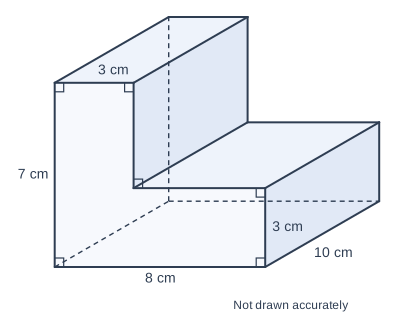
The diagram shows a prism. Its cross-section is an L-shape.

Work out the volume of the prism.

A prism drawn in 3D with hidden edges shown as dashed lines. Its front face (the cross-section) is a 6-sided shape. The length of the prism is labelled 10 cm (along the edge going back from the lowest right-hand corner of the front face). On the front face, the edge from corner 1 to corner 2 is labelled 8 cm, the edge from corner 2 to corner 3 is labelled 3 cm, the edge from corner 5 to corner 6 is labelled 3 cm and the edge from corner 6 to corner 1 is labelled 7 cm. Right angles are marked on the front face. The diagram is labelled "Not drawn accurately".

Model answer

Split the L-shape into two rectangles.
Bottom: \(8 \times 3 = 24\) cm²
Upright part: \(7 - 3 = 4\), so \(3 \times 4 = 12\) cm²
Area = \(24 + 12 = 36\) cm²
Volume = \(36 \times 10 = 360\) cm³

Explanation

Find the area of the L-shaped end first by splitting it into two rectangles. You need the missing height of the upright part, \(7 - 3 = 4\) cm. The area is \(24 + 12 = 36\) cm², and the volume is \(36 \times 10 = 360\) cm³. A common mistake is to use 7 cm for the upright part as well as the 3 cm at the bottom, which counts a corner square twice.

Mark scheme
  1. 1 mark

    A missing length of the cross-section found: 5 (cm) for the top of the step (\(8 - 3\)) or 4 (cm) for the inner upright edge (\(7 - 3\)); or the correct answer 360 cm³ with no working

    Also award for the cross-section split correctly into two rectangles with their lengths, e.g. 8 by 3 and 3 by 4, or 3 by 7 and 5 by 3.

  2. 1 mark

    Area of the cross-section = 36 (cm²)

    e.g. \(8 \times 3 + 3 \times 4 = 24 + 12\), or \(3 \times 7 + 5 \times 3 = 21 + 15\), or \(8 \times 7 - 5 \times 4 = 56 - 20\).

  3. 1 mark

    360 (cm³)

    Follow through: their area × 10, if their area came from adding or subtracting rectangle areas. Units not needed. Do not accept 560 (treating the cross-section as a full 8 by 7 rectangle). A correct answer with no working scores full marks.

Question 4

4 marks

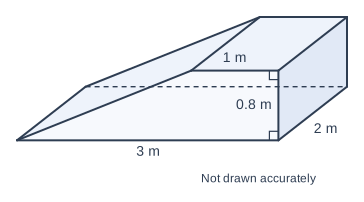
Jamal's youth club is building a concrete ramp for its skate park, as shown in the diagram. The ramp is a prism. Its cross-section is a trapezium.

Concrete costs £85 for each m³. There is also a delivery charge of £40.

Work out the total cost of the concrete for the ramp, including delivery.

A prism drawn in 3D with hidden edges shown as dashed lines. Its front face (the cross-section) is a 4-sided shape. The length of the prism is labelled 2 m (along the edge going back from the lowest right-hand corner of the front face). On the front face, the edge from corner 1 to corner 2 is labelled 3 m, the edge from corner 2 to corner 3 is labelled 0.8 m and the edge from corner 3 to corner 4 is labelled 1 m. Right angles are marked on the front face. The diagram is labelled "Not drawn accurately".

Model answer

Area of cross-section = \(\dfrac{1}{2} \times (3 + 1) \times 0.8 = 2 \times 0.8 = 1.6\) m²
Volume = \(1.6 \times 2 = 3.2\) m³
Concrete: \(3 \times 85 = 255\) and \(0.2 \times 85 = 17\), so \(3.2 \times 85 = 272\)
Total: \(272 + 40 = 312\)
£312

Explanation

Find the area of the trapezium end: the parallel sides are 3 m and 1 m and they are 0.8 m apart, so the area is \(\dfrac{1}{2} \times 4 \times 0.8 = 1.6\) m². The volume is \(1.6 \times 2 = 3.2\) m³, and \(3.2 \times 85 = 272\), so the concrete costs £272. Add the £40 delivery charge to get £312. A common mistake is to work out \(3 \times 0.8 \times 2\), as if the ramp were a cuboid with no sloping face.

Mark scheme
  1. 1 mark

    Area of the trapezium \(\dfrac{1}{2} \times (3 + 1) \times 0.8 = 1.6\) (m²); or the correct answer £312 with no working

    Also award for splitting into a rectangle and a triangle: \(1 \times 0.8 + \dfrac{1}{2} \times 2 \times 0.8 = 0.8 + 0.8 = 1.6\).

  2. 1 mark

    Volume \(1.6 \times 2 = 3.2\) (m³)

    Follow through from their area.

  3. 1 mark

    Cost of the concrete \(3.2 \times 85 = 272\) (£)

    Follow through: their volume × 85, e.g. \(3 \times 85 + 0.2 \times 85 = 255 + 17\). Accept 272 or £272. Rounding the volume up to 4 m³ (£340) loses this mark: the question does not say that only whole m³ can be bought.

  4. 1 mark

    £312

    Follow through: their cost of the concrete + £40. Accept 312 or £312.00. Do not accept £272 (the delivery charge left out). A correct answer with no working scores full marks.

Ready to try the rest? Every answer you write is marked against the mark scheme, so you can see exactly where the marks are.

Topic notes

Volume of prisms

The big idea

A prism is a solid that is the same shape all the way through, like a bar of chocolate or a stick of rock. Because every slice is the same, one simple rule gives the volume of any prism. It tells you how much space a tent, a tank or a box takes up, or how much it can hold.

In Year 7 you found the volume of a cuboid with length × width × height, and the area of a triangle with \(\dfrac{1}{2} \times b \times h\) and of a trapezium with \(\dfrac{1}{2}(a + b)h\). You also met capacity: 1 cm³ = 1 ml, so 1000 cm³ = 1 litre.

What makes a prism?

Slice a prism anywhere, parallel to its end, and you always get the same shape. That shape is the cross-section. A prism has two identical ends joined by rectangles, and it is named after its cross-section: a triangular prism, an L-shaped prism and so on. A cuboid is a prism whose cross-section is a rectangle.

A pyramid or a cone is not a prism, even though it has a flat base: its slices get smaller towards the point.

Volume = area of cross-section × length

\[ \text{volume} = \text{area of cross-section} \times \text{length} \]

Think of the prism as layers 1 cm thick. Each layer is a copy of the cross-section, so a cross-section of 20 cm² gives 20 cm³ in every layer. Find the area of the cross-section first, then multiply by the length.

A triangular prism drawn in 3D with hidden edges shown as dashed lines. Its end is a right-angled triangle. The base of the triangle is labelled 12 cm (along the bottom edge of the front triangle). The height of the triangle is labelled 5 cm (along the vertical left side of the front triangle). The length of the prism is labelled 4 cm (along the bottom edge going back from the front triangle). The right-hand side of the triangular end is labelled 13 cm (along the right side of the front triangle). The diagram is labelled "Diagram NOT accurately drawn".
A wooden doorstop. Its cross-section is a right-angled triangle with a base of 12 cm, a height of 5 cm and a sloping side of 13 cm.

How much wood is in the doorstop in the diagram?

The cross-section is the triangle at the front. Use the base and the perpendicular height; the 13 cm sloping side is not needed.

Area of the triangle: \(\dfrac{1}{2} \times 12 \times 5 = 30\) cm²

Volume: \(30 \times 4 = 120\) cm³

L-shaped and trapezium cross-sections

For an L-shaped cross-section, split it into two rectangles (work out any missing lengths first), or take a small rectangle away from a big one. For a trapezium, use \(\dfrac{1}{2}(a + b)h\), where \(a\) and \(b\) are the parallel sides.

The end of a wooden beam: a rectangle 10 cm wide and 8 cm high, with a rectangle 6 cm wide and 5 cm high cut away from its top right corner. The cut-away part is outlined with dashed lines. What is left is an L-shape, shaded.
The end of the beam: a 10 cm by 8 cm rectangle with a 6 cm by 5 cm strip cut away (dashed).

A carpenter cuts a strip out of a wooden beam, all the way along, to leave the L-shaped prism in the diagram. The beam is 30 cm long. How much wood is left?

Subtract. The whole end was \(10 \times 8 = 80\) cm². The strip was \(6 \times 5 = 30\) cm².

Area of cross-section: \(80 - 30 = 50\) cm²

Volume: \(50 \times 30 = 1500\) cm³

Check by splitting. The missing lengths are \(8 - 5 = 3\) cm and \(10 - 6 = 4\) cm. Bottom: \(10 \times 3 = 30\) cm². Upright: \(4 \times 5 = 20\) cm². Total: \(30 + 20 = 50\) cm², the same.

Capacity and missing lengths

Volume = area of cross-section × length, so working backwards, length = volume ÷ area of cross-section. When a prism stands on its end, its length is its height. Change litres into cm³ (multiply by 1000) before you divide.

A horse trough is a prism with a trapezium-shaped end: 64 cm across the top, 32 cm across the bottom and 25 cm deep. When it is full it holds 180 litres. How long is the trough?

Area of cross-section: the top and bottom are the parallel sides, and they are 25 cm apart.

\(\dfrac{1}{2} \times (64 + 32) \times 25 = 48 \times 25 = 1200\) cm²

Capacity: 180 litres \(= 180 \times 1000 = 180{,}000\) cm³

Length: \(180{,}000 \div 1200 = 150\) cm, which is 1.5 m.

Check: \(1200 \times 150 = 180{,}000\) cm³, which is 180 litres.

Remember

  • A prism has the same cross-section all the way through.
  • Volume = area of cross-section × length.
  • Length = volume ÷ area of cross-section.
  • Volume is in cubic units, such as cm³ and m³. 1000 cm³ = 1 litre.

Common mistakes

  • Working out base × height × length for a triangular prism. This forgets the half, and gives a volume twice as big.
  • Using the sloping side of a triangle as its height.
  • Counting a corner of an L-shape twice by using the full length of both arms.
  • Dividing by 100 instead of 1000 to change cm³ into litres.
  • Calling a pyramid or a cone a prism because it has a flat base.

Top tip

Shade the cross-section on the diagram. Work out its area and write it down in cm² before you multiply by the length.

Study Helper Hints first, answers after you try

Stuck on this one? Ask for a hint and I’ll point you in the right direction, without giving the answer away. Once you’ve checked your answer, I’ll show you how the marks are awarded.