Practise 25 questions on Enlargement for Year 8 Maths. Write your answer and get it marked in seconds against the mark scheme, point by point, with the Study Helper on hand if you get stuck.
25 questions
1–5 marks each
Instant marking
No sign-up needed
20 questions, marked as you go
Sample questions with model answers
Here are 4 of the questions in this topic, each with a model answer, an explanation of why it earns the marks and the mark scheme.
Question 1
1 mark
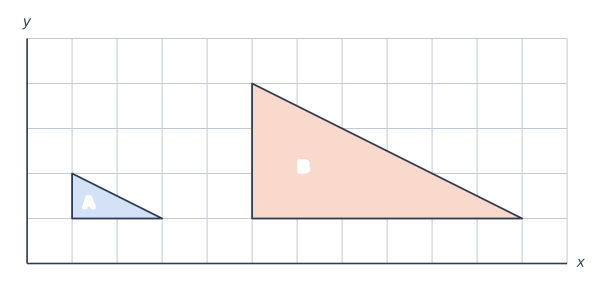
The grid shows a small triangle A and a large triangle B. Triangle B is an enlargement of triangle A.
What is the scale factor?
Model answer
The bottom side of A is 2 squares long. The bottom side of B is 6 squares long. \(6 \div 2 = 3\) Scale factor 3
Explanation
Compare a pair of matching sides: the bottom side of A is 2 squares and the bottom side of B is 6 squares, so every length has been multiplied by 3. Check with the upright sides: 1 square in A and 3 squares in B. A common mistake is to find the difference between the lengths instead of dividing.
Mark scheme
1 mark
3
Accept 'scale factor 3' or 'x3'. 4 (6 - 2, the difference in the bottom sides) scores 0. A correct answer with no working scores full marks.
Question 2
2 marks
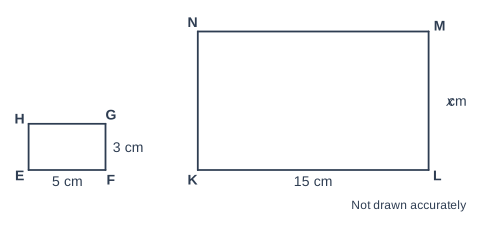
The diagram shows rectangle EFGH and rectangle KLMN. Rectangle KLMN is an enlargement of rectangle EFGH.
Work out the scale factor of the enlargement and the value of \(x\).
Model answer
EF = 5 cm matches KL = 15 cm: \(15 \div 5 = 3\), so the scale factor is 3. \(x\) = LM, which matches FG: \(3 \times 3 = 9\)
Explanation
Find the scale factor from a pair of matching sides, the two lengths: \(15 \div 5 = 3\). Every length of EFGH is multiplied by 3, so the width of KLMN is \(3 \times 3 = 9\) cm. A common mistake is to add 10 to the width because 10 was added to the length; an enlargement multiplies, it does not add.
Mark scheme
1 mark
Scale factor 3
From 15 ÷ 5 (KL and EF). Accept 'x3'.
1 mark
\(x = 9\)
Follow through their scale factor times 3. 13 (3 + 10) scores 0 for this mark. A correct answer with no working scores full marks.
Question 3
3 marks
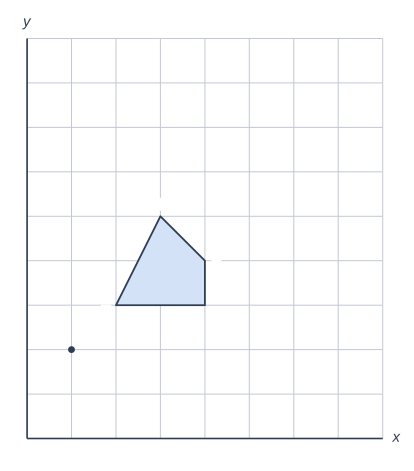
The diagram shows quadrilateral EFGH and the point C.
EFGH is enlarged by scale factor 2, with C as the centre of enlargement. Write the coordinates of the images of E, F, G and H.
Model answer
Work from C \((1, 2)\) and double each move. E: 1 right, 1 up → 2 right, 2 up: \((3, 4)\) F: 3 right, 1 up → 6 right, 2 up: \((7, 4)\) G: 3 right, 2 up → 6 right, 4 up: \((7, 6)\) H: 2 right, 3 up → 4 right, 6 up: \((5, 8)\)
Explanation
For each corner, find the move from the centre C to the corner, multiply it by the scale factor, and make the new move from C. The image is twice as far from C in every direction, so each side of the image is twice as long. Check: EF is 2 units long and its image is 4 units long. A common mistake is to double the coordinates, which uses the origin as the centre instead of C.
Mark scheme
1 mark
One image correct
E goes to (3, 4), F to (7, 4), G to (7, 6) and H to (5, 8). If every image is given for an enlargement from the origin instead, (4, 6), (8, 6), (8, 8), (6, 10), award 1 mark in total.
1 mark
Three images correct
1 mark
All four images correct
Brackets are not needed, but each image must be written in the order (x, y). A correct answer with no working scores full marks.
Question 4
4 marks
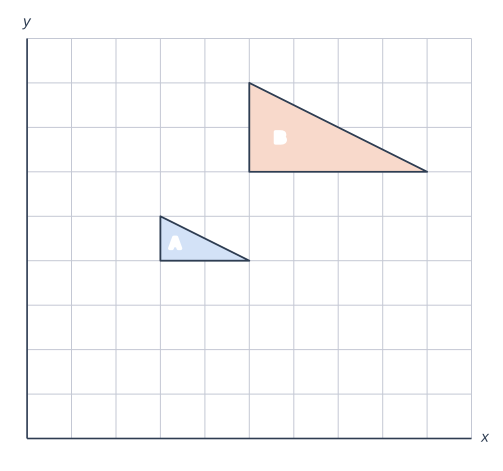
On the grid, triangle B is an enlargement of triangle A.
Find the scale factor. Then find the centre of enlargement, giving its coordinates.
Model answer
The bottom side of A is 2 squares and the bottom side of B is 4 squares, so the scale factor is 2. The corner \((3, 4)\) of A moves to \((5, 6)\) on B: 2 right and 2 up. For scale factor 2, the centre is the same distance back from A: 2 left and 2 down from \((3, 4)\). The centre is \((1, 2)\). Check: \((5, 4)\) is 4 right and 2 up from \((1, 2)\), and \((9, 6)\) is 8 right and 4 up, twice as far. ✓
Explanation
On your own grid, draw straight lines through each corner of B and the matching corner of A and carry them on: they all meet at the centre of enlargement. With scale factor 2, each corner of B is twice as far from the centre as the matching corner of A, so the move from A to B is the same as the move from the centre to A. A common mistake is to assume the centre is the origin.
Mark scheme
1 mark
Scale factor 2; or the correct answers 2 and \((1, 2)\) with no working
From 4 ÷ 2 (the bottom sides) or 2 ÷ 1. Accept 'x2'.
1 mark
A correct method for the centre, e.g. lines through matching corners drawn back until they meet, or 'the corner \((3, 4)\) moves 2 right and 2 up to \((5, 6)\), so the centre is 2 left and 2 down from \((3, 4)\)'; or the correct answer \((1, 2)\) with no working
1 mark
One coordinate of the centre correct
x-coordinate 1 or y-coordinate 2.
1 mark
\((1, 2)\)
Accept 1, 2 without brackets; the coordinates must be in the order (x, y). (0, 0) scores 0 for the last two marks. A correct answer with no working scores full marks.
Ready to try the rest? Every answer you write is marked against the mark scheme, so you can see exactly where the marks are.
Ctrl + Enter to check
Study HelperHints first, answers after you try
Stuck on this one? Ask for a hint and I’ll point you in the right direction, without giving the answer away. Once you’ve checked your answer, I’ll show you how the marks are awarded.