Practise 25 questions on Gradient, intercept and y = mx + c for Year 8 Maths. Write your answer and get it marked in seconds against the mark scheme, point by point, with the Study Helper on hand if you get stuck.
25 questions
1–5 marks each
Instant marking
No sign-up needed
20 questions, marked as you go
Sample questions with model answers
Here are 4 of the questions in this topic, each with a model answer, an explanation of why it earns the marks and the mark scheme.
Question 1
1 mark
Which of these lines is parallel to the line \(y = 3x + 2\)?
Choose your answer.
\(y = 3x - 5\)
\(y = 2x + 3\)
\(y = -3x + 2\)
\(y = 5x + 2\)
Model answer
Parallel lines have the same gradient. \(y = 3x + 2\) has gradient 3. \(y = 3x - 5\) also has gradient 3, so it is parallel.
Explanation
Parallel lines never meet, because they have the same steepness: the same gradient. \(y = 3x + 2\) has gradient 3, and so does \(y = 3x - 5\). The different number on the end just moves the line up or down. A common mistake is to choose a line with the same y-intercept, \(y = 5x + 2\); those lines cross at \((0, 2)\).
Mark scheme
1 mark
\(y = 3x - 5\)
Accept the option typed as y = 3x - 5. Do not accept any other option: \(y = 2x + 3\) swaps the numbers round; \(y = -3x + 2\) has gradient \(-3\), which slopes the other way; \(y = 5x + 2\) has the same y-intercept, not the same gradient.
Question 2
2 marks
A straight line has the equation \(y - 2x = 5\).
Write the gradient of the line and the coordinates of the point where it crosses the y-axis.
Model answer
Add \(2x\) to both sides: \(y = 2x + 5\) Gradient \(= 2\) It crosses the y-axis at \((0, 5)\).
Explanation
Rearrange the equation into the form \(y = mx + c\) by adding \(2x\) to both sides: \(y = 2x + 5\). Now you can read off \(m = 2\) and \(c = 5\). A common mistake is to read the gradient as \(-2\) straight from \(y - 2x = 5\), without rearranging first.
Mark scheme
1 mark
Gradient 2
Do not accept \(-2\) (from not rearranging).
1 mark
\((0, 5)\)
Accept 'y-intercept 5' or c = 5. Do not accept \((5, 0)\). A correct answer with no working scores full marks.
Question 3
3 marks
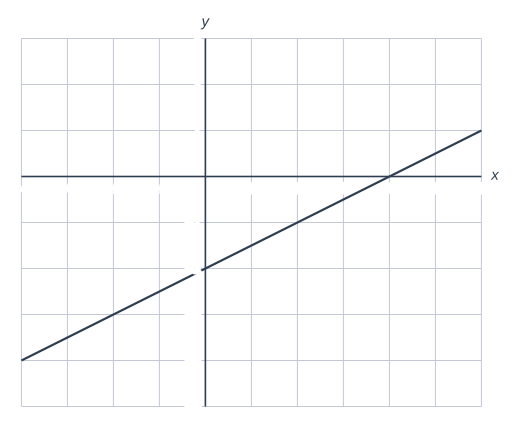
The grid shows line K.
Work out the equation of line K. Give your answer in the form \(y = mx + c\).
Model answer
K crosses the y-axis at \((0, -2)\), so \(c = -2\). From \((0, -2)\) to \((4, 0)\): 4 across, 2 up. \(m = \dfrac{2}{4} = \dfrac{1}{2}\) \(y = \dfrac{1}{2}x - 2\)
Explanation
This line is not steep: it goes up 1 for every 2 across, so the gradient is \(\dfrac{1}{2}\). Use points far apart to see this clearly, such as \((-4, -4)\) and \((4, 0)\): 8 across and 4 up. The line crosses the y-axis at \(-2\), so the equation is \(y = \dfrac{1}{2}x - 2\). A common mistake is to work out across ÷ up and get 2.
Mark scheme
1 mark
Gradient \(\dfrac{1}{2}\) (or 0.5); or the correct answer \(y = \dfrac{1}{2}x - 2\) with no working
Do not accept 2 (run over rise).
1 mark
y-intercept \(-2\)
1 mark
\(y = \dfrac{1}{2}x - 2\)
Accept any equivalent form, e.g. \(y = 0.5x - 2\), y = x/2 - 2 or y = (1/2)x - 2. Follow through their gradient and intercept if both are read from the graph. A correct answer with no working scores full marks.
Question 4
4 marks
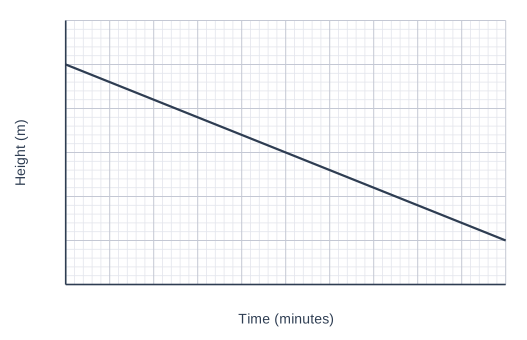
A hot-air balloon comes down at a steady rate. The graph shows its height above the ground for the first 10 minutes.
Find the gradient of the line. Explain what the gradient tells you about the balloon.
The balloon keeps coming down at the same rate. How many minutes after the start does it reach the ground?
Model answer
The line goes from \((0, 500)\) to \((10, 100)\). Gradient \(= \dfrac{100 - 500}{10 - 0} = \dfrac{-400}{10} = -40\) The balloon's height goes down by 40 m every minute. Time to fall 500 m: \(500 \div 40 = 12.5\) minutes
Explanation
Read two points on the line: the balloon starts at 500 m and is at 100 m after 10 minutes. The gradient is the change in height ÷ the change in time, \(-400 \div 10 = -40\), in metres per minute; the minus sign shows it is coming down. At 40 m a minute, falling 500 m takes \(500 \div 40 = 12.5\) minutes. You could also say it falls the last 100 m in \(100 \div 40 = 2.5\) more minutes, so it lands after \(10 + 2.5 = 12.5\) minutes. A common mistake is to give 2.5 minutes, which is only the time after the graph ends.
Mark scheme
1 mark
A correct method for the gradient, e.g. \(\dfrac{100 - 500}{10}\) / a fall of 400 m in 10 minutes
1 mark
Gradient \(-40\)
Accept -40 m per minute. Do not accept 40 for this mark.
1 mark
It tells you the balloon comes down 40 m every minute (its height falls by 40 m each minute)
Follow through their gradient. Accept 'it descends at 40 metres per minute'. Do not accept 'it is going down' with no rate.
1 mark
12.5 minutes
From \(500 \div 40\), or \(10 + 100 \div 40\). Accept 12 and a half minutes or 12 minutes 30 seconds. Do not accept 2.5, 12 or 13. Follow through their rate. The gradient and the time with no working score the first, second and fourth marks; the third mark needs the meaning of the gradient in words. A complete correct explanation (the height goes down 40 m each minute) on its own scores the third mark.
Ready to try the rest? Every answer you write is marked against the mark scheme, so you can see exactly where the marks are.
Ctrl + Enter to check
Study HelperHints first, answers after you try
Stuck on this one? Ask for a hint and I’ll point you in the right direction, without giving the answer away. Once you’ve checked your answer, I’ll show you how the marks are awarded.