Practise 21 questions on Line and rotational symmetry for Year 8 Maths. Write your answer and get it marked in seconds against the mark scheme, point by point, with the Study Helper on hand if you get stuck.
21 questions
1–5 marks each
Instant marking
No sign-up needed
20 questions, marked as you go
Sample questions with model answers
Here are 4 of the questions in this topic, each with a model answer, an explanation of why it earns the marks and the mark scheme.
Question 1
1 mark
A shape only looks the same when it has been turned through a full turn.
What is its order of rotational symmetry?
Choose your answer.
0
1
360
Model answer
In one full turn the shape looks the same only once, at the end of the turn. Order 1
Explanation
The order of rotational symmetry counts how many times a shape looks exactly the same during one full turn. Every shape looks the same after a full turn, so the smallest possible order is 1. A shape with order 1 is often described as having no rotational symmetry. A common mistake is to say the order is 0.
Mark scheme
1 mark
1
Accept 'order 1'. 0 scores 0 (the misconception that a shape with no rotational symmetry has order 0). 360 scores 0 (confusing the order with the angle of a full turn).
Question 2
2 marks
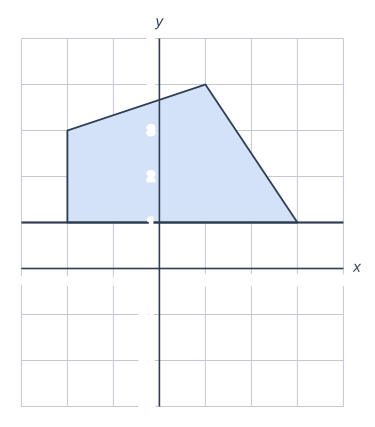
The diagram shows the line \(y = 1\) and the top half of a shape. The bottom half of the shape is the reflection of the top half in the line \(y = 1\).
Write the coordinates of the two corners of the shape that are below the line \(y = 1\).
Model answer
\((1, 4)\) is 3 squares above \(y = 1\), so its image is 3 squares below: \((1, -2)\). \((-2, 3)\) is 2 squares above \(y = 1\), so its image is 2 squares below: \((-2, -1)\).
Explanation
Each corner above the line has a matching corner the same distance below it, with the same x-coordinate. Count the squares from each corner down to the line \(y = 1\), then count the same number again below it. The corners on the line stay where they are. A common mistake is to reflect in the x-axis instead of the line \(y = 1\).
Mark scheme
1 mark
\((1, -2)\)
Accept the two corners in either order, with or without brackets; each corner's coordinates must be in the order (x, y), so (-2, 1) is not the corner (1, -2). Ignore points on the line y = 1 if they are also given. Max 1 if any other wrong point is also given.
1 mark
\((-2, -1)\)
(1, -4) and (-2, -3) (reflected in the x-axis) score 0. A correct answer with no working scores full marks.
Question 3
3 marks
A triangle has rotational symmetry of order 3.
Write the type of triangle. Then write how many lines of symmetry it has and the size of each of its angles.
Model answer
It looks the same after every third of a turn, so its three sides and three angles are equal: it is equilateral. It has 3 lines of symmetry, one through each corner. Each angle is \(180^\circ \div 3 = 60^\circ\).
Explanation
Only an equilateral triangle looks the same after a third of a turn, because each corner moves onto the next one, so all the sides and angles must be equal. It has 3 lines of symmetry, from each corner to the middle of the opposite side. The angles in a triangle add up to \(180^\circ\), so each one is \(60^\circ\). A common mistake is to think an isosceles triangle has rotational symmetry: it has a line of symmetry, but rotational symmetry of order 1 only.
Mark scheme
1 mark
Equilateral
Accept 'an equilateral triangle' or 'a regular triangle'. Isosceles scores 0 for this mark.
1 mark
3 (lines of symmetry)
1 mark
\(60^\circ\)
Accept 60 or 60 degrees. A correct answer with no working scores full marks.
Question 4
4 marks
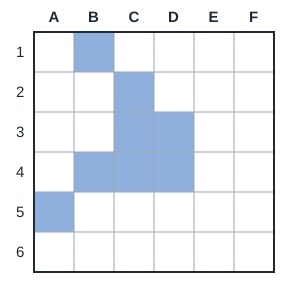
The diagram shows a pattern of shaded squares on a grid. The columns are labelled A to F and the rows 1 to 6.
Sadia wants the finished pattern to have rotational symmetry of order 4 about the centre of the grid. Four more squares need to be shaded.
Which four squares are they? Write each square as a letter and a number, like A2.
Model answer
Turn each shaded square a quarter turn clockwise about the centre, again and again: B1 → F2 → E6 → A5 C2 → E3 → D5 → B4 The four middle squares already work. The squares are F2, E6, E3 and D5.
Explanation
For rotational symmetry of order 4, the pattern must look the same after every quarter turn, so each shaded square must come with the three squares it turns onto. B1 and A5 belong to one set of four, so F2 and E6 are needed; C2 and B4 belong to another set, so E3 and D5 are needed. A common mistake is to find only the squares for a half turn, which gives order 2.
Mark scheme
1 mark
F2
Accept the squares in any order, and 2F for F2. Max 3 if a wrong square is also given.
1 mark
E6
1 mark
E3
1 mark
D5
A correct answer with no working scores full marks.
Ready to try the rest? Every answer you write is marked against the mark scheme, so you can see exactly where the marks are.
Ctrl + Enter to check
Study HelperHints first, answers after you try
Stuck on this one? Ask for a hint and I’ll point you in the right direction, without giving the answer away. Once you’ve checked your answer, I’ll show you how the marks are awarded.