Level:
Correct: 0
Incorrect: 0
Marks: 0/0
Practice
Course:
Topics:
Year 8 Maths Smart practice A mixed round aimed at your weak spots
Unit 1
Number: accuracy, powers and standard form
Unit 2
Fractions, decimals and percentages
Unit 3
Algebraic expressions
Unit 4
Equations, inequalities and formulae
Unit 5
Sequences and graphs
Unit 6
Ratio, proportion and rates of change
Unit 7
Circles, area and volume
Unit 8
Angles and constructions
Unit 9
Transformations and symmetry
Unit 10
Probability
Unit 11
Statistics
Avg
score:
–
Topics
done:
0/50

The nth term of linear sequences

Practise 22 questions on The nth term of linear sequences for Year 8 Maths. Write your answer and get it marked in seconds against the mark scheme, point by point, with the Study Helper on hand if you get stuck.

  • 22 questions
  • 1–5 marks each
  • Instant marking
  • No sign-up needed
20 questions, marked as you go

Sample questions with model answers

Here are 4 of the questions in this topic, each with a model answer, an explanation of why it earns the marks and the mark scheme.

Question 1

1 mark

A sequence has nth term \(\dfrac{1}{2}n + 3\).

Find the value of its 15th term.

Model answer

\(n = 15\)
\(\dfrac{1}{2} \times 15 = 7.5\)
\(7.5 + 3 = 10.5\)
The 15th term is 10.5.

Explanation

\(\dfrac{1}{2}n\) means half of n. Half of 15 is 7.5, and adding 3 gives 10.5. The terms of this sequence go up by \(\dfrac{1}{2}\) each time: 3.5, 4, 4.5, ... A common mistake is to add first and then halve, \((15 + 3) \div 2 = 9\).

Mark scheme
  1. 1 mark

    10.5

    From \(\dfrac{1}{2} \times 15 + 3 = 7.5 + 3\). Accept \(10\dfrac{1}{2}\) or \(\dfrac{21}{2}\), typed in any clear way (10 1/2, 21/2). Do not accept 9 (halving \(15 + 3\)) or 18. A correct answer with no working scores full marks.

Question 2

2 marks

Here is a sequence.

\(2.5, \; 3.2, \; 3.9, \; 4.6, \; \dots\)

Work out the nth term of the sequence.

Model answer

The terms go up by 0.7, so compare with \(0.7n\): 0.7, 1.4, 2.1, 2.8.
Each term is 1.8 more: \(2.5 - 0.7 = 1.8\).
The nth term is \(0.7n + 1.8\).

Explanation

Decimal sequences work in the same way. The difference is 0.7, so start with \(0.7n\), which gives 0.7, 1.4, 2.1, 2.8. Each term of the sequence is 1.8 more, so the nth term is \(0.7n + 1.8\). Check: when \(n = 4\), \(2.8 + 1.8 = 4.6\). A common mistake is to add the first term and write \(0.7n + 2.5\).

Mark scheme
  1. 1 mark

    \(0.7n\) seen (with any number added); or the correct answer \(0.7n + 1.8\) with no working

    Do not award for \(n + 0.7\) (the term-to-term rule).

  2. 1 mark

    \(0.7n + 1.8\)

    Accept any equivalent form, e.g. \(1.8 + 0.7n\) or \(\dfrac{7n + 18}{10}\); ignore 'nth term =' written in front. Do not accept \(0.7n + 2.5\) or \(0.7n + 1.7\). A correct answer with no working scores full marks.

Question 3

2 marks

Here is a sequence.

\(3, \; 8, \; 13, \; 18, \; \dots\)

Ben says, "The nth term is \(5n + 3\)."

Is Ben right? Explain how you know.

Model answer

When \(n = 1\), \(5n + 3 = 5 + 3 = 8\), but the 1st term is 3.
Compare with \(5n\): 5, 10, 15, 20. Each term is 2 less, so the nth term is \(5n - 2\).
No, Ben is not right.

Explanation

Always check an nth term by putting in \(n = 1\). Ben's rule gives \(5 + 3 = 8\), which is the 2nd term, not the 1st. The terms are 2 less than \(5n\), so the nth term is \(5n - 2\). Ben has used the first term as the number part, which is a common mistake.

Mark scheme
  1. 1 mark

    No (Ben is not right), with a relevant but incomplete reason, e.g. 'the number part is wrong' / 'it should be \(5n\) take away something'

    'No' on its own scores 0. Do not accept 'No, because it goes up by 3'.

  2. 1 mark

    A complete correct reason: \(5n + 3\) gives 8 (not 3) when \(n = 1\) / \(5n + 3\) gives 8, 13, 18, ..., which leaves out the 3 / the nth term is \(5n - 2\)

    A complete correct reason on its own scores both marks. Giving the correct nth term \(5n - 2\) (in any equivalent form, e.g. \(-2 + 5n\)), with or without a check, is a complete reason.

Question 4

4 marks

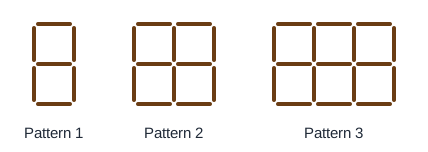
The diagram shows the first three patterns in a sequence made from matchsticks. Each pattern is 2 squares high.

Zara makes one of the patterns in this sequence. She uses exactly 152 matchsticks.

Which pattern does Zara make? How many small squares does her pattern have?

Three patterns made from matchsticks, labelled Pattern 1, Pattern 2 and Pattern 3. Each pattern is a grid of small squares 2 squares high, with each side of a square one matchstick. Pattern 1 is 1 square wide, Pattern 2 is 2 squares wide and Pattern 3 is 3 squares wide.

Model answer

Pattern 1: 7, Pattern 2: 12, Pattern 3: 17 matchsticks
The number goes up by 5, so compare with \(5n\): 5, 10, 15. Each is 2 more.
Pattern n uses \(5n + 2\) matchsticks.
\(5n + 2 = 152\)
\(5n = 150\)
\(n = 30\)
Zara makes Pattern 30. It is 30 squares wide and 2 squares high, so it has \(2 \times 30 = 60\) squares.

Explanation

Each new column of 2 squares needs 5 more matchsticks: 3 across and 2 down the side. So Pattern n uses \(5n + 2\) matchsticks (the 2 is the upright side on the far left, 2 matchsticks tall). Solving \(5n + 2 = 152\) gives \(n = 30\). Pattern n is n squares wide and 2 squares high, so Pattern 30 has 60 squares. A common mistake is to divide 152 by 5 without taking away the 2 first.

Mark scheme
  1. 1 mark

    Counts 7, 12, 17 matchsticks, or says 5 more matchsticks each time; or the correct answers (Pattern 30, 60 squares) with no working

  2. 1 mark

    \(5n + 2\) matchsticks in Pattern n

    Accept any equivalent form, e.g. \(2 + 5n\). Also award for a correct method that adds 5s to 7, e.g. \(7 + 5 \times 29 = 152\).

  3. 1 mark

    Pattern 30

    From \(5n + 2 = 152\), \(5n = 150\). Follow through their nth term if it is of the form \(5n + k\). Do not accept Pattern 31 or 30.4 (\(152 \div 5\)).

  4. 1 mark

    60 (squares)

    From 2 squares in each of 30 columns. Follow through: 2 × their pattern number. A correct answer with no working scores full marks.

Ready to try the rest? Every answer you write is marked against the mark scheme, so you can see exactly where the marks are.

Topic notes

The nth term of linear sequences

The big idea

A linear sequence goes up or down by the same amount each time. Its nth term gives any term straight from its position, \(n\), so you can find far-off terms and test whether a number belongs.

In Year 7 you found the nth term of sequences that go up: the difference goes in front of \(n\), then you compare with that times table.

Finding the nth term of any linear sequence

The same method works when the terms go down, or are negative, decimals or fractions.

  1. Find the difference. If the terms go down, it is negative.
  2. Write it in front of \(n\) and work out the first few terms of that part.
  3. See what you add or subtract to get the sequence, and check with \(n = 1\).

The number part is always the term that would come just before the 1st term.

In a game, Kofi loses the same number of points each round. His scores after rounds 1 to 4 are 8, 2, −4, −10. What did he start on, and what is his score after round 25?

The scores go down by 6, so compare them with \(-6n\): −6, −12, −18, −24.

Each score is 14 more, so the nth term is \(14 - 6n\). Check: \(n = 3\) gives \(14 - 18 = -4\).

He started on 14 points (the term before the 1st). After round 25: \(14 - 6 \times 25 = 14 - 150 = -136\) points.

With fractions: \(\dfrac{1}{2}, 1\dfrac{1}{4}, 2, 2\dfrac{3}{4}, \dots\) goes up by \(\dfrac{3}{4}\). Each term is \(\dfrac{1}{4}\) less than \(\dfrac{3}{4}n\), so the nth term is \(\dfrac{3}{4}n - \dfrac{1}{4}\).

Is a number in the sequence?

To find a term, put its position in place of \(n\). To test a number, make the nth term equal to it and solve the equation. The number is a term only if \(n\) is a whole number.

Are 15.1 and 20 terms of 1.3, 1.9, 2.5, 3.1, ...?

The difference is 0.6, and each term is 0.7 more than \(0.6n\), so the nth term is \(0.6n + 0.7\).

15.1: \(0.6n + 0.7 = 15.1\), so \(0.6n = 14.4\) and \(n = 144 \div 6 = 24\), a whole number. So 15.1 is the 24th term.

20: \(0.6n = 19.3\), so \(n = 193 \div 6\), which is 32 remainder 1: not a whole number. So 20 is not a term.

Patterns and the first term past a value

For a pattern of shapes, count something in each pattern and find the nth term. For the first term greater than a number, solve as if it were an equation, then round \(n\) up.

Three patterns of triangles in a row, made from sticks. Pattern 1 is 1 triangle (3 sticks), Pattern 2 is 2 triangles (5 sticks) and Pattern 3 is 3 triangles (7 sticks). Neighbouring triangles share a stick.
Each side is one stick. Pattern 1 uses 3 sticks, Pattern 2 uses 5 and Pattern 3 uses 7.

Which is the first pattern of triangles that needs more than 100 sticks?

Count the sticks: 3, 5, 7. Each new triangle shares a stick with the one before, so it needs 2 more. The counts are 1 more than \(2n\), so Pattern \(n\) needs \(2n + 1\) sticks.

\(2n + 1 > 100\), so \(2n > 99\) and \(n > 49.5\). Round up: \(n = 50\).

Check: Pattern 49 needs 99 sticks; Pattern 50 needs 101.

Stretch: terms that two sequences share

List terms of both sequences. After the first shared number, the shared numbers go up by the lowest common multiple of the two differences (the smallest number in both times tables).

Which numbers are in both 4, 7, 10, 13, ... and 1, 6, 11, 16, ...? Which is the first one above 100?

Listing terms, both sequences contain 16, then 31. The lowest common multiple of 3 and 5 is 15, so the shared numbers are 16, 31, 46, 61, ...

Each is 1 more than \(15n\), so their nth term is \(15n + 1\). \(15n + 1 > 100\), so \(15n > 99\) and \(n > 6.6\). Round up to \(n = 7\): \(15 \times 7 + 1 = 106\).

Remember

  • The number in front of \(n\) is the difference: negative when the terms go down.
  • A number is a term only if \(n\) is a whole number.
  • For "the first term greater than", round \(n\) up, then check if you need the term or its position.

Common mistakes

  • Using the term-to-term rule: 15, 12, 9, ... is \(18 - 3n\), not \(n - 3\).
  • Using the 1st term as the number part: 13, 11, 9, ... is \(15 - 2n\), not \(13 - 2n\).
  • Thinking −9, −5, −1, ... goes down: it goes up by 4.
  • Rounding \(n\) down: if \(n > 26.3\), the first whole number that works is 27.
  • Dividing too soon: for \(6n + 4 = 70\), take away 4 first.

Top tip

For two terms that are not next to each other, count the steps between them: from the 2nd term to the 7th is 5 steps.

Study Helper Hints first, answers after you try

Stuck on this one? Ask for a hint and I’ll point you in the right direction, without giving the answer away. Once you’ve checked your answer, I’ll show you how the marks are awarded.