Practise 21 questions on Ruler and compass constructions for Year 8 Maths. Write your answer and get it marked in seconds against the mark scheme, point by point, with the Study Helper on hand if you get stuck.
21 questions
1–5 marks each
Instant marking
No sign-up needed
20 questions, marked as you go
Sample questions with model answers
Here are 4 of the questions in this topic, each with a model answer, an explanation of why it earns the marks and the mark scheme.
Question 1
1 mark
P is a point on the perpendicular bisector of the line segment AB. PA = 7 cm.
What is the length of PB?
Model answer
Every point on the perpendicular bisector of AB is the same distance from A and from B. PB = 7 cm
Explanation
This is what the perpendicular bisector shows: every point on it is equidistant from (the same distance from) both ends of the line segment. So PB is the same as PA. A common mistake is to halve the 7 cm, mixing this up with the fact that the bisector cuts AB in half.
Mark scheme
1 mark
7 cm
Accept 7 (the unit is given in the question). 3.5 or 14 scores 0. A correct answer with no working scores full marks.
Question 2
2 marks
Owen bisects angle XYZ with a ruler and compasses.
Step 1: He puts the point of the compasses on Y and makes an arc that crosses YX at P and YZ at Q. Step 2: He puts the point on P and makes an arc inside the angle. Without changing the compasses, he puts the point on Q and makes an arc that crosses the first one at R. Step 3: He joins Y to R with a straight line.
Explain what the arc in step 1 does. Explain why the compasses must stay the same in step 2.
Model answer
Step 1: the arc is centred on Y, so P and Q are the same distance from Y: YP = YQ. Step 2: with the same compass setting, R is the same distance from P and from Q: RP = RQ. Then the drawing is symmetrical about YR, so YR cuts the angle exactly in half.
Explanation
Each arc keeps a fixed distance from its centre. The first arc makes the two arms 'equal' near Y, and the two arcs with the same radius find a point R that is equally far from P and Q. Everything is then symmetrical about the line YR, so the two angles either side of it are equal. If Owen changed the compasses in step 2, R would move off the bisector. A common mistake is to say only that the step 1 arc crosses the two arms: what matters is that P and Q are the same distance from Y.
Mark scheme
1 mark
Step 1: it marks P and Q so that YP = YQ (P and Q are the same distance from Y)
Accept 'it marks two points on the arms the same distance from the vertex'. 'It crosses the arms' alone scores 0.
1 mark
Step 2: so that R is the same distance from P and from Q (RP = RQ), which puts R on the line that cuts the angle in half
Accept 'so that the two arcs are the same size and R is equidistant from P and Q'. The two marks are separate: a complete correct explanation of a step on its own scores that step's mark.
Question 3
3 marks
Here is how Dan constructs a line perpendicular to the straight line L at the point P on L.
Step 1: With the compass point on P, he makes two arcs that cross L at X and Y, one on each side of P. Step 2: He opens the compasses wider. With the compass point on X, he makes an arc above P. Keeping the same setting, he makes an arc from Y that crosses the first one at Z. Step 3: He joins P to Z with a ruler.
Explain what the arcs in step 1 do. Explain what the arcs in step 2 do. Why must Dan open the compasses wider in step 2?
Model answer
Step 1: the arcs mark X and Y on L so that PX = PY, so P is the midpoint of XY. Step 2: the arcs cross at Z, which is the same distance from X and from Y. So P and Z are both on the perpendicular bisector of XY, and PZ is perpendicular to L. The compasses must be wider than PX: with the same setting, the arcs from X and Y would meet only at P.
Explanation
This construction is a perpendicular bisector in disguise. Step 1 makes P the midpoint of a new line segment XY. Step 2 finds another point Z that is equidistant from X and Y. Both P and Z are on the perpendicular bisector of XY, so PZ meets L at right angles. A common mistake is to think the compasses are opened wider just to make bigger arcs: with the step 1 setting, the arcs from X and Y would only touch at P, so no new point would appear.
Mark scheme
1 mark
Step 1: they make PX = PY (X and Y are the same distance from P), so P is the midpoint of XY
Accept 'they mark two points on L the same distance from P'.
1 mark
Step 2: they make ZX = ZY (Z is the same distance from X and from Y), so Z is on the perpendicular bisector of XY, like P
Accept 'they find a point above P that is the same distance from X and Y'.
1 mark
With the compasses still set to PX, the arcs from X and Y would only meet at P, on the line; opening them wider makes the arcs cross at a new point Z above L
Accept 'so that the arcs cross above the line' or 'otherwise they would meet at P'. The three marks are separate: a complete correct explanation of a step on its own scores that step's mark.
Question 4
4 marks
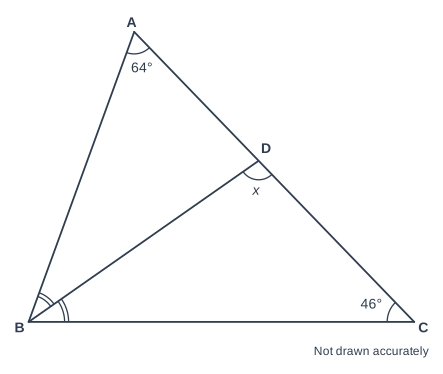
In triangle ABC, the line BD bisects angle ABC. D is on AC.
Work out the size of angle \(x\). Give reasons for your working.
Model answer
Angle ABC \(= 180 - 64 - 46 = 70^\circ\) (angles in a triangle add up to \(180^\circ\)) Angle DBC \(= 70 \div 2 = 35^\circ\) (BD bisects angle ABC, so it cuts it into two equal angles) \(x = 180 - 35 - 46 = 99^\circ\) (angles in triangle BCD add up to \(180^\circ\))
Explanation
First find the whole angle at B from triangle ABC. The bisector cuts it into two equal parts of \(35^\circ\). Angle \(x\) is in triangle BCD, which now has two known angles, \(35^\circ\) and \(46^\circ\). A common mistake is to use the whole \(70^\circ\) angle in triangle BCD.
Mark scheme
1 mark
Angle ABC \(= 180 - 64 - 46 = 70^\circ\); or the correct answer \(99^\circ\) with no working
1 mark
Angle DBC \(= 70 \div 2 = 35^\circ\)
Follow through half their angle ABC.
1 mark
\(x = 180 - 35 - 46 = 99^\circ\)
Accept 99. Follow through 134 minus their angle DBC. Another correct route: angle ABD = 35°, angle ADB = 180 − 64 − 35 = 81°, then x = 180 − 81 = 99° (angles on a straight line). The answer 99 with no reasons scores the first three marks only; the last mark needs reasons.
1 mark
Reasons: the angles in a triangle add up to \(180^\circ\), AND the bisector cuts angle ABC into two equal angles
Also 'angles on a straight line add up to 180°' if that route is used. A complete correct reason on its own scores the last mark only.
Ready to try the rest? Every answer you write is marked against the mark scheme, so you can see exactly where the marks are.
Ctrl + Enter to check
Study HelperHints first, answers after you try
Stuck on this one? Ask for a hint and I’ll point you in the right direction, without giving the answer away. Once you’ve checked your answer, I’ll show you how the marks are awarded.