Level:
Correct: 0
Incorrect: 0
Marks: 0/0
Practice
Course:
Topics:
Year 8 Maths Smart practice A mixed round aimed at your weak spots
Unit 1
Number: accuracy, powers and standard form
Unit 2
Fractions, decimals and percentages
Unit 3
Algebraic expressions
Unit 4
Equations, inequalities and formulae
Unit 5
Sequences and graphs
Unit 6
Ratio, proportion and rates of change
Unit 7
Circles, area and volume
Unit 8
Angles and constructions
Unit 9
Transformations and symmetry
Unit 10
Probability
Unit 11
Statistics
Avg
score:
–
Topics
done:
0/50

Angle reasoning with triangles and quadrilaterals

Practise 21 questions on Angle reasoning with triangles and quadrilaterals for Year 8 Maths. Write your answer and get it marked in seconds against the mark scheme, point by point, with the Study Helper on hand if you get stuck.

  • 21 questions
  • 1–5 marks each
  • Instant marking
  • No sign-up needed
20 questions, marked as you go

Sample questions with model answers

Here are 4 of the questions in this topic, each with a model answer, an explanation of why it earns the marks and the mark scheme.

Question 1

1 mark

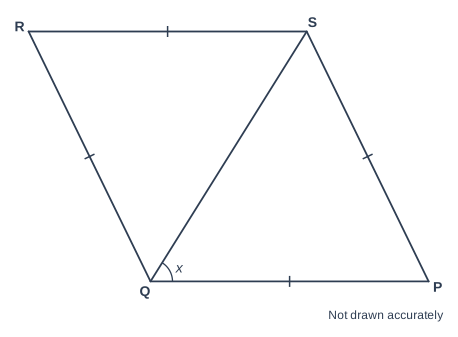
The diagram shows a rhombus PQRS with the diagonal QS.
Angle PQR \(= 116^\circ\).

Work out the size of angle \(x\).

Geometry diagram, marked "Not drawn accurately". Rhombus PQRS. Line segment QS is drawn. Angle PQS is marked x. PQ, QR, RS and SP are each marked with one short dash (equal lengths).

Model answer

The diagonal of a rhombus cuts the angle in half.
\(x = 116 \div 2 = 58^\circ\)

Explanation

A diagonal of a rhombus cuts the angles at its ends exactly in half, because it splits the rhombus into two identical isosceles triangles. So angle PQS is half of \(116^\circ\). A common mistake is to think the diagonal makes a right angle with the side.

Mark scheme
  1. 1 mark

    \(58^\circ\)

    Accept 58 or \(x = 58\). 64 (from \(180 - 116\)) or 116 scores 0. A correct answer with no working scores full marks.

Question 2

2 marks

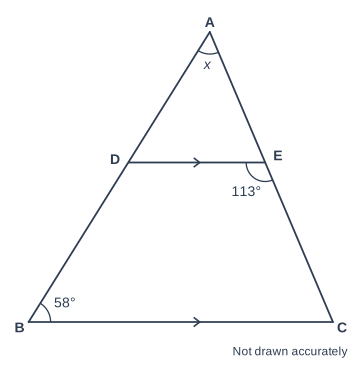
In the diagram, D is on the side AB of triangle ABC, and E is on the side AC.
DE is parallel to BC.

Work out the size of angle \(x\).

Geometry diagram, marked "Not drawn accurately". Triangle ABC. Line segment DE is drawn. D lies on side AB. E lies on side AC. Angle ABC is marked 58°. Angle DEC is marked 113°. Angle BAC is marked x. DE and BC are each marked with an arrowhead (parallel lines).

Model answer

Angle AED \(= 180 - 113 = 67^\circ\) (angles on a straight line)
Angle ADE \(= 58^\circ\) (corresponding angles, as DE is parallel to BC)
\(x = 180 - 58 - 67 = 55^\circ\) (angles in triangle ADE)

Explanation

Angle \(x\) is in triangle ADE, so find its other two angles. The \(113^\circ\) angle makes a straight line with angle AED, so angle AED \(= 67^\circ\). AB crosses the parallel lines DE and BC, so angle ADE corresponds to the \(58^\circ\) angle at B. A common mistake is to put the \(113^\circ\) angle straight into the triangle and get \(180 - 58 - 113 = 9^\circ\).

Mark scheme
  1. 1 mark

    A correct first step, e.g. angle AED \(= 67^\circ\), angle ADE \(= 58^\circ\) or angle ACB \(= 67^\circ\); or the correct answer \(55^\circ\) with no working

    Angle AED from the straight line AC (\(180 - 113\)); angle ADE from corresponding angles (DE is parallel to BC); angle ACB from co-interior angles (\(180 - 113\)). The angle may be shown by its letters or described in words.

  2. 1 mark

    \(x = 55^\circ\)

    Accept 55. 9 (from \(180 - 58 - 113\)) scores 0 for this mark. A correct answer with no working scores full marks.

Question 3

3 marks

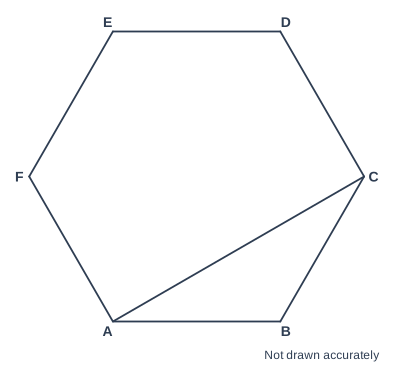
The diagram shows a regular hexagon ABCDEF and the line AC.

Kai says, "Angle ACD is a right angle."

Is Kai right?
Show how you decide.

Geometry diagram, marked "Not drawn accurately". Regular hexagon ABCDEF. Line segment AC is drawn.

Model answer

Each exterior angle is \(360 \div 6 = 60^\circ\), so each interior angle is \(180 - 60 = 120^\circ\).
AB = BC (the hexagon is regular), so triangle ABC is isosceles and angles BAC and BCA are equal.
Angle BCA \(= (180 - 120) \div 2 = 30^\circ\)
Angle ACD \(= 120 - 30 = 90^\circ\)
Yes, Kai is right: angle ACD is a right angle.

Explanation

The interior angle at C, \(120^\circ\), is split by the line AC into angle BCA and angle ACD. Triangle ABC is isosceles because the sides of a regular hexagon are equal, so its base angles share \(180 - 120 = 60^\circ\) equally. A common mistake is to agree with Kai because the angle looks like a right angle: you need to show why it is \(90^\circ\).

Mark scheme
  1. 1 mark

    Angle ABC (or BCD) \(= 120^\circ\), the interior angle of a regular hexagon

    120 may come from 720 ÷ 6 or 180 − 60. 'Yes' on its own, or 'it looks like a right angle', scores 0: the diagram is not drawn accurately.

  2. 1 mark

    Angle BCA \(= 30^\circ\), from \((180 - 120) \div 2\), because AB = BC makes triangle ABC isosceles

    The isosceles reason is needed: AB = BC because the hexagon is regular.

  3. 1 mark

    Angle ACD \(= 120 - 30 = 90^\circ\), so yes, Kai is right

    Follow through 120 minus their angle BCA, with a matching conclusion. A complete correct explanation on its own scores all 3 marks.

Question 4

4 marks

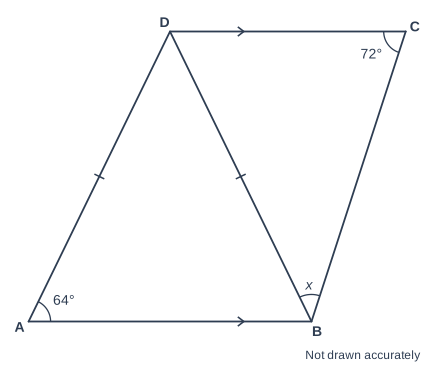
The diagram shows a trapezium ABCD.
AB is parallel to DC, and AD = BD.

Work out the size of angle \(x\).
Give a reason for each step of your working.

Geometry diagram, marked "Not drawn accurately". Trapezium ABCD. Line segment BD is drawn. Angle DAB is marked 64°. Angle BCD is marked 72°. Angle DBC is marked x. AD and BD are each marked with one short dash (equal lengths). AB and DC are each marked with an arrowhead (parallel lines).

Model answer

Angle ABD \(= 64^\circ\) (base angles of an isosceles triangle are equal, as AD = BD)
Angle BDC \(= 64^\circ\) (alternate angles are equal, as AB is parallel to DC)
\(x = 180 - 64 - 72 = 44^\circ\) (angles in a triangle add up to \(180^\circ\))

Explanation

Angle \(x\) is in triangle BCD, where you know only the \(72^\circ\) angle. Triangle ABD is isosceles, so angle ABD is also \(64^\circ\). BD crosses the parallel sides, so angle BDC is alternate to angle ABD. Then use the angle sum of triangle BCD. (Another way: angle ABC \(= 180 - 72 = 108^\circ\), because co-interior angles add up to \(180^\circ\), so \(x = 108 - 64\).) A common mistake is to use the \(64^\circ\) angle at A as if it were in triangle BCD.

Mark scheme
  1. 1 mark

    Angle ABD \(= 64^\circ\); or the correct answer \(44^\circ\) with no working

  2. 1 mark

    Angle BDC \(= 64^\circ\), or angle ABC \(= 180 - 72 = 108^\circ\)

    Follow through their angle ABD.

  3. 1 mark

    \(x = 44^\circ\), e.g. from \(180 - 64 - 72\) or \(108 - 64\)

    Accept 44. Follow through 108 minus their angle BDC, or their angle ABC minus 64. The answer 44 with no reasons scores the first three marks only; the last mark needs the reasons.

  4. 1 mark

    Reasons for their method, e.g. the base angles of an isosceles triangle are equal, AND alternate angles are equal, AND the angles in a triangle add up to \(180^\circ\); or, through angle ABC, the base angles of an isosceles triangle are equal AND co-interior angles add up to \(180^\circ\)

    All the reasons their method uses are needed; any complete correct chain of named facts scores. Accept 'allied angles' for co-interior angles. 'Z angles', 'F angles' and 'C angles' are not accepted: the reason must name the fact. A complete correct reason on its own scores the last mark only.

Ready to try the rest? Every answer you write is marked against the mark scheme, so you can see exactly where the marks are.

Topic notes

Angle reasoning with triangles and quadrilaterals

The big idea

Harder angle problems need several facts in a row, about triangles, quadrilaterals and parallel lines. The skill is choosing the next fact and naming it as your reason. The same chain of reasons can show whether a statement about angles is true.

From Year 7: the angles in a triangle add up to 180°, and in a quadrilateral they add up to 360°. An isosceles triangle has two equal sides, and its two base angles (opposite those sides) are equal.

Special quadrilaterals and their diagonals

A diagonal joins two opposite corners of a shape.

ShapeAnglesDiagonals
Squareall 90°cross at right angles; cut each corner into 45° + 45°
Rectangleall 90°do not cut the angles in half
Parallelogramopposite angles equal; angles next to each other add up to 180°cut each other in half, but not the angles
Rhombusthe same as a parallelogramcross at right angles; each cuts the angles at its ends in half
Kiteone pair of equal angles, where a short side meets a long sidecross at right angles; the line of symmetry cuts the angles at its ends in half
Geometry diagram, marked "Diagram NOT accurately drawn". Rhombus ABCD. Line segments AC and BD are drawn. M lies on AC and BD. Angle AMD is marked as a right angle (90°). Angle BAM is marked 35°. Angle MAD is marked 35°. Angle ABM is marked 55°. Angle MBC is marked 55°. AB, BC, CD and DA are each marked with one short dash (equal lengths).
Rhombus ABCD. Its diagonals cross at right angles at M, and cut the 70° angle at A into 35° + 35° and the 110° angle at B into 55° + 55°.

Isosceles triangles inside other shapes

Look for two equal sides: dashes on the sides, the sides of a rhombus or a regular polygon, or a pair of sides of a kite. Each pair gives an isosceles triangle with equal base angles.

Geometry diagram, marked "Diagram NOT accurately drawn". Kite ABCD. Line segment BD is drawn. Angle BAD is marked 108°. Angle BCD is marked 52°. Angle ABC is marked x. AB and AD are each marked with one short dash (equal lengths). CB and CD are each marked with two short dashes (equal lengths).
A toy kite ABCD with AB = AD and CB = CD. The cross-piece BD splits it into two isosceles triangles.

Find angle x in the toy kite

AB = AD, so triangle ABD is isosceles. Its base angles share \(180 - 108 = 72^\circ\).

Angle ABD \(= 72 \div 2 = 36^\circ\) (base angles of an isosceles triangle are equal; angles in a triangle add up to 180°)

CB = CD, so triangle CBD is isosceles too: angle CBD \(= (180 - 52) \div 2 = 64^\circ\) (same reasons)

\(x = 36 + 64 = 100^\circ\)

Check: angle D is also 100° (a kite's equal angles), and \(108 + 52 + 100 + 100 = 360\).

When angles are written with a letter, use the facts to make an equation, solve it, then work out each angle.

Find the angles at the end of a tent

The end of a tent is a triangle KLM with KL = KM. Angle L is \((2x + 3)^\circ\) and angle K is \((3x + 6)^\circ\). Work out all three angles.

KL = KM, so the base angles L and M are equal: angle M is also \((2x + 3)^\circ\).

Angles in a triangle add up to 180°: \(2x + 3 + 2x + 3 + 3x + 6 = 180\)

\(7x + 12 = 180\), so \(7x = 168\) and \(x = 24\).

Angles L and M are \(2 \times 24 + 3 = 51^\circ\), and angle K is \(3 \times 24 + 6 = 78^\circ\). Check: \(51 + 51 + 78 = 180\)

True or false?

To show a statement is false, one example where it fails is enough. To show it is always true, you need a reason that works every time. Checking one set of numbers, or saying it looks right in the diagram, is not enough.

Can a parallelogram have exactly one right angle?

Suppose angle A of parallelogram ABCD is 90°.

Angles B and D are both \(180 - 90 = 90^\circ\) (co-interior angles add up to 180°).

Angle C = angle A = 90° (opposite angles of a parallelogram are equal).

One right angle always brings three more, so the answer is no: the shape must be a rectangle.

Stretch: the exterior angle of a triangle

Carry one side of a triangle on past a corner to make an exterior angle. It equals the two interior angles at the other corners added together. Why? The exterior angle and the interior angle beside it add up to 180° (a straight line), and so do all three interior angles. Take that shared interior angle away from 180° both times, and what is left must be equal. For example, angles of 47° and 68° give an exterior angle of 47° + 68° = 115° at the third corner.

Remember

  • The diagonals of a square, a rhombus and a kite cross at right angles.
  • Each diagonal of a rhombus cuts the angles at its ends in half.
  • Two equal sides make an isosceles triangle with equal base angles.
  • Every step needs a reason.

Common mistakes

  • Thinking any diagonal cuts an angle in half. Only those of a square or rhombus, and a kite's line of symmetry, do.
  • Leaving out the right angle where the diagonals of a kite or rhombus cross, because it is not marked.
  • Using an angle in a triangle when it is not one of that triangle's angles.
  • Stopping at \(x\), or at half an angle, when you were asked for the whole angle.

Top tip

Mark the equal sides and right angles on the diagram first. Then write each angle on it as you find it.

Study Helper Hints first, answers after you try

Stuck on this one? Ask for a hint and I’ll point you in the right direction, without giving the answer away. Once you’ve checked your answer, I’ll show you how the marks are awarded.