Level:
Correct: 0
Incorrect: 0
Marks: 0/0
Practice
Course:
Topics:
Year 8 Maths Smart practice A mixed round aimed at your weak spots
Unit 1
Number: accuracy, powers and standard form
Unit 2
Fractions, decimals and percentages
Unit 3
Algebraic expressions
Unit 4
Equations, inequalities and formulae
Unit 5
Sequences and graphs
Unit 6
Ratio, proportion and rates of change
Unit 7
Circles, area and volume
Unit 8
Angles and constructions
Unit 9
Transformations and symmetry
Unit 10
Probability
Unit 11
Statistics
Avg
score:
–
Topics
done:
0/50

Area of a circle

Practise 26 questions on Area of a circle for Year 8 Maths. Write your answer and get it marked in seconds against the mark scheme, point by point, with the Study Helper on hand if you get stuck.

  • 26 questions
  • 1–5 marks each
  • Instant marking
  • No sign-up needed
20 questions, marked as you go

Sample questions with model answers

Here are 4 of the questions in this topic, each with a model answer, an explanation of why it earns the marks and the mark scheme.

Question 1

1 mark

The top of a round cushion is a circle with a radius of 20 cm.

Use \(\pi = 3.14\) to work out the area of the top of the cushion.

Model answer

\(A = \pi r^2 = 3.14 \times 20^2 = 3.14 \times 400 = 1256\) cm²

Explanation

Square the radius first: \(20^2 = 400\). Then \(3.14 \times 400 = 1256\) cm². A common mistake is to work out \(3.14 \times 20 \times 2\), which gives the circumference instead of the area.

Mark scheme
  1. 1 mark

    1256 cm²

    Accept 1256 or 1,256 with no unit. An answer that uses the calculator's \(\pi\) (1256.6...) instead of 3.14 also scores: accept [1256, 1257]. Do not accept 125.6 (the circumference) or 5024 (the diameter, 40 cm, squared). A correct answer with no working scores full marks.

Question 2

2 marks

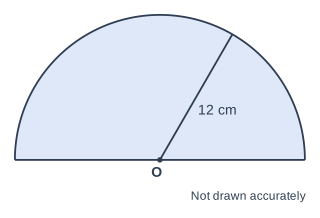
Isla makes a fan from card. When it is open, the fan is a semicircle. Its centre is O and its radius is 12 cm, as shown in the diagram.

How much card is in the open fan? Work out its area.

Give your answer in terms of \(\pi\).

Geometry diagram, marked "Not drawn accurately". A semicircle on the straight line joining its ends as diameter, drawn above it (centre O) (the region between the arc and the straight line joining its ends is shaded). A horizontal line with no labelled ends is drawn. A line is drawn from O going up and to the right. O lies on an unlabelled line going to the right. The line going up and to the right from O is labelled 12 cm.

Model answer

Whole circle: \(\pi \times 12^2 = 144\pi\) cm²
Semicircle: \(144\pi \div 2 = 72\pi\) cm²

Explanation

A semicircle is half of a circle. Work out the area of the whole circle with radius 12 cm, \(144\pi\) cm², then halve it to get \(72\pi\) cm². A common mistake is to halve the radius instead of halving the area: a circle with radius 6 cm has an area of only \(36\pi\) cm².

Mark scheme
  1. 1 mark

    Area of the whole circle: \(\pi \times 12^2 = 144\pi\); or the correct answer \(72\pi\) cm² with no working

  2. 1 mark

    \(72\pi\) cm²

    Accept 72pi, 72π, 72 × π or \(72\pi\) typed any clear way. The unit is not needed. A decimal answer (226.2, or 226.08 from 3.14) scores the first mark only. Do not accept \(144\pi\) (not halved), \(36\pi\) (the radius halved instead of the area) or \(12\pi\) (half of the circumference). A correct answer with no working scores full marks.

Question 3

3 marks

Tomasz can buy one large pizza with a diameter of 30 cm, or two small pizzas that each have a diameter of 20 cm.

Tomasz says, "The two small pizzas give me more pizza."

Is Tomasz right? Show how you decide. You may give areas in terms of \(\pi\).

Model answer

Large: radius 15 cm, \(A = \pi \times 15^2 = 225\pi\) cm²
Small: radius 10 cm, \(A = \pi \times 10^2 = 100\pi\) cm² each
Two small: \(2 \times 100\pi = 200\pi\) cm²
\(225\pi\) > \(200\pi\), so the one large pizza gives more. Tomasz is not right.

Explanation

Compare the total areas. Halve the diameters to get the radii, 15 cm and 10 cm. The large pizza is \(225\pi\) cm² and the two small ones together are \(200\pi\) cm², so the one large pizza gives more. Leaving the areas in terms of \(\pi\) makes them easy to compare. A common mistake is to add the diameters (40 cm is more than 30 cm), but area depends on the radius squared.

Mark scheme
  1. 1 mark

    Area of the large pizza: \(\pi \times 15^2 = 225\pi\) cm² (or 706.9, or 706.5 from 3.14)

  2. 1 mark

    Area of the two small pizzas: \(2 \times \pi \times 10^2 = 200\pi\) cm² (or 628.3, or 628 from 3.14)

    One small pizza (\(100\pi\)) with no doubling does not score this mark.

  3. 1 mark

    No (Tomasz is not right), because \(225\pi\) is more than \(200\pi\)

    ft their two areas, if the decision follows from them. 'No' alone, or 'No' with no areas, scores 0. A complete correct reason (both areas worked out and compared) on its own scores all 3 marks.

Question 4

4 marks

You may use a calculator.

A round cake board has an area of 1,000 cm².

Nadia sticks ribbon once round the edge of the board. The ends of the ribbon just meet.

Work out the length of ribbon she needs. Give your answer correct to 1 decimal place.

Model answer

\(\pi r^2 = 1000\)
\(r^2 = 1000 \div \pi = 318.309...\)
\(r = \sqrt{318.309...} = 17.841...\) cm
\(C = 2 \times \pi \times 17.841... = 112.099...\)
Ribbon = 112.1 cm (1 d.p.)

Explanation

The ribbon goes round the circumference, but you only know the area, so find the radius first. Divide the area by \(\pi\) to get \(r^2 = 318.3\), then take the square root: \(r = 17.84\) cm. Now \(C = 2\pi r = 112.1\) cm. Keep the full calculator values until the end: rounding the radius too early can change the answer.

Mark scheme
  1. 1 mark

    \(r^2 = 1000 \div \pi\) (= 318.3...); or the correct answer 112.1 cm with no working

  2. 1 mark

    \(r = \sqrt{318.3...} = 17.84...\) cm

    ft the square root of their \(r^2\).

  3. 1 mark

    \(2 \times \pi \times\) their radius, or \(\pi \times\) their diameter (35.68...)

  4. 1 mark

    112.1 cm

    Accept 112.1 with no unit; accept [112.05, 112.15]. A more accurate value in this range (112.09...) also scores. 111.8 (from rounding the radius to 17.8 too early) scores the first three marks only. Do not accept 56.0 (\(\pi \times\) the radius). A correct answer with no working scores full marks.

Ready to try the rest? Every answer you write is marked against the mark scheme, so you can see exactly where the marks are.

Topic notes

Area of a circle

The big idea

The area of a circle is the amount of flat space inside it, measured in square units such as cm² and m². One short formula gives the area of any circle from its radius. You need it for pizzas, ponds, lawns and anything else that is round.

The formula

\[ A = \pi r^2 \]

This means \(\pi \times r \times r\). Only the radius is squared, not π.

Why it works: cut a circle into lots of thin slices, like a pizza, and lay them side by side, pointing up and down in turn. They make a shape that is almost a rectangle. Its length is half the circumference, \(\pi r\), and its height is the radius, \(r\). So the area is \(\pi r \times r = \pi r^2\).

As with the circumference, a question may ask for the answer in terms of π (leave π in it), using π = 3.14, or rounded from a calculator.

Radius or diameter?

The formula needs the radius. If you are given the diameter, halve it first.

The top of a drum is a circle 26 cm across. Work out its area in terms of π, and then using π = 3.14.

26 cm across is the diameter, so the radius is \(26 \div 2 = 13\) cm.

\(A = \pi \times 13^2 = \pi \times 169 = 169\pi\) cm²

Using π = 3.14: \(3.14 \times 169 = 530.66\) cm²

Squaring the diameter by mistake would give \(676\pi\) cm², which is 4 times too big.

Semicircles and quarter circles

Work out the area of the whole circle. Then halve it for a semicircle, or divide it by 4 for a quarter circle. Halve the area, not the radius.

A lawn shaped like a quarter of a circle. Its two straight edges are radii, each 7.5 m long, with a right angle between them, and its third edge is a curved arc. The word Lawn is written inside it.
The lawn is a quarter circle. Its two straight edges are radii, 7.5 m long, with a right angle between them.

A lawn fills one corner of a garden. It is a quarter of a circle of radius 7.5 m. Work out its area to 1 decimal place. Each roll of turf covers 1 m². How many rolls are needed? (uses a calculator)

Whole circle: \(\pi \times 7.5^2 = 176.71...\) m². Type π × 7.5², not (π × 7.5)², which squares π as well.

Quarter circle: \(176.71... \div 4 = 44.178...\), so the area is 44.2 m² (1 d.p.)

Rolls: 44 rolls cover only 44 m², which is not quite enough, so 45 rolls are needed.

Comparing areas

To compare areas, work each one out in the same form. In terms of π they are easy to compare.

Two round rugs. The large rug is a circle with a diameter of 3 m drawn across it. The small rug is a circle with a diameter of 1 m drawn across it.
The large rug has a diameter of 3 m. The small rug has a diameter of 1 m.

The large rug in the diagram is 3 times as wide as the small rug. How many times as much floor does it cover?

Large rug: radius \(3 \div 2 = 1.5\) m, so \(A = \pi \times 1.5^2 = 2.25\pi\) m²

Small rug: radius \(1 \div 2 = 0.5\) m, so \(A = \pi \times 0.5^2 = 0.25\pi\) m²

Both areas are a number of πs, so divide the numbers: \(2.25 \div 0.25 = 9\). The large rug covers 9 times as much floor, not 3 times.

In the same way, doubling the radius does not double the area. A circle with a radius of 2 cm has an area of \(4\pi\) cm², but a radius of 4 cm gives \(16\pi\) cm²: 4 times as much, because the radius is squared.

Stretch: finding the radius from the area

Work backwards: divide the area by π to get \(r^2\), then take the square root. For example, the grass in the middle of a roundabout is a circle with an area of 113.04 m². Using π = 3.14, \(r^2 = 113.04 \div 3.14 = 36\), so \(r = \sqrt{36} = 6\) m. In terms of π it is quicker: an area of \(121\pi\) cm² means \(r^2 = 121\), so \(r = 11\) cm.

Remember

  • \(A = \pi r^2\), which means \(\pi \times r \times r\).
  • Halve the diameter to get the radius first.
  • Semicircle: half of the circle's area. Quarter circle: a quarter of it.
  • Areas are in square units, such as cm² and m².

Common mistakes

  • Squaring the diameter instead of the radius. The area comes out 4 times too big.
  • Working out \(2 \times r\) instead of \(r \times r\), or mixing up the area with the circumference, \(2\pi r\).
  • Halving the radius for a semicircle. Halve the whole circle's area instead.
  • Thinking that doubling the radius doubles the area. It makes it 4 times as big.
  • Buying 44.2 rolls, or rounding down. You can only buy whole rolls or bags, and you need enough, so round up.

Top tip

Check that your answer is sensible: the area of a circle is a little more than \(3 \times r^2\). With a radius of 10 cm, expect a bit more than 300 cm².

Study Helper Hints first, answers after you try

Stuck on this one? Ask for a hint and I’ll point you in the right direction, without giving the answer away. Once you’ve checked your answer, I’ll show you how the marks are awarded.