Level:
Correct: 0
Incorrect: 0
Marks: 0/0
Practice
Course:
Topics:
Year 8 Maths Smart practice A mixed round aimed at your weak spots
Unit 1
Number: accuracy, powers and standard form
Unit 2
Fractions, decimals and percentages
Unit 3
Algebraic expressions
Unit 4
Equations, inequalities and formulae
Unit 5
Sequences and graphs
Unit 6
Ratio, proportion and rates of change
Unit 7
Circles, area and volume
Unit 8
Angles and constructions
Unit 9
Transformations and symmetry
Unit 10
Probability
Unit 11
Statistics
Avg
score:
–
Topics
done:
0/50

Mutually exclusive events

Practise 21 questions on Mutually exclusive events for Year 8 Maths. Write your answer and get it marked in seconds against the mark scheme, point by point, with the Study Helper on hand if you get stuck.

  • 21 questions
  • 1–5 marks each
  • Instant marking
  • No sign-up needed
20 questions, marked as you go

Sample questions with model answers

Here are 4 of the questions in this topic, each with a model answer, an explanation of why it earns the marks and the mark scheme.

Question 1

1 mark

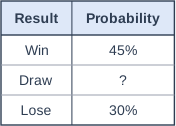
Kwame's football team plays a match on Saturday.
The team will win, draw or lose the match.

The table shows the probability of each result. The probability of a draw is missing.

Work out the probability that the match is a draw.

Table with columns "Result", "Probability". Result: Win; Probability: 45% | Result: Draw; Probability: ? | Result: Lose; Probability: 30%.

Model answer

45% + 30% = 75%
P(draw) = 100% - 75% = 25%

Explanation

The match must end in exactly one of the three results, so the three probabilities add up to 100%. Winning and losing together make 75%, so a draw has a probability of 100% - 75% = 25%. A common mistake is to stop at 75%, which is the probability that the match is not a draw.

Mark scheme
  1. 1 mark

    25%

    Accept 0.25, \(\dfrac{25}{100}\) or any equivalent fraction such as \(\dfrac{1}{4}\). Do not accept 25 with no % sign, or 75% (win or lose). A probability written as '1 in 4', '25 out of 100' or 1 : 4 scores 0. A correct answer with no working scores full marks.

Question 2

2 marks

A biased spinner is numbered 1 to 5.
The probability that it lands on 1 is \(\dfrac{3}{25}\).

Work out the probability that it does not land on 1.
Give your answer as a decimal and as a percentage.

Model answer

\(\dfrac{3}{25} = \dfrac{12}{100}\) = 0.12
P(not 1) = 1 - 0.12 = 0.88
0.88 = 88%

Explanation

First change \(\dfrac{3}{25}\) to hundredths: multiply the top and the bottom by 4 to get \(\dfrac{12}{100}\), which is 0.12 or 12%. The probability of not landing on 1 is 1 - 0.12 = 0.88, which is 88%. A common mistake is to give 0.12, which is the probability that the spinner does land on 1.

Mark scheme
  1. 1 mark

    \(\dfrac{22}{25}\) seen, or P(1) written as 0.12 or 12%; or the correct answers 0.88 and 88% with no working

    One of 0.88 or 88% correct, with the other missing or wrong, also scores this mark.

  2. 1 mark

    0.88 and 88%

    Both are needed for this mark. Accept .88. Do not accept 0.12 or 12% (the probability that it does land on 1). A probability written as '88 in 100', '88 out of 100' or 88 : 100 scores 0. A correct answer with no working scores full marks.

Question 3

3 marks

A spinner can land on A, B, C or D.
The probability that it lands on A is 0.28.
B, C and D all have the same probability.

Work out the probability that the spinner lands on C.
Then work out the probability that it lands on A or C.

Model answer

B, C and D together: 1 - 0.28 = 0.72
P(C) = \(0.72 \div 3 = 0.24\)
P(A or C) = 0.28 + 0.24 = 0.52

Explanation

The four probabilities add up to 1, so B, C and D share 1 - 0.28 = 0.72. They are equally likely, so each one gets \(0.72 \div 3 = 0.24\). Landing on A and landing on C are mutually exclusive, so add: 0.28 + 0.24 = 0.52. A common mistake is to share 0.72 between four letters instead of three.

Mark scheme
  1. 1 mark

    1 - 0.28 = 0.72 (B, C and D together); or the correct answers 0.24 and 0.52 with no working

  2. 1 mark

    P(C) = 0.24

    Follow through their 0.72 shared by 3. Accept 24% or \(\dfrac{24}{100}\) (or any equivalent fraction such as \(\dfrac{6}{25}\)). Do not accept 0.18 (from sharing 0.72 by 4) or 0.36 (sharing by 2).

  3. 1 mark

    P(A or C) = 0.52

    Follow through 0.28 + their P(C). Accept 52% or \(\dfrac{52}{100}\) (or any equivalent fraction such as \(\dfrac{13}{25}\)). A probability written as 'a in b', 'a out of b' or a : b scores 0. A correct answer with no working scores full marks.

Question 4

4 marks

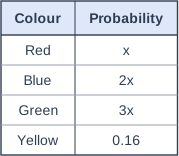
The table shows the probabilities for a biased spinner with four colours.

Work out the probability that the spinner lands on blue or green.

Table with columns "Colour", "Probability". Colour: Red; Probability: x | Colour: Blue; Probability: 2x | Colour: Green; Probability: 3x | Colour: Yellow; Probability: 0.16.

Model answer

\(x + 2x + 3x + 0.16 = 1\)
\(6x = 0.84\)
\(x = 0.14\)
P(blue) = \(2 \times 0.14 = 0.28\)
P(green) = \(3 \times 0.14 = 0.42\)
P(blue or green) = 0.28 + 0.42 = 0.7

Explanation

The four probabilities add up to 1, so \(x + 2x + 3x + 0.16 = 1\). Collect the \(x\) terms to get \(6x = 0.84\), so \(x = 0.14\). Blue and green are mutually exclusive, so P(blue or green) = \(2x + 3x = 5x = 0.7\). A common mistake is to stop at \(x = 0.14\), which is only the probability of red.

Mark scheme
  1. 1 mark

    \(x + 2x + 3x + 0.16 = 1\) or \(6x = 0.84\); or the correct answer 0.7 with no working

  2. 1 mark

    \(x = 0.14\)

    Accept 0.14 on its own. \(x = 0.14\) with no further work scores the first two marks.

  3. 1 mark

    P(blue) = 0.28 or P(green) = 0.42, or \(5x\) used for blue or green

    Follow through their value of \(x\).

  4. 1 mark

    0.7

    Accept 0.70, 70%, \(\dfrac{7}{10}\) or any equivalent fraction. Follow through \(5 \times\) their \(x\). A probability written as '7 in 10', '7 out of 10' or 7 : 10 scores 0. A correct answer with no working scores full marks.

Ready to try the rest? Every answer you write is marked against the mark scheme, so you can see exactly where the marks are.

Topic notes

Mutually exclusive events

The big idea

Two events are mutually exclusive when they cannot happen at the same time. Then the probability that one or the other happens is found by adding. Because all the probabilities add up to 1, you can also work out one that is missing.

Year 7 reminder: a probability goes from 0 (impossible) to 1 (certain). When the outcomes are equally likely, P(event) is the number of ways it can happen divided by the total number of outcomes.

What mutually exclusive means

An event is something that might happen, such as "the dice shows a 6". Two events are mutually exclusive if they have no outcome (result) in common. To check, list the outcomes for each event and look for one that is in both.

A day of the week is picked at random.

  • "Starts with T" (Tuesday, Thursday) and "at the weekend" (Saturday, Sunday) are mutually exclusive.
  • "At the weekend" and "has 6 letters" (Monday, Friday, Sunday) are not: Sunday is in both.
A Venn diagram of the days of the week with two separate circles that do not overlap. The circle 'Starts with T' holds Tuesday and Thursday, the circle 'Weekend' holds Saturday and Sunday, and Monday, Wednesday and Friday are outside both circles.
The days of the week. The circles do not overlap, so 'starts with T' and 'at the weekend' are mutually exclusive. Monday, Wednesday and Friday are in neither.

Mutually exclusive does not mean "opposite": on a Monday, neither event happens.

The 'or' rule

For two mutually exclusive events A and B:

\[ \text{P(A or B)} = \text{P(A)} + \text{P(B)} \]

Only add when the events cannot happen together: if they overlap, adding counts the shared outcomes twice. If two probabilities add up to more than 1, the events cannot be mutually exclusive.

A letter is picked at random from the word MATHEMATICS. Find P(M or a vowel), then P(M or a letter from A to M).

The 11 letters are M, A, T, H, E, M, A, T, I, C, S.

P(M) = \(\dfrac{2}{11}\) and P(vowel) = \(\dfrac{4}{11}\) (A, E, A, I). An M is not a vowel, so add:

P(M or vowel) = \(\dfrac{2}{11} + \dfrac{4}{11} = \dfrac{6}{11}\)

M is itself a letter from A to M, so these events overlap: do not add. Count the letters from A to M instead (M, A, H, E, M, A, I, C): there are 8, so the probability is \(\dfrac{8}{11}\).

Missing probabilities

The outcomes of one roll, spin or pick are mutually exclusive, and one of them must happen. So the probabilities of all the outcomes add up to 1 (or 100%). This means:

  • a missing probability is 1 take away all the others;
  • P(not A) = 1 − P(A). If P(the train is late) = 0.08, then P(not late) = 0.92.

Write every probability in the same form before you add or subtract: \(\dfrac{3}{20}\) = 0.15 = 15%.

A shop sells T-shirts in four sizes. The table gives the probability that the next one sold is each size. Is it more likely to be Medium, or to be Large or Extra large?

SizeSmallMediumLargeExtra large
Probability0.05\(\dfrac{9}{20}\)?12%

In percentages: 0.05 = 5% and \(\dfrac{9}{20} = \dfrac{45}{100}\) = 45%.

P(Large) = 100% − 5% − 45% − 12% = 38%

A T-shirt has one size, so these events are mutually exclusive:

P(Large or Extra large) = 38% + 12% = 50%

50% is more than 45%, so Large or Extra large is more likely.

Stretch: missing probabilities with algebra

When the probabilities use a letter, they still add up to 1. Write that as an equation, solve it, then use the letter's value to answer the question.

A bag holds only red, blue and green counters. A counter is taken at random. Blue is twice as likely as red, and green is seven times as likely as red. Find the probability of red or green.

Let P(red) = \(x\). Then P(blue) = \(2x\) and P(green) = \(7x\).

\(x + 2x + 7x = 1\), so \(10x = 1\) and \(x = 0.1\).

P(green) = \(7 \times 0.1 = 0.7\)

P(red or green) = 0.1 + 0.7 = 0.8

Remember

  • Mutually exclusive events cannot happen at the same time.
  • For mutually exclusive events, P(A or B) = P(A) + P(B).
  • All the probabilities add up to 1, so P(not A) = 1 − P(A).
  • A probability is a fraction, a decimal or a percentage, never "3 in 8" or 3 : 8.

Common mistakes

  • Adding tops and bottoms: \(\dfrac{1}{4} + \dfrac{1}{3}\) is not \(\dfrac{2}{7}\). It is \(\dfrac{3}{12} + \dfrac{4}{12} = \dfrac{7}{12}\).
  • Adding the probabilities of events that can happen together. List the outcomes instead.
  • Stopping at the missing probability when the question asks for "this or that". Finish by adding.
  • Writing 45 instead of 45% or 0.45: no probability is bigger than 1.

Top tip

Before you add two probabilities, ask: "Can both of these happen at once?" If not, add. If they can, list the outcomes.

Study Helper Hints first, answers after you try

Stuck on this one? Ask for a hint and I’ll point you in the right direction, without giving the answer away. Once you’ve checked your answer, I’ll show you how the marks are awarded.