Practise 21 questions on Reflections and rotations for Year 8 Maths. Write your answer and get it marked in seconds against the mark scheme, point by point, with the Study Helper on hand if you get stuck.
21 questions
1–5 marks each
Instant marking
No sign-up needed
20 questions, marked as you go
Sample questions with model answers
Here are 4 of the questions in this topic, each with a model answer, an explanation of why it earns the marks and the mark scheme.
Question 1
1 mark
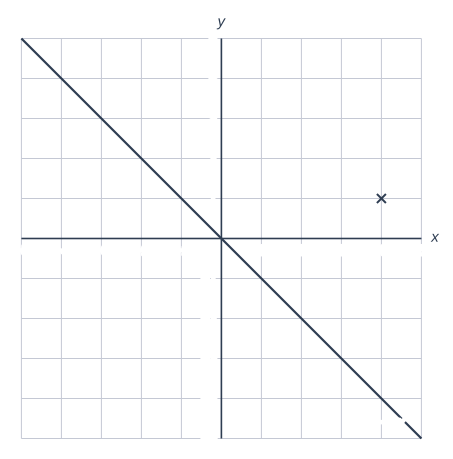
The diagram shows the point A and the line \(y = -x\).
Write the coordinates of the image of A after a reflection in the line \(y = -x\).
Model answer
A is \((4, 1)\). Reflecting in \(y = -x\) swaps the coordinates and changes both signs. The image is \((-1, -4)\).
Explanation
The line \(y = -x\) slopes downwards through \((0, 0)\), \((1, -1)\), \((-2, 2)\) and so on. Folding the grid along it sends \((4, 1)\) to \((-1, -4)\): the rule for this line is to swap the coordinates and change both signs. You can check that \((4, 1)\) and \((-1, -4)\) are the same distance from the line, with the midpoint \((1.5, -1.5)\) on it. A common mistake is only to swap the coordinates, which is the rule for \(y = x\).
Mark scheme
1 mark
\((-1, -4)\)
Accept -1, -4 without brackets; the coordinates must be in the order (x, y). (1, 4) (reflected in y = x), (-4, -1) (rotated through 180 degrees) or (-4, 1) (reflected in the y-axis) scores 0. A correct answer with no working scores full marks.
Question 2
2 marks
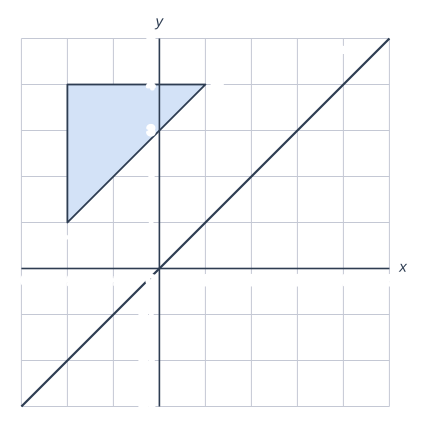
The diagram shows triangle LMN and the line \(y = x\).
Triangle LMN is reflected in the line \(y = x\). Write the coordinates of the images of L, M and N.
Model answer
Reflecting in \(y = x\) swaps the coordinates. L \((-2, 1)\) → \((1, -2)\) M \((1, 4)\) → \((4, 1)\) N \((-2, 4)\) → \((4, -2)\)
Explanation
For a reflection in \(y = x\), the x- and y-coordinates of each corner swap over. Do one corner at a time, then check the image: it should be the same size and shape, on the other side of the line \(y = x\), and flipped over. A common mistake is to swap the coordinates and change a sign as well.
Mark scheme
1 mark
Two images correct
L goes to (1, -2), M to (4, 1) and N to (4, -2).
1 mark
All three: \((1, -2)\), \((4, 1)\), \((4, -2)\)
Accept the images in any order if they are clearly the three corners of the image. Brackets are not needed, but each image must be written in the order (x, y). A correct answer with no working scores full marks.
Question 3
3 marks
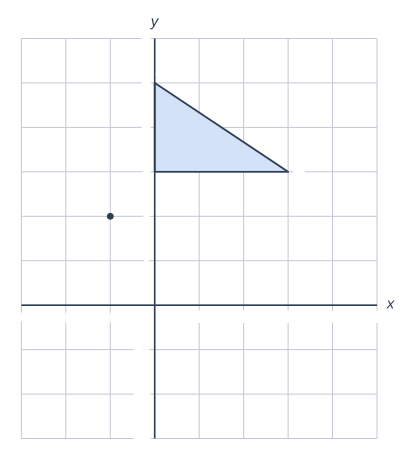
The diagram shows triangle GHJ and the centre of rotation M.
Triangle GHJ is turned \(90^\circ\) clockwise about M. Write the coordinates of the new positions of G, H and J.
Model answer
M is \((-1, 2)\). A quarter turn clockwise turns 'right' into 'down' and 'up' into 'right'. G: 1 right, 1 up from M → 1 right, 1 down: \((0, 1)\) H: 4 right, 1 up → 1 right, 4 down: \((0, -2)\) J: 1 right, 3 up → 3 right, 1 down: \((2, 1)\)
Explanation
Treat each corner separately: find how far it is from M across and up, then turn that move a quarter turn clockwise. Moves to the right become moves down, and moves up become moves to the right. Check your image: the side GH, which was horizontal, should now be vertical. A common mistake is to turn about the origin instead of about M.
Mark scheme
1 mark
One image correct
G goes to (0, 1), H to (0, -2) and J to (2, 1). If all three images are given for a rotation of 90 degrees anticlockwise about M instead, (-2, 3), (-2, 6), (-4, 3), award 1 mark in total.
1 mark
Two images correct
1 mark
All three: \((0, 1)\), \((0, -2)\), \((2, 1)\)
Brackets are not needed, but each image must be written in the order (x, y). A correct answer with no working scores full marks.
Question 4
4 marks
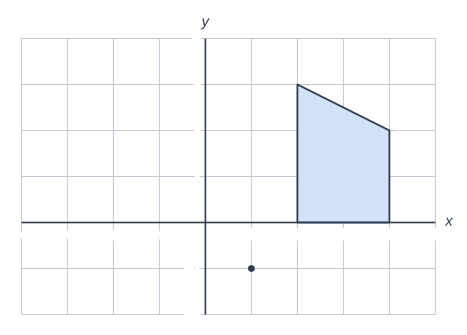
The diagram shows quadrilateral WXYZ and the point C.
WXYZ is rotated \(270^\circ\) clockwise about C. Write the coordinates of the images of W, X, Y and Z.
Model answer
\(270^\circ\) clockwise is the same as \(90^\circ\) anticlockwise. From C \((1, -1)\), 'right' turns into 'up' and 'up' turns into 'left'. W: 1 right, 1 up → 1 up, 1 left: \((0, 0)\) X: 3 right, 1 up → 3 up, 1 left: \((0, 2)\) Y: 3 right, 3 up → 3 up, 3 left: \((-2, 2)\) Z: 1 right, 4 up → 1 up, 4 left: \((-3, 0)\)
Explanation
Three quarter turns clockwise is the same as one quarter turn anticlockwise, which is quicker to do. Work from C for each corner: a move to the right of C becomes a move up, and a move up becomes a move to the left. Then check that the image is the same shape as WXYZ. A common mistake is to do just one quarter turn clockwise.
Mark scheme
1 mark
W: \((0, 0)\)
Brackets are not needed, but each image must be written in the order (x, y). If every image is given for a rotation of 90 degrees clockwise about C instead, (2, -2), (2, -4), (4, -4), (5, -2), award 1 mark in total.
1 mark
X: \((0, 2)\)
1 mark
Y: \((-2, 2)\)
1 mark
Z: \((-3, 0)\)
A correct answer with no working scores full marks.
Ready to try the rest? Every answer you write is marked against the mark scheme, so you can see exactly where the marks are.
Ctrl + Enter to check
Study HelperHints first, answers after you try
Stuck on this one? Ask for a hint and I’ll point you in the right direction, without giving the answer away. Once you’ve checked your answer, I’ll show you how the marks are awarded.