Level:
Correct: 0
Incorrect: 0
Marks: 0/0
Practice
Course:
Topics:
Year 8 Maths Smart practice A mixed round aimed at your weak spots
Unit 1
Number: accuracy, powers and standard form
Unit 2
Fractions, decimals and percentages
Unit 3
Algebraic expressions
Unit 4
Equations, inequalities and formulae
Unit 5
Sequences and graphs
Unit 6
Ratio, proportion and rates of change
Unit 7
Circles, area and volume
Unit 8
Angles and constructions
Unit 9
Transformations and symmetry
Unit 10
Probability
Unit 11
Statistics
Avg
score:
–
Topics
done:
0/50

Simple interest and everyday money

Practise 22 questions on Simple interest and everyday money for Year 8 Maths. Write your answer and get it marked in seconds against the mark scheme, point by point, with the Study Helper on hand if you get stuck.

  • 22 questions
  • 1–5 marks each
  • Instant marking
  • No sign-up needed
20 questions, marked as you go

Sample questions with model answers

Here are 4 of the questions in this topic, each with a model answer, an explanation of why it earns the marks and the mark scheme.

Question 1

1 mark

A phone case costs £12.50 before VAT. VAT at 20% is added to the price.

What is the price of the phone case including VAT?

Model answer

10% of 12.50 = 1.25
20% of 12.50 = 2.50
\(12.50 + 2.50 = 15\), so £15

Explanation

VAT is a tax that is added on to the price. 20% of £12.50 is £2.50 (find 10% and double it). Add it on to get £15. A common mistake is to give only the VAT, £2.50.

Mark scheme
  1. 1 mark

    £15

    Accept 15 or £15.00. £2.50 (the VAT only) or £10 (taking 20% off) scores 0. A correct answer with no working scores full marks.

Question 2

2 marks

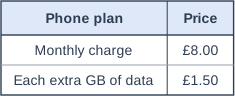
The table shows the prices for Zara's phone plan. The monthly charge includes the first 5 GB of data.

One month, Zara uses 9 GB of data. How much is her bill for that month?

Table with columns "Phone plan", "Price". Phone plan: Monthly charge; Price: £8.00 | Phone plan: Each extra GB of data; Price: £1.50.

Model answer

Extra data: \(9 - 5 = 4\) GB
Extra cost: \(4 \times 1.50 = 6\), so £6
Bill: \(8 + 6 = 14\), so £14

Explanation

The first 5 GB are already paid for in the £8 monthly charge, so Zara only pays extra for 4 GB. Four lots of £1.50 is £6, so her bill is £8 + £6 = £14. A common mistake is to charge for all 9 GB of data.

Mark scheme
  1. 1 mark

    4 GB of extra data, or \(4 \times 1.50 = 6\); or the correct answer £14 with no working

  2. 1 mark

    £14

    Accept 14 or £14.00. £21.50 (charging £1.50 for all 9 GB, plus £8) scores 0. A correct answer with no working scores full marks.

Question 3

3 marks

Maya puts £1,200 into a savings account. The interest rate is 4% a year, and the interest is simple interest.

How many years will it take until there is £1,440 in the account?

Model answer

Interest each year: 1% of 1,200 = 12, so 4% = 48, which is £48
Interest needed: \(1440 - 1200 = 240\), so £240
\(240 \div 48 = 5\), so 5 years

Explanation

Each year the account earns the same £48. Maya needs £240 of interest altogether, and \(240 \div 48 = 5\), so it takes 5 years. A common mistake is to divide £1,440 by £48, which forgets that £1,200 of the money is Maya's own.

Mark scheme
  1. 1 mark

    Interest each year: 4% of £1,200 = £48; or the correct answer 5 years with no working

  2. 1 mark

    Interest needed: \(1440 - 1200 = 240\), so £240

  3. 1 mark

    5 years

    Accept 5. 30 (from 1,440 ÷ 48) scores the first mark only. A correct answer with no working scores full marks.

Question 4

4 marks

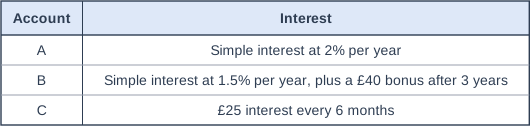
Hassan has £2,000 to save for 3 years. The table shows three savings accounts.

Which account would give Hassan the most interest after 3 years? Show your working.

Table with columns "Account", "Interest". Account: A; Interest: Simple interest at 2% per year | Account: B; Interest: Simple interest at 1.5% per year, plus a £40 bonus after 3 years | Account: C; Interest: £25 interest every 6 months.

Model answer

A: 2% of 2,000 = 40 a year, and \(3 \times 40 = 120\), so £120
B: 1.5% of 2,000 = 30 a year, and \(3 \times 30 + 40 = 130\), so £130
C: £25 twice a year for 3 years, \(6 \times 25 = 150\), so £150
Account C gives the most interest.

Explanation

Work out the total interest from each account over the full 3 years. Account C looks small because it pays only £25 at a time, but it pays twice a year, which is £50 a year: more than the £40 a year from Account A. A common mistake is to choose the account with the biggest percentage without working out the money.

Mark scheme
  1. 1 mark

    One account worked out correctly: A £120, B £130 or C £150

    Account C pays £25 six times in 3 years (twice a year). C as £75 (one payment a year) is wrong. For B, accept £90 interest and the £40 bonus shown separately (£130 altogether).

  2. 1 mark

    Two accounts worked out correctly

  3. 1 mark

    All three worked out correctly

  4. 1 mark

    Account C

    Needs the previous mark. 'Account C' with no working scores 0, because the question asks for working. 'Account A, because 2% is the biggest rate' scores 0 for this mark.

Ready to try the rest? Every answer you write is marked against the mark scheme, so you can see exactly where the marks are.

Topic notes

Simple interest and everyday money

The big idea

Money maths helps with real choices: what savings earn, what bills cost, and whether an offer really saves money.

From Year 7: £1 = 100p, and money has two decimal places (£4.50, not £4.5). Never mix pounds and pence in one calculation.

Simple interest

Interest is money a bank pays you for saving, or money you pay for borrowing. The interest rate is a percentage for each year. With simple interest, the interest is the same every year, because it is always worked out on the starting amount.

  • Interest for one year = the rate % of the starting amount
  • Total = starting amount + number of years × interest for one year

Ama borrows £1,200 for a scooter, at 6% simple interest a year. She pays it all back in equal monthly amounts over 2 years. How much is each payment?

1% of £1,200 is £12, so 6% is \(6 \times 12 = 72\): £72 interest a year.

For 2 years: \(2 \times 72 = 144\), so £144 interest.

Total to pay back: \(1200 + 144 = 1344\), so £1,344.

2 years is 24 months: \(1344 \div 24 = 56\). Ama pays £56 a month.

VAT and discounts

VAT (value added tax) is a tax of 20% added on to many prices: find 10%, double it, and add it on. VAT on £65 is \(2 \times 6.50 = 13\), so the price is £78. A discount is money taken off; the sale price is what is left: 25% off £36 is £9 off, so the sale price is £27. Take off discounts and add VAT in the order the question gives.

Wages and overtime

Wages for hourly work are hours × hourly rate. Overtime (extra hours) is often paid at a higher rate: time and a half is 1.5 times the normal rate, and double time is 2 times.

Ellie's cousin earns £10.60 an hour. One weekend he works 8 hours on Saturday at the normal rate and 5 hours on Sunday at double time. How much does he earn?

Saturday: \(8 \times 10.60 = 84.80\), so £84.80

Sunday: double time is \(2 \times 10.60 = 21.20\), so £21.20 an hour, and \(5 \times 21.20 = 106\), so £106

Total: \(84.80 + 106 = 190.80\), so he earns £190.80.

Bills, best value and budgets

Bills often come as tables: read every row, and include any fixed charge as well as the cost of each unit. For best value, compare the price of the same amount. Oats cost £1.20 for 500 g or £3.30 for 1.5 kg. 1.5 kg is 3 lots of 500 g, so the big bag costs £3.30 ÷ 3 = £1.10 for each 500 g: better value. With a multi-buy offer such as "3 for 2", you pay for 2 in every 3: 6 cans cost the same as 4. For a budget, add up the money coming in and the money going out, then compare.

A family of 2 adults and 3 children goes swimming. What is the cheapest way for them to pay?

TicketPrice
Adult£5.20
Child£3.10
Family (2 adults and 2 children)£14.00

Single tickets: \(2 \times 5.20 + 3 \times 3.10 = 10.40 + 9.30 = 19.70\), so £19.70

A family ticket and a child ticket: \(14.00 + 3.10 = 17.10\), so £17.10. This is the cheaper way.

Stretch: working back to the rate or the time

Zoe has £2,500 in an account that pays 3% simple interest a year. She wants £450 of interest to buy a bike. How many years must she wait?

Interest each year: 1% of £2,500 is £25, so 3% is £75.

Number of years = interest needed ÷ interest for one year: \(450 \div 75 = 6\), so 6 years.

To find the rate, write the interest for one year as a percentage of the starting amount. £900 that earns £72 in 2 years earns £36 a year; 1% of £900 is £9, and \(36 \div 9 = 4\), so the rate is 4%.

Remember

  • Simple interest is the same every year: the rate % of the starting amount.
  • VAT is 20%: find 10%, double it, and add it on.
  • Time and a half is 1.5 × the normal rate; double time is 2 ×.

Common mistakes

  • Giving the total when the question asks for the interest, or the other way round.
  • Adding only one year of interest when the money is saved for several years.
  • Taking the VAT off instead of adding it on.
  • Paying every hour at the normal rate when some hours are overtime.

Top tip

Label each step, such as "Interest for one year", and check that you have given the amount the question asks for.

Study Helper Hints first, answers after you try

Stuck on this one? Ask for a hint and I’ll point you in the right direction, without giving the answer away. Once you’ve checked your answer, I’ll show you how the marks are awarded.