Level:
Correct: 0
Incorrect: 0
Marks: 0/0
Practice
Course:
Topics:
Year 8 Maths Smart practice A mixed round aimed at your weak spots
Unit 1
Number: accuracy, powers and standard form
Unit 2
Fractions, decimals and percentages
Unit 3
Algebraic expressions
Unit 4
Equations, inequalities and formulae
Unit 5
Sequences and graphs
Unit 6
Ratio, proportion and rates of change
Unit 7
Circles, area and volume
Unit 8
Angles and constructions
Unit 9
Transformations and symmetry
Unit 10
Probability
Unit 11
Statistics
Avg
score:
–
Topics
done:
0/50

Angles in parallel lines

Practise 26 questions on Angles in parallel lines for Year 8 Maths. Write your answer and get it marked in seconds against the mark scheme, point by point, with the Study Helper on hand if you get stuck.

  • 26 questions
  • 1–5 marks each
  • Instant marking
  • No sign-up needed
20 questions, marked as you go

Sample questions with model answers

Here are 4 of the questions in this topic, each with a model answer, an explanation of why it earns the marks and the mark scheme.

Question 1

1 mark

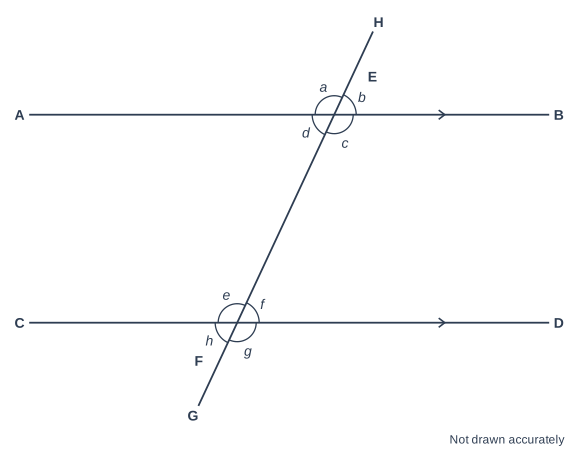
The diagram shows two parallel lines crossed by a transversal.
Eight angles are marked with the letters \(a\) to \(h\).

Which angle is alternate to angle \(d\)?

Geometry diagram, marked "Not drawn accurately". Line segments AB, CD and GH are drawn. E lies on AB and GH. F lies on CD and GH. Angle AEH is marked a. Angle HEB is marked b. Angle BEF is marked c. Angle FEA is marked d. Angle CFE is marked e. Angle EFD is marked f. Angle DFG is marked g. Angle GFC is marked h. AB and CD are each marked with an arrowhead (parallel lines).

Model answer

Angle \(f\)

Explanation

Alternate angles are between the two parallel lines, on opposite sides of the transversal. Angle \(d\) is between the lines on the left of the transversal, so its alternate angle is the one between the lines on the right: angle \(f\). A common mistake is to choose \(h\), which is in the same position as \(d\) at the other crossing: that makes \(h\) the corresponding angle.

Mark scheme
  1. 1 mark

    \(f\)

    Accept f or angle EFD (or DFE). \(h\) (the corresponding angle) or \(e\) (the co-interior angle) scores 0. A correct answer with no working scores full marks.

Question 2

2 marks

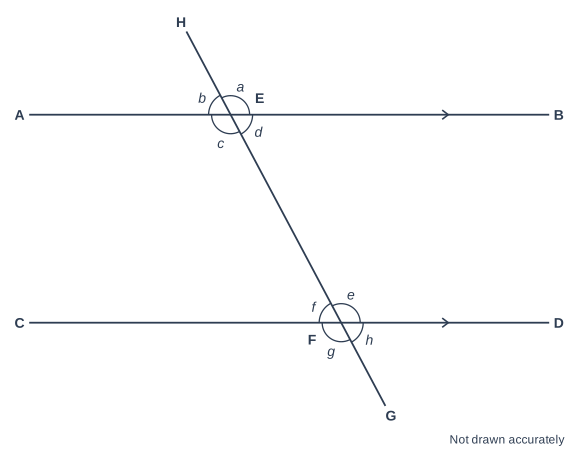
In the diagram, a transversal crosses two parallel lines.
The angles at the two crossing points are labelled \(a\) to \(h\).

Write down the angle that corresponds to angle \(b\).
Write down the angle that is co-interior with angle \(d\).

Geometry diagram, marked "Not drawn accurately". Line segments AB, CD and GH are drawn. E lies on AB and GH. F lies on CD and GH. Angle BEH is marked a. Angle HEA is marked b. Angle AEF is marked c. Angle FEB is marked d. Angle DFE is marked e. Angle EFC is marked f. Angle CFG is marked g. Angle GFD is marked h. AB and CD are each marked with an arrowhead (parallel lines).

Model answer

Corresponds to \(b\): angle \(f\)
Co-interior with \(d\): angle \(e\)

Explanation

Corresponding angles are in the same position at each crossing: \(b\) is above the top line and to the left of the transversal, and so is \(f\) at the lower crossing. Co-interior angles are between the parallel lines on the same side of the transversal: \(d\) is between the lines on the right, and so is \(e\). A common mistake is to choose \(d\) for the first answer: \(d\) is vertically opposite \(b\), not corresponding to it. Remember that corresponding angles are equal, but co-interior angles add up to \(180^\circ\).

Mark scheme
  1. 1 mark

    Corresponds to \(b\): \(f\)

    Accept f or angle CFE (EFC). \(d\) (vertically opposite \(b\)) scores 0.

  2. 1 mark

    Co-interior with \(d\): \(e\)

    Accept e or angle EFD (DFE). \(f\) (the alternate angle) scores 0. The answers must be clearly matched to the two questions: f for the first and e for the second. A correct answer with no working scores full marks.

Question 3

3 marks

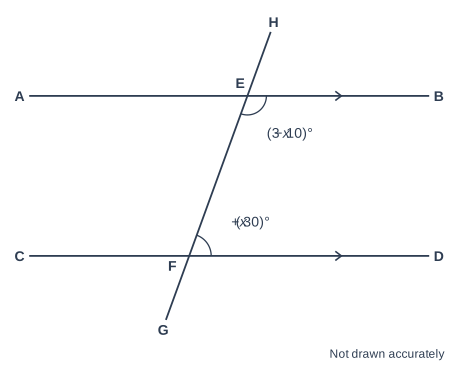
In the diagram, AB and CD are parallel lines.

Work out the value of \(x\).

Geometry diagram, marked "Not drawn accurately". Line segments AB, CD and GH are drawn. E lies on AB and GH. F lies on CD and GH. Angle BEF is marked (3x − 10)°. Angle EFD is marked (x + 30)°. AB and CD are each marked with an arrowhead (parallel lines).

Model answer

Co-interior angles add up to \(180^\circ\).
\(3x - 10 + x + 30 = 180\)
\(4x + 20 = 180\)
\(4x = 160\)
\(x = 40\)

Explanation

The two marked angles are co-interior, so they add up to \(180^\circ\). Write that as an equation, collect the \(x\) terms and the numbers, then solve. Check: \(3 \times 40 - 10 = 110\) and \(40 + 30 = 70\), and \(110 + 70 = 180\). A common mistake is to make the two expressions equal, which is only right for alternate or corresponding angles.

Mark scheme
  1. 1 mark

    \((3x - 10) + (x + 30) = 180\) or \(4x + 20 = 180\); or the correct answer \(x = 40\) with no working

    Uses co-interior angles adding up to \(180^\circ\). Setting the two expressions equal (\(3x - 10 = x + 30\), giving \(x = 20\)) scores 0.

  2. 1 mark

    \(4x = 160\)

    Or \(160 \div 4\) seen.

  3. 1 mark

    \(x = 40\)

    Accept 40. A correct answer with no working scores full marks.

Question 4

4 marks

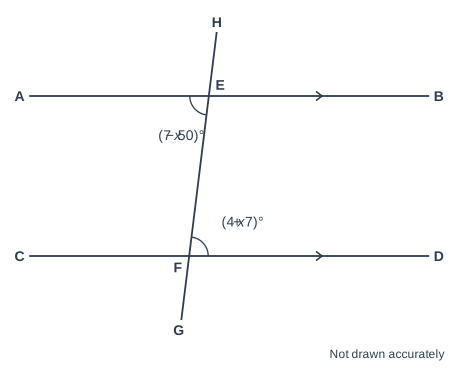
In the diagram, AB is parallel to CD.

Work out the size of angle AEF.

Geometry diagram, marked "Not drawn accurately". Line segments AB, CD and GH are drawn. E lies on AB and GH. F lies on CD and GH. Angle AEF is marked (7x − 50)°. Angle EFD is marked (4x + 7)°. AB and CD are each marked with an arrowhead (parallel lines).

Model answer

Alternate angles are equal.
\(7x - 50 = 4x + 7\)
\(3x = 57\)
\(x = 19\)
Angle AEF \(= 7 \times 19 - 50 = 83^\circ\)
Check: \(4 \times 19 + 7 = 83\)

Explanation

The two angles are between the parallel lines on opposite sides of the transversal, so they are alternate angles and are equal. Set the expressions equal and solve: take \(4x\) from both sides, then add 50. Finally put \(x = 19\) back in to find the angle. A common mistake is to stop at \(x = 19\): the question asks for the angle.

Mark scheme
  1. 1 mark

    \(7x - 50 = 4x + 7\); or the correct answer \(83^\circ\) with no working

    Uses alternate angles being equal. \(7x - 50 + 4x + 7 = 180\) scores 0.

  2. 1 mark

    \(3x = 57\)

    Or \(7x - 4x = 7 + 50\) seen.

  3. 1 mark

    \(x = 19\)

  4. 1 mark

    Angle AEF \(= 83^\circ\)

    Accept 83. Follow through \(7 \times\) their \(x - 50\). An answer of 19 scores 0 for this mark. A correct answer with no working scores full marks.

Ready to try the rest? Every answer you write is marked against the mark scheme, so you can see exactly where the marks are.

Topic notes

Angles in parallel lines

The big idea

Parallel lines go in exactly the same direction and never meet, like the two rails of a train track. When another straight line crosses them, the angles it makes at one line are copied exactly at the other. So one known angle can give you many more, if you name the right fact as your reason.

From Year 7: angles on a straight line add up to 180°, angles around a point add up to 360°, and vertically opposite angles (opposite each other where two lines cross) are equal.

Three pairs of angles

A line that crosses two parallel lines is called a transversal. Matching arrows show which lines are parallel.

Geometry diagram, marked "Diagram NOT accurately drawn". Line segments AB, CD and GH are drawn. E lies on AB and GH. F lies on CD and GH. Angle AEF is marked 66°. Angle CFG is marked p. Angle EFD is marked q. Angle CFE is marked r. AB and CD are each marked with an arrowhead (parallel lines).
AB is parallel to CD, and GH is a transversal. Angle p corresponds to the 66° angle, q is alternate to it, and r is co-interior with it.
PairWhere to find themRule
Corresponding anglesin the same position at each crossingequal
Alternate anglesbetween the parallel lines, on opposite sides of the transversalequal
Co-interior angles (also called allied angles)between the parallel lines, on the same side of the transversaladd up to 180°

Tracing round the pairs makes an F shape (corresponding), a Z shape (alternate) or a C shape (co-interior). That helps you spot them, but the letters are not reasons. Write the proper name: "alternate angles are equal", never "Z angles".

Find angles p, q and r in the diagram above

\(p = 66^\circ\) (corresponding angles are equal)

\(q = 66^\circ\) (alternate angles are equal)

\(r = 180 - 66 = 114^\circ\) (co-interior angles add up to 180°)

Check: q and r sit together on the straight line CD, and \(66 + 114 = 180\).

Problems with more than one step

If the angle you want is not paired with one you know, find a stepping-stone angle first. Write a reason for every step, and mark each angle on the diagram as you find it.

Geometry diagram, marked "Diagram NOT accurately drawn". A straight line is drawn through G and H, extending beyond G and H. Line segments PE, EG, PF, FH and EF are drawn. Angle PGH is marked 74°. Angle EFH is marked 110°. Angle EPF is marked x. EF and GH are each marked with an arrowhead (parallel lines).
A stepladder with legs PG and PH stands on the floor GH. Its safety bar EF is parallel to the floor.

Find the angle x at the top of the stepladder

Angle PEF \(= 74^\circ\) (corresponding angles are equal, because EF is parallel to GH)

Angle PFE \(= 180 - 110 = 70^\circ\) (angles on a straight line add up to 180°)

\(x = 180 - 74 - 70 = 36^\circ\) (angles in a triangle add up to 180°)

Parallelograms and trapezia

A trapezium has one pair of parallel sides, and a parallelogram has two. The other sides are transversals, so two angles next to each other between parallel sides are co-interior and add up to 180°. In a parallelogram this works all the way round, which is why its opposite angles are equal.

Find the other two angles of a trapezium-shaped field

Field PQRS is a trapezium with PQ parallel to SR. Angle P \(= 78^\circ\) and angle Q \(= 127^\circ\).

Angle S \(= 180 - 78 = 102^\circ\) (co-interior angles add up to 180°, as PS crosses the parallel sides)

Angle R \(= 180 - 127 = 53^\circ\) (co-interior angles add up to 180°, as QR crosses them too)

Check: \(78 + 127 + 102 + 53 = 360\), the angle sum of a quadrilateral.

Stretch: showing that lines are parallel

The facts also work backwards. Two lines are parallel if corresponding angles are equal, or alternate angles are equal, or co-interior angles add up to 180°. Never decide from how a diagram looks: it is not drawn accurately.

Are the rungs of a ladder parallel?

Two rungs of a wooden ladder meet the same side rail. Between the rungs, on the same side of the rail, the angles are 84° and 96°.

The side rail is a transversal, and the two angles sit between the rungs on one side of it, so they are a co-interior pair. Their total is \(84 + 96 = 180\), which only happens between parallel lines. So the rungs are parallel.

With 84° and 95°, the total would be 179°: those rungs would not be parallel.

Remember

  • Corresponding angles are equal.
  • Alternate angles are equal.
  • Co-interior (allied) angles add up to 180°.
  • Vertically opposite angles are equal, and angles on a straight line add up to 180°.
  • Every reason names the fact in words.

Common mistakes

  • Thinking co-interior angles are equal. They add up to 180°: one is acute and the other obtuse, unless both are 90°.
  • Taking an alternate or corresponding angle away from 180°. These pairs are equal, even when they are obtuse.
  • Writing "Z angles", "F angles" or "C angles" as a reason. Write the fact: "alternate angles are equal".
  • Calling two angles alternate when they are outside the parallel lines. Alternate and co-interior angles are always between them.
  • Stopping at the stepping-stone angle instead of going on to the angle you were asked for.

Top tip

Find the transversal that joins your two angles. If both angles are between the parallel lines, they are alternate (opposite sides) or co-interior (same side). If not, look for corresponding angles.

Study Helper Hints first, answers after you try

Stuck on this one? Ask for a hint and I’ll point you in the right direction, without giving the answer away. Once you’ve checked your answer, I’ll show you how the marks are awarded.