Level:
Correct: 0
Incorrect: 0
Marks: 0/0
Practice
Course:
Topics:
Year 8 Maths Smart practice A mixed round aimed at your weak spots
Unit 1
Number: accuracy, powers and standard form
Unit 2
Fractions, decimals and percentages
Unit 3
Algebraic expressions
Unit 4
Equations, inequalities and formulae
Unit 5
Sequences and graphs
Unit 6
Ratio, proportion and rates of change
Unit 7
Circles, area and volume
Unit 8
Angles and constructions
Unit 9
Transformations and symmetry
Unit 10
Probability
Unit 11
Statistics
Avg
score:
–
Topics
done:
0/50

Composite shapes with circles

Practise 21 questions on Composite shapes with circles for Year 8 Maths. Write your answer and get it marked in seconds against the mark scheme, point by point, with the Study Helper on hand if you get stuck.

  • 21 questions
  • 1–5 marks each
  • Instant marking
  • No sign-up needed
20 questions, marked as you go

Sample questions with model answers

Here are 4 of the questions in this topic, each with a model answer, an explanation of why it earns the marks and the mark scheme.

Question 1

1 mark

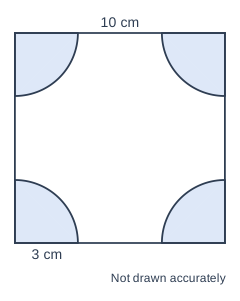
The diagram shows a square tile with sides of 10 cm. In each corner there is a shaded quarter circle with a radius of 3 cm.

Work out the total shaded area.

Give your answer in terms of \(\pi\).

Geometry diagram, marked "Not drawn accurately". A square (its vertices are not labelled). A quarter circle (its vertices are not labelled) (shaded); side an unlabelled line going up and to the left is not drawn (the outline is open there). A minor arc from an unlabelled point to an unlabelled point (the region between the arc and the straight line joining its ends is shaded). A quarter circle (its vertices are not labelled) (shaded); side an unlabelled line going down and to the left is not drawn (the outline is open there). A minor arc from an unlabelled point to an unlabelled point (the region between the arc and the straight line joining its ends is shaded). A quarter circle (its vertices are not labelled) (shaded); side an unlabelled line going down and to the right is not drawn (the outline is open there). A minor arc from an unlabelled point to an unlabelled point (the region between the arc and the straight line joining its ends is shaded). A quarter circle (its vertices are not labelled) (shaded); side an unlabelled line going up and to the right is not drawn (the outline is open there). A minor arc from an unlabelled point to an unlabelled point (the region between the arc and the straight line joining its ends is shaded). The unlabelled side going to the right is labelled 10 cm. The unlabelled side going to the right is labelled 3 cm.

Model answer

Four quarter circles make one whole circle with radius 3 cm.
Area \(= \pi \times 3^2 = 9\pi\) cm²

Explanation

Four quarter circles with the same radius fit together to make one whole circle. So the total shaded area is the area of a circle with radius 3 cm: \(\pi \times 3^2 = 9\pi\) cm². The 10 cm side of the tile is not needed. A common mistake is to work out four whole circles.

Mark scheme
  1. 1 mark

    \(9\pi\) cm²

    Accept 9pi, 9π, 9 × π or \(9\pi\) typed any clear way. The unit is not needed. A decimal answer (28.3, or 28.26 from 3.14) does not score. Do not accept \(36\pi\) (four whole circles) or \(2.25\pi\) (only one quarter circle). A correct answer with no working scores full marks.

Question 2

2 marks

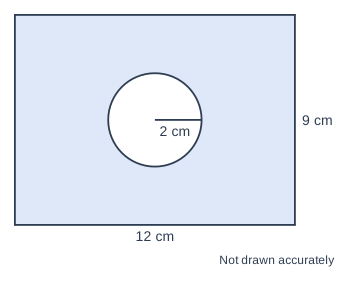
Priya cuts a circular hole with a radius of 2 cm out of a rectangle of card. The rectangle is 12 cm long and 9 cm wide, as shown in the diagram.

Work out the area of card that is left.

Give your answer in terms of \(\pi\).

Geometry diagram, marked "Not drawn accurately". A circle (filled white, so the inside of the circle is not shaded). A rectangle (its vertices are not labelled) (shaded). A horizontal line with no labelled ends is drawn. The unlabelled side going to the right is labelled 12 cm. The unlabelled side going upwards is labelled 9 cm. The line between the centre of the circle and an unlabelled point is labelled 2 cm.

Model answer

Rectangle: \(12 \times 9 = 108\) cm²
Hole: \(\pi \times 2^2 = 4\pi\) cm²
Card left \(= 108 - 4\pi\) cm²

Explanation

Work out the whole rectangle and take away the hole. The rectangle is \(12 \times 9 = 108\) cm² and the hole is \(\pi \times 2^2 = 4\pi\) cm², so \(108 - 4\pi\) cm² is left. You cannot simplify this to \(104\pi\), because 108 is not a number of \(\pi\)s.

Mark scheme
  1. 1 mark

    Both areas: 108 and \(4\pi\); or the correct answer \((108 - 4\pi)\) cm² with no working

  2. 1 mark

    \((108 - 4\pi)\) cm²

    Accept 108 − 4pi or 108 − 4π typed any clear way, with or without brackets. The unit is not needed. A decimal answer (95.4, or 95.44 from 3.14) scores the first mark only. Do not accept \(104\pi\) or \(108 - 16\pi\) (the diameter used as the radius). A correct answer with no working scores full marks.

Question 3

3 marks

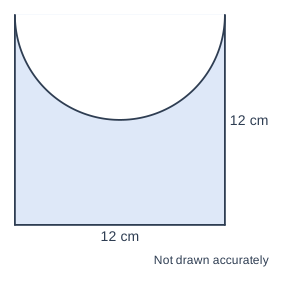
Ola has a square piece of card with sides of 12 cm. She cuts a semicircle out of one side, as shown in the diagram. The diameter of the semicircle is the whole of that side.

Use \(\pi = 3.14\) to work out the perimeter of the card that is left.

Geometry diagram, marked "Not drawn accurately". A square of card (its vertices are not labelled) (shaded); side an unlabelled line going to the left is not drawn (the outline is open there). A semicircle on the straight line joining its ends as diameter, drawn below it (the region between the arc and the straight line joining its ends is filled white). The unlabelled side going to the right is labelled 12 cm. The unlabelled side going upwards is labelled 12 cm.

Model answer

Curved edge: \(3.14 \times 12 \div 2 = 18.84\) cm
Straight sides: \(3 \times 12 = 36\) cm
Perimeter: \(36 + 18.84 = 54.84\) cm

Explanation

The cut takes away one 12 cm side but adds a curved edge, half of a circumference with diameter 12 cm: 18.84 cm. So the perimeter is three straight sides, 36 cm, plus 18.84 cm, which is 54.84 cm. The area got smaller, but the perimeter got bigger than the square's 48 cm. A common mistake is to count the side that has been cut away.

Mark scheme
  1. 1 mark

    Curved edge: \(3.14 \times 12 \div 2 = 18.84\) cm; or the correct answer 54.84 cm with no working

  2. 1 mark

    Three straight sides, \(12 + 12 + 12 = 36\), added to their curved edge

  3. 1 mark

    54.84 cm

    Accept 54.84 with no unit, or 54.8. An answer that uses the calculator's \(\pi\) (54.849...) instead of 3.14 also scores: accept [54.8, 54.85]. Do not accept 66.84 (the side that was cut away counted as well), 73.68 (the whole circumference used) or 48 (the perimeter of the square). A correct answer with no working scores full marks.

Question 4

4 marks

You may use a calculator.

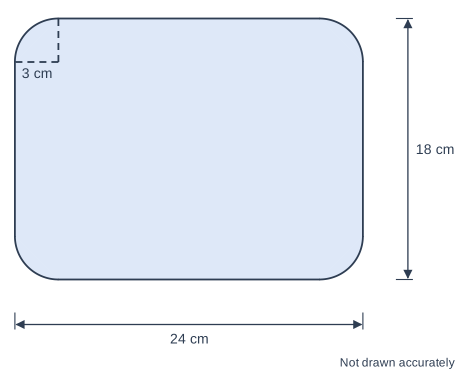
A mouse mat is a rectangle 24 cm long and 18 cm wide with rounded corners. Each corner is a quarter circle with a radius of 3 cm, as shown in the diagram.

Rafael sews binding round the whole edge of the mat.

Work out the length of binding he needs. Give your answer correct to 1 decimal place.

Geometry diagram, marked "Not drawn accurately". A mouse mat (its vertices are not labelled) (shaded); sides an unlabelled line going up and to the right, an unlabelled line going up and to the left, an unlabelled line going down and to the left and an unlabelled line going down and to the right are not drawn (the outline is open there). A minor arc from an unlabelled point to an unlabelled point (the region between the arc and the straight line joining its ends is shaded). A minor arc from an unlabelled point to an unlabelled point (the region between the arc and the straight line joining its ends is shaded). A minor arc from an unlabelled point to an unlabelled point (the region between the arc and the straight line joining its ends is shaded). A minor arc from an unlabelled point to an unlabelled point (the region between the arc and the straight line joining its ends is shaded). A dashed vertical line with no labelled ends is drawn. A dashed horizontal line with no labelled ends is drawn. A double-headed dimension arrow alongside an unlabelled line going to the right (the distance from an unlabelled point to an unlabelled point) is labelled 24 cm. A double-headed dimension arrow alongside an unlabelled line going upwards (the distance from an unlabelled point to an unlabelled point) is labelled 18 cm. An unlabelled line going to the left is labelled 3 cm.

Model answer

Straight edges: \(24 - 3 - 3 = 18\) cm and \(18 - 3 - 3 = 12\) cm
All straight edges: \(18 + 12 + 18 + 12 = 60\) cm
Four quarter circles make one circle: \(C = 2 \times \pi \times 3 = 18.849...\) cm
Binding: \(60 + 18.849... = 78.849...\)
Length = 78.8 cm (1 d.p.)

Explanation

Each rounded corner takes 3 cm off both ends of every straight edge, so the long edges are 18 cm and the short edges are 12 cm: 60 cm in all. The four curved corners are quarter circles with the same radius, so together they make one circle with radius 3 cm, \(6\pi = 18.85\) cm. The total is 78.8 cm. A common mistake is to use the full 24 cm and 18 cm sides as well as the curves.

Mark scheme
  1. 1 mark

    Straight edges shortened: \(24 - 6 = 18\) or \(18 - 6 = 12\); or the correct answer 78.8 cm with no working

  2. 1 mark

    Total of the straight edges: \(18 + 12 + 18 + 12 = 60\) cm

    ft their shortened edges.

  3. 1 mark

    The four quarter circles make one circle: \(2 \times \pi \times 3 = 18.84...\) cm

  4. 1 mark

    78.8 cm

    Accept 78.8 with no unit; accept [78.75, 78.85]. A more accurate value in this range (78.849...) also scores, and so does 78.84 from \(\pi = 3.14\). Do not accept 84 (the perimeter of the rectangle) or 102.8 (the straight edges not shortened). A correct answer with no working scores full marks.

Ready to try the rest? Every answer you write is marked against the mark scheme, so you can see exactly where the marks are.

Topic notes

Composite shapes with circles

The big idea

A composite shape is made by joining simpler shapes together. In this topic the parts include whole circles, semicircles and quarter circles as well as rectangles and triangles. Running tracks, arched windows, rings and garden plans are all composite shapes.

In Year 7 you found the area of a compound shape in two ways: split it into parts and add their areas, or work out a bigger shape and subtract the part that is missing. The perimeter is only the distance round the outside edge.

Plan before you calculate

  1. Name the parts: rectangles, triangles and parts of circles.
  2. Work out any missing lengths first. A radius is often the side of a rectangle, or half of one.
  3. For the area, split and add, or subtract.
  4. For the perimeter, go round the outside. A dashed line where two parts join is inside the shape, so it does not count.

Split and add

A patio made from a rectangle 10 m long and 4 m high, with a quarter circle joined to its right-hand end. A dashed line, the right-hand side of the rectangle, separates the two parts and is one radius of the quarter circle; the other radius runs along the bottom.
A patio: a rectangle 10 m by 4 m with a quarter circle on one end. The dashed line is where the two parts join.

The diagram shows a patio. Work out its area and its perimeter, in terms of π.

Missing lengths. The dashed line is a radius of the quarter circle, and it is as long as the rectangle is high: 4 m. So the bottom edge is \(10 + 4 = 14\) m.

Area. Rectangle: \(10 \times 4 = 40\) m²

Quarter circle: \(\pi \times 4^2 \div 4 = 16\pi \div 4 = 4\pi\) m², so the area is \(40 + 4\pi\) m².

Perimeter. Curved edge: \(2 \times \pi \times 4 \div 4 = 2\pi\) m

Straight edges: \(14 + 4 + 10 = 28\) m, so the perimeter is \(28 + 2\pi\) m.

You cannot write \(40 + 4\pi\) as \(44\pi\): 40 is not a number of πs, just as \(40 + 4x\) is not \(44x\).

Subtract: rings and holes

A ring (or annulus) is the shape between two circles with the same centre. Its area is the big circle take away the small circle. Shapes with holes or pieces cut out work the same way.

A CD is a circle with a diameter of 12 cm, with a hole in the middle 1.5 cm across. Work out the area of one side of the CD, correct to 1 decimal place. (uses a calculator)

Halve the diameters: the radii are 6 cm and 0.75 cm.

Whole circle: \(\pi \times 6^2 = 113.097...\) cm²

Hole: \(\pi \times 0.75^2 = 1.767...\) cm²

CD: \(113.097... - 1.767... = 111.33...\), so 111.3 cm² (1 d.p.)

Subtract the two areas, not the two radii: \(\pi \times (6 - 0.75)^2\) gives the wrong answer.

Problems with costs

Find the area (or the perimeter) first, then multiply by the price.

A running track, shaded, around a white field. The track has two straight parts, each 90 m long, and two curved ends. Dashed lines show where the straight parts end. A line from the centre of the right-hand curved end to the inside edge of the track is 30 m long. A line across the top straight shows that the track is 10 m wide.
A running track 10 m wide. Each curved end is half of a ring: the inside edge has a radius of 30 m.

The track in the diagram gets a new surface at £12 per m². Using π = 3.14, how much does the new surface cost?

Straights. Each one is a rectangle \(90 \times 10 = 900\) m², so the two straights are 1800 m².

Curved ends. Together they make a whole ring. Its outer radius is \(30 + 10 = 40\) m.

Ring: \(3.14 \times 40^2 - 3.14 \times 30^2 = 5024 - 2826 = 2198\) m²

Track. \(1800 + 2198 = 3998\) m², so the cost is \(3998 \times 12 = 47{,}976\): £47,976.

Remember

  • Area: split into parts and add, or take the missing part away from a bigger shape.
  • Perimeter: only the outside edges, never a dashed join.
  • Two semicircles with the same diameter make one circle. Four quarter circles with the same radius make one circle.
  • A number and a π term cannot be added together: \(40 + 4\pi\) stays as it is.

Common mistakes

  • Using a diameter as the radius. A circle that just fits inside an 8 cm square has a radius of 4 cm.
  • Counting a dashed line inside the shape as part of the perimeter.
  • Using the whole height for the rectangle when a semicircle sits on top. Take the radius off first.
  • Subtracting the radii of a ring first, then squaring. Work out both circles, then subtract.
  • Adding a number to a π term, such as writing \(50 + 8\pi\) as \(58\pi\).

Top tip

Write the area of each part on the diagram before you add or subtract. Then check the size of your answer using π ≈ 3: the patio is about \(40 + 4 \times 3 = 52\) m².

Study Helper Hints first, answers after you try

Stuck on this one? Ask for a hint and I’ll point you in the right direction, without giving the answer away. Once you’ve checked your answer, I’ll show you how the marks are awarded.