Level:
Correct: 0
Incorrect: 0
Marks: 0/0
Practice
Course:
Topics:
Year 8 Maths Smart practice A mixed round aimed at your weak spots
Unit 1
Number: accuracy, powers and standard form
Unit 2
Fractions, decimals and percentages
Unit 3
Algebraic expressions
Unit 4
Equations, inequalities and formulae
Unit 5
Sequences and graphs
Unit 6
Ratio, proportion and rates of change
Unit 7
Circles, area and volume
Unit 8
Angles and constructions
Unit 9
Transformations and symmetry
Unit 10
Probability
Unit 11
Statistics
Avg
score:
–
Topics
done:
0/50

Solving equations with brackets

Practise 26 questions on Solving equations with brackets for Year 8 Maths. Write your answer and get it marked in seconds against the mark scheme, point by point, with the Study Helper on hand if you get stuck.

  • 26 questions
  • 1–5 marks each
  • Instant marking
  • No sign-up needed
20 questions, marked as you go

Sample questions with model answers

Here are 4 of the questions in this topic, each with a model answer, an explanation of why it earns the marks and the mark scheme.

Question 1

1 mark

Solve \(2(x + 7) = 10\)

Model answer

\(2(x + 7) = 10\)
Divide both sides by 2: \(x + 7 = 5\)
Subtract 7 from both sides: \(x = 5 - 7 = -2\)

Explanation

Divide both sides by 2 to get \(x + 7 = 5\). Then subtract 7 from both sides: \(5 - 7 = -2\), so \(x = -2\). Check: \(2 \times (-2 + 7) = 2 \times 5 = 10\). A solution can be a negative number, so do not be put off when you get one, but do check it.

Mark scheme
  1. 1 mark

    \(x = -2\)

    Accept \(-2\). Do not accept 2 (a sign error), 12 (from \(x + 7 = 5\), adding 7) or 1.5 (from \(2x + 7 = 10\)). A correct answer with no working scores full marks.

Question 2

2 marks

Solve \(4(x - 1) = -10\)

Model answer

\(4(x - 1) = -10\)
Expand: \(4x - 4 = -10\)
Add 4: \(4x = -10 + 4 = -6\)
Divide by 4: \(x = -6 \div 4 = -1.5\)

Explanation

Expand the bracket to get \(4x - 4 = -10\). Add 4 to both sides: \(-10 + 4 = -6\), so \(4x = -6\). Divide by 4: \(x = -1.5\). Check: \(4 \times (-1.5 - 1) = 4 \times (-2.5) = -10\). Take care with the signs: adding 4 to \(-10\) gives \(-6\), not \(-14\).

Mark scheme
  1. 1 mark

    \(4x - 4 = -10\) or \(4x = -6\) or \(x - 1 = -2.5\); or the correct answer \(x = -1.5\) with no working

  2. 1 mark

    \(x = -1.5\)

    Accept \(-\dfrac{3}{2}\), \(-1\dfrac{1}{2}\) or \(-\dfrac{6}{4}\). Do not accept 1.5 (a sign error), \(-3.5\) (from \(x - 1 = -2.5\), subtracting 1) or \(-2.25\) (from \(4x - 1 = -10\)). A correct answer with no working scores full marks.

Question 3

3 marks

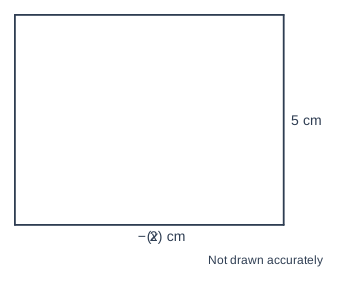
The diagram shows a rectangle.

The area of the rectangle is 32 cm².

Work out the value of \(x\).

Geometry diagram, marked "Not drawn accurately". A rectangle (its vertices are not labelled). The unlabelled side going to the right is labelled (x − 2) cm. The unlabelled side going upwards is labelled 5 cm.

Model answer

Area = length × width
\(5(x - 2) = 32\)
Divide by 5: \(x - 2 = 6.4\)
Add 2: \(x = 8.4\)

Explanation

The area of a rectangle is length × width, so \(5(x - 2) = 32\). Divide both sides by 5 to get \(x - 2 = 6.4\), then add 2 to get \(x = 8.4\). Check: the length is 6.4 cm and \(5 \times 6.4 = 32\). A common mistake is to write \(5x - 2 = 32\) without the bracket, which multiplies only the \(x\) by 5.

Mark scheme
  1. 1 mark

    \(5(x - 2) = 32\) or \(5x - 10 = 32\); or the correct answer \(x = 8.4\) with no working

    Accept \((x - 2) \times 5 = 32\).

  2. 1 mark

    \(x - 2 = 6.4\) or \(5x = 42\)

  3. 1 mark

    \(x = 8.4\)

    Accept \(8\dfrac{2}{5}\) or \(\dfrac{42}{5}\), with or without cm. Do not accept 6.4 (the length of the rectangle) or 6.8 (from \(5x - 2 = 32\)). A correct answer with no working scores full marks.

Question 4

4 marks

Solve \(2(3(x + 1) - 4) = 22\)

Model answer

Divide both sides by 2: \(3(x + 1) - 4 = 11\)
Add 4: \(3(x + 1) = 15\)
Divide by 3: \(x + 1 = 5\)
Subtract 1: \(x = 4\)

Explanation

Work from the outside in, undoing one step at a time: divide both sides by 2, then add 4, then divide by 3, then subtract 1. Or simplify the inside first: \(3(x + 1) - 4 = 3x - 1\), so the equation is \(2(3x - 1) = 22\), which gives \(6x = 24\). Check: \(3 \times 5 - 4 = 11\) and \(2 \times 11 = 22\). A common mistake is to stop at \(x + 1 = 5\) and give 5 as the answer.

Mark scheme
  1. 1 mark

    \(3(x + 1) - 4 = 11\) or \(2(3x - 1) = 22\) or \(6x + 6 - 8 = 22\); or the correct answer \(x = 4\) with no working

    Either divide both sides by 2 or expand from the inside out.

  2. 1 mark

    \(3(x + 1) = 15\) or \(6x - 2 = 22\) or \(3x - 1 = 11\)

  3. 1 mark

    \(x + 1 = 5\) or \(6x = 24\) or \(3x = 12\)

  4. 1 mark

    \(x = 4\)

    Accept 4. Do not accept 5 (the value of \(x + 1\)). A correct answer with no working scores full marks.

Ready to try the rest? Every answer you write is marked against the mark scheme, so you can see exactly where the marks are.

Topic notes

Solving equations with brackets

The big idea

Many equations have a bracket in them, such as \(4(x - 3) = 20\). The number outside the bracket multiplies everything inside it. There are two ways to deal with the bracket, and choosing the better one keeps the numbers simple. Brackets appear whenever a whole group is multiplied, so you will use this often.

In Year 7 you solved two-step equations by doing the same to both sides and undoing each step with its inverse operation (its opposite), in reverse order: \(2x + 9 = 23\) gives \(2x = 14\), so \(x = 7\).

Divide first or expand first

Expanding a bracket means multiplying every term inside it by the number outside: \(4(x - 3) = 4x - 12\).

To solve \(4(x - 3) = 20\) you can:

  • divide first: divide both sides by 4 to get \(x - 3 = 5\), so \(x = 8\);
  • expand first: \(4x - 12 = 20\), so \(4x = 32\) and \(x = 8\).

Both ways give the same answer. Dividing first is quicker when the number outside the bracket divides exactly into the other side. When it does not, expand first, so the numbers stay whole for longer.

Solve \(7(x + 3) = 56\) and \(7(x + 3) = 30\)

\(7(x + 3) = 56\): \(56 \div 7 = 8\) exactly, so divide first.

Divide both sides by 7: \(x + 3 = 8\)

Subtract 3 from both sides: \(x = 5\)

\(7(x + 3) = 30\): \(30 \div 7\) is not a whole number, so expand first.

Expand the bracket: \(7x + 21 = 30\)

Subtract 21 from both sides: \(7x = 9\)

Divide both sides by 7: \(x = \dfrac{9}{7} = 1\dfrac{2}{7}\)

Check: \(7 \times (5 + 3) = 7 \times 8 = 56\) ✓ and \(7 \times (1\tfrac{2}{7} + 3) = 7 \times 4\tfrac{2}{7} = 28 + 2 = 30\) ✓

A solution can be a fraction. \(\dfrac{9}{7}\) is exact, but its decimal, 1.2857..., would have to be rounded, so leave it as a fraction.

Negative and decimal solutions

Solutions can also be negative numbers or decimals. Take extra care with the signs, and do one step at a time.

Solve \(4(3x + 5) = 2\)

2 is not a multiple of 4, so expand first.

Expand the bracket: \(12x + 20 = 2\)

Subtract 20 from both sides: \(12x = 2 - 20 = -18\)

Divide both sides by 12: \(x = -18 \div 12 = -1.5\)

Check: \(3 \times (-1.5) + 5 = -4.5 + 5 = 0.5\), and \(4 \times 0.5 = 2\) ✓

Two brackets on one side

Expand each bracket, then collect like terms: add the \(x\) terms together and the numbers together. Now you have a two-step equation.

Watch the sign in front of a bracket. \(-4(x - 1)\) means multiply each term by \(-4\): \(-4 \times x = -4x\) and \(-4 \times (-1) = +4\).

Solve \(6(x + 2) - 4(x - 1) = 21\)

Expand both brackets: \(6x + 12 - 4x + 4 = 21\)

Collect like terms: \(6x - 4x = 2x\) and \(12 + 4 = 16\), so \(2x + 16 = 21\)

Subtract 16 from both sides: \(2x = 5\)

Divide both sides by 2: \(x = 2.5\)

Check: \(6 \times (2.5 + 2) - 4 \times (2.5 - 1) = 6 \times 4.5 - 4 \times 1.5 = 27 - 6 = 21\) ✓

To check a solution, substitute it: put it in place of \(x\) in the equation you started with, and work out each bracket first. If you get the other side, the solution is right.

Remember

  • The number outside a bracket multiplies every term inside it.
  • Divide first when the number outside divides exactly into the other side. Otherwise, expand first.
  • With two brackets, expand both, collect like terms, then solve.
  • A solution can be negative, a decimal or a fraction.
  • Check by substituting into the equation you started with.

Common mistakes

  • Multiplying only the first term: \(7(x + 3)\) is \(7x + 21\), not \(7x + 3\).
  • Losing a sign after a minus: \(-4(x - 1)\) is \(-4x + 4\), not \(-4x - 4\).
  • Stopping too soon: \(x + 3 = 8\) gives the value of \(x + 3\). Subtract 3 to find \(x\).
  • Dividing the wrong way round: \(12x = -18\) gives \(x = -18 \div 12 = -1.5\), not \(12 \div (-18)\).
  • Rounding when a question asks for a fraction: write \(\dfrac{9}{7}\), not 1.29.

Top tip

Before you start, look at the number outside the bracket and the number on the other side. If the first goes exactly into the second, divide first. If not, expand first.

Study Helper Hints first, answers after you try

Stuck on this one? Ask for a hint and I’ll point you in the right direction, without giving the answer away. Once you’ve checked your answer, I’ll show you how the marks are awarded.